
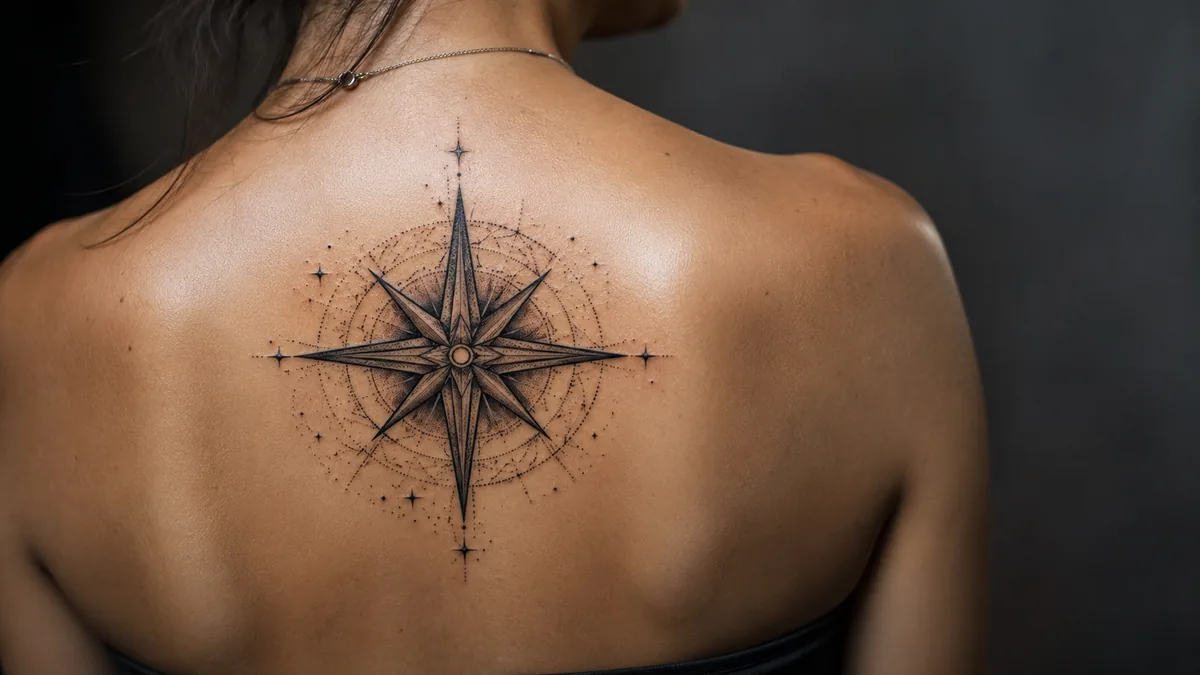
The north star tattoo is one of those designs that hits different for almost everyone who wears it. Polaris, the actual North Star, sits nearly motionless in the sky while everything else rotates around it. That’s the whole point. It’s the one fixed thing in a spinning world, and people tattoo it for exactly that reason.
You’ll see it on navigators, on people fresh out of a hard chapter, on folks who just needed a reminder of where they’re going. The meaning is personal, but it’s never random. This is a tattoo with real weight behind it.
Core Meaning: Guidance and Direction
The number one meaning behind a north star tattoo is guidance. Polaris has been used for navigation for centuries because it holds position directly above the North Pole, almost perfectly still. Sailors, travelers, and explorers relied on it to find their way home. Getting it tattooed says, I know which direction I’m heading, or I found my way back when I was lost.
A lot of clients come in saying they want something that represents staying on course. This design delivers that without being heavy-handed about it. It’s a clean concept. One fixed point. You build the meaning around that, and it reads immediately to anyone who understands the symbolism.
Deeper Symbolism: Hope, Resilience, and Inner Compass
Every sailor who made it home trusted one fixed point in the sky.
Beyond navigation, the north star carries a strong association with hope. When things are dark, you look up and find that one constant light. That’s a powerful image for anyone who’s survived a rough stretch, dealt with mental health struggles, or lost their sense of purpose and found it again. The star doesn’t move. You come back to it.
There’s also a resilience angle that resonates with a lot of people. The north star doesn’t burn bright because it’s the biggest or flashiest, it’s reliable. Steady. People who identify with being the dependable one in their circle, the anchor for others, connect with that energy. It’s a quiet flex, not a loud one.
Historical and Cultural Background
Polaris has been a navigational anchor across cultures for thousands of years. Ancient Greeks called it Cynosura, meaning dog’s tail, and built entire stories around it. Norse navigators used it across open water long before GPS or compasses were reliable. In the US, the North Star held a specific and profound meaning for enslaved people following the Underground Railroad north to freedom. Follow the Drinking Gourd was code for following the Big Dipper to Polaris and moving toward free states.
That Underground Railroad connection adds serious historical weight to the design for many people, particularly in the American South. If a client tells you that’s their reason, respect it and build something worthy of it. The symbolism isn’t just poetic. For a lot of families, that star was literally life or death.
Popular Design Variations and Styles
The classic nautical star, a compass rose, and a simple geometric eight-pointed star are the most common north star designs. Fine line work is huge right now, especially a minimal four or eight-pointed star with clean crispy lines and maybe a small burst of rays. Geometric and dotwork versions hold well and read sharp from a distance. Some people add a compass or coordinates, but keep it intentional or it starts looking like a souvenir.
Illustrative and neo-traditional styles let you build more detail. Think celestial rays, shading, a moon, or constellation context like Ursa Minor around Polaris. Black and grey with whip shade gives it a soft glow that heals beautifully. Watercolor behind a solid star works, but pure watercolor with no black anchor tends to fade out and loses definition within a few years.
Color vs. Black and Grey
Black and grey is the dominant choice for this design, and for good reason. A solid black star with grey shading holds its shape for decades. The contrast stays crispy, and the design reads clearly even as the skin changes over time. Bold will hold applies here hard. If your lines are too fine and packed tight, they’ll spread and blur. Give them room.
Color opens up some cool options, especially deep navy, gold, or white highlights to suggest light. Saturated color on a star can pop beautifully fresh, but it fades faster, especially in high-wear zones. If you go color, plan a touch-up within a couple of years. White ink alone as the star almost always disappears. It needs a dark outline to survive on skin long-term.
Best Placements and How It Ages
The wrist, inner forearm, sternum, back of the neck, and ankle are the most common spots for north star tattoos. Smaller designs on the wrist or ankle read well and feel personal. Sternum placements look stunning on all body types and stay protected from sun exposure, which helps longevity. Behind the ear and on fingers are popular but those spots are high-wear and will need touch-ups faster than most.
Avoid putting a fine line north star on the palm, side of the finger, or anywhere that flexes constantly. It’ll blow out or fade within months. For a design with tight detail or geometric linework, the inner forearm or ribcage are solid bets. The ribcage is spicy on the pain scale but heals clean and protects the ink well. Wherever you place it, keep sun protection on it once it’s healed.
Who Gets This Tattoo and How to Make It Personal
This tattoo crosses every demographic. Hikers, sailors, military veterans, recovering addicts, people who lost a parent, survivors of all kinds. The unifying thread is that they’ve all needed a fixed point to come back to. It’s not trendy in a disposable way. People who get it tend to think about it for a while before they sit down.
Making it personal is about specificity. Adding coordinates of a hometown, a birth year, or the name of a person who was your north star takes it from a symbol to a story. Some clients pair it with a quote in small clean script, but keep the text legible and away from joints. If you want it to stay readable in twenty years, serif fonts at a decent size beat scratchy micro-lettering every time.









