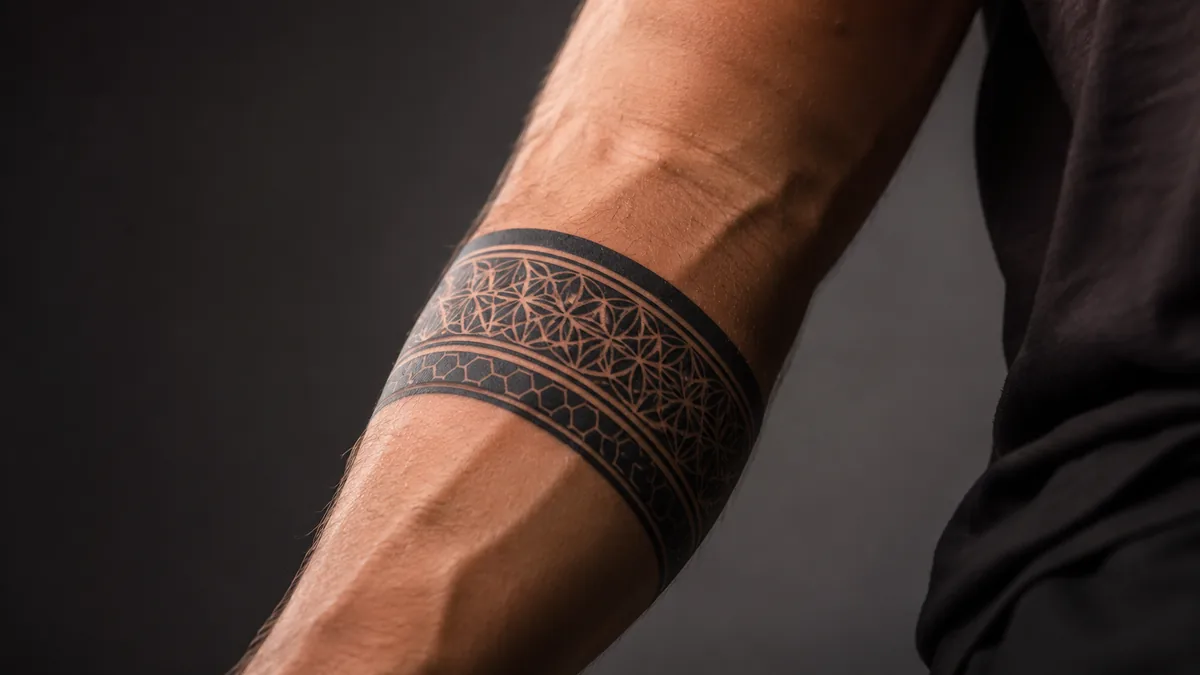
A banded tattoo is exactly what it sounds like, a solid or patterned band that wraps all the way around a limb. Usually the upper arm, sometimes the wrist, calf, or thigh. Clean, continuous, no break in the line. That completeness is the whole point.
People wear bands for a lot of different reasons, grief, loyalty, strength, spiritual protection. The meaning changes depending on the color, the style, and sometimes the specific person wearing it. Here is what these tattoos actually mean, and how to make one work for you.
Core Symbolism: What a Banded Tattoo Means
The most common meaning is grief and remembrance. A solid black band around the upper arm is widely recognized as a mourning symbol, a permanent marker of loss. You lost someone and you carry that. No explanation needed, no words on the skin. The band says it all to anyone who knows.
Beyond mourning, bands also read as strength and continuity. A circle has no beginning and no end. That closed loop signals permanence, resilience, an unbroken spirit. Some people get one after surviving something hard, illness, addiction, a hard chapter of life. The band marks the threshold between before and after.
Historical and Cultural Background
A band around the arm says what words never quite can.
Solid black armbands have a documented history in Western mourning traditions going back centuries. People wore black fabric bands on their sleeves as a public sign of grief, usually after losing a family member or comrade in wartime. The tattoo version follows that same logic, just permanent.
In Polynesian cultures, banded tattoos carry a different but equally serious weight. Samoan pe’a and Maori tā moko both use thick banded forms to mark rank, lineage, and passage into adulthood. Those traditions are specific and tied to ancestry. If you are not from those cultures, borrowing those exact patterns is a conversation worth having with yourself first.
Popular Design Variations
A solid black fill band is the most recognizable. Bold, saturated, reads from across the room. Some artists add a thin fine-line border on either edge to keep it crispy. Others whip shade the edges to soften the transition into bare skin, which can look sharp in person and ages a little more forgiving than a hard edge.
Patterned bands are everywhere too. Celtic knotwork, tribal geometry, barbed wire, floral wreaths, vine work, dotwork mandalas. You can build a band from repeated motifs rather than solid fill. These carry the same circular symbolism but add a decorative or cultural layer depending on the pattern you choose. Discuss the geometry with your artist before committing, symmetry errors on a full wrap are painful to live with.
Black and Grey vs. Color
Most banded tattoos run black and grey or solid black. That is intentional. The grief symbolism works best in black. It is serious ink. A mourning band in turquoise or red just does not land the same way emotionally or visually. If you are getting one for loss, stay in black. Bold will hold, and a fully saturated black band heals incredibly clean on most skin tones.
Color bands exist and can be beautiful, especially floral wraps or geometric bands built around a specific palette. A botanical band with green leaves and soft watercolor flowers reads totally differently, more life-affirming, more decorative. Just know that heavily colored ink on a wrap requires good sun protection and touch-ups down the line. The arm is a high-wear zone. Color fades faster there than on protected areas like the ribs or upper back.
Best Placements and How They Age
Upper arm is the classic spot. Good surface area, the muscle holds the ink well, and a band there is visible when you want it to be without being constantly on display. Forearm and wrist bands are popular but spicier to sit through and harder to keep saturated long-term. The wrist especially flexes constantly, which can cause the inside portion to blur or fade faster than the outer face.
Calf bands are underrated. Solid muscle, lower pain level than the ditch or shin, and they age nicely on most people. Thigh bands work great too, lots of real estate, heals well, less sun exposure. Avoid banding over bony prominences like the knee or ankle if you want clean lines that stay crisp. Those high-flex, low-fat zones are where blowout and migration happen first.
Pain by Zone
A band wraps all the way around, which means you are hitting every angle of that limb in one session. On the upper arm, the outer bicep is pretty manageable. The inner arm near the brachial vein and the armpit area gets spicy fast. Most people rate that inner portion a solid seven or eight out of ten. Your artist will likely save that section for last once you are warmed up.
Calf bands are more forgiving overall, though the shin bone is sharp and the back of the knee is sensitive. Wrist bands are short sessions but the area over the tendons and the inner wrist pulse point are genuinely uncomfortable. Go in fed and hydrated, plan for breaks on the tender sections, and trust an experienced artist who has done full wraps before. Distortion from poor tension during linework ruins the symmetry permanently.
Who Gets Banded Tattoos and How to Make It Personal
Veterans and military families get black bands for fallen brothers and sisters. Firefighters, cops, and first responders have their own versions of that tradition. Survivors, people in recovery, and people who lost parents or partners early also reach for this design. It is not a trend tattoo. People who get bands usually have a real reason.
You can personalize a band in subtle ways without losing the impact. A thin inner line in red or white, a specific width that matches a meaningful number, a break in the band filled with a small symbol, a date worked into a geometric repeat. Talk to your artist about what matters to you and let them integrate it cleanly rather than just adding elements. The power of this tattoo is in its restraint. Keep it tight, keep it intentional.