
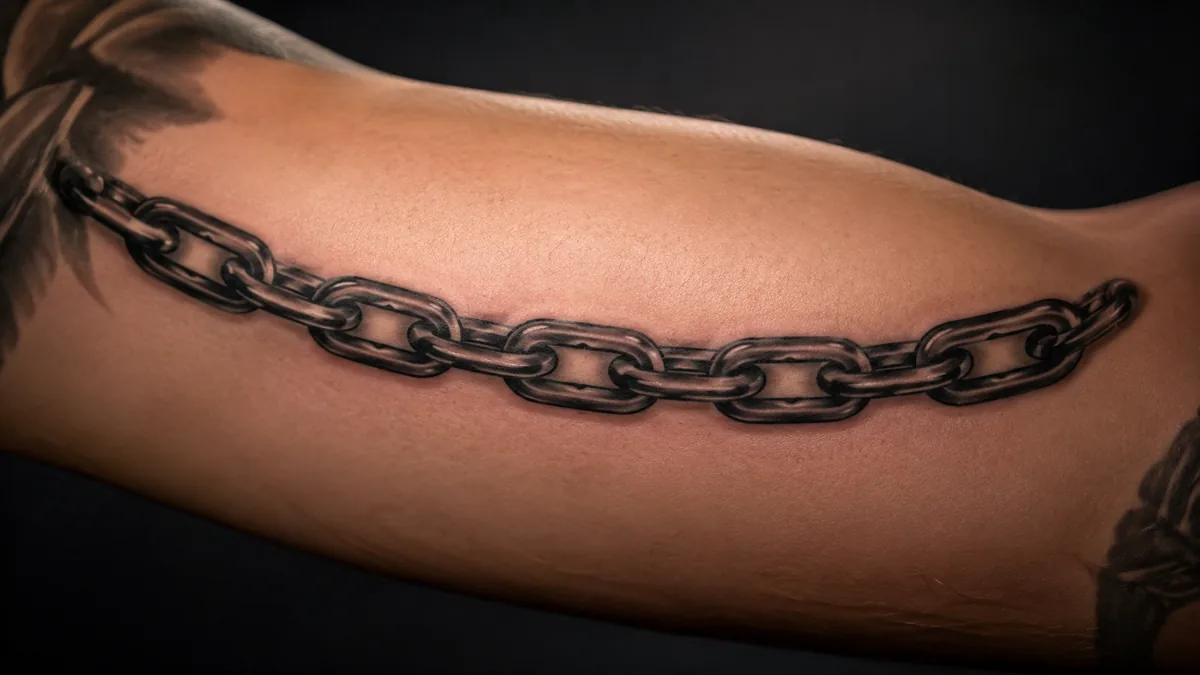
A chain tattoo isn’t subtle. It’s a bold, graphic image that people immediately read as powerful, and for good reason. Chains have been part of human experience for thousands of years, tied directly to power, captivity, loyalty, and survival. When someone sits down and commits to that image on their skin, they’re pulling from a deep well of meaning.
What’s interesting is how flexible the symbolism is. Two people can wear the same chain design and mean completely opposite things. One person is marking freedom from something that held them back. Another is honoring a bond they never want to break. That’s rare for a tattoo. Understanding the main readings helps you own the design instead of just wearing it.
Core Meanings: What a Chain Tattoo Actually Says
The most common reading is duality. A chain represents both bondage and strength at the same time. It can mean you were held down by something, addiction, a relationship, a system, a version of yourself, and you broke free. Or it can mean you chose a bond willingly and you’re proud of it. That tension between captivity and choice is exactly why chains resonate with so many people.
Secondary meanings include resilience, loyalty, and endurance. A chain is only as strong as its weakest link, and wearing one says you’ve tested yours and it held. Some people use it to represent family ties or brotherhood. Others use it to mark survival. The core message is almost always about being connected to something or having broken free from it.
Historical and Cultural Context
A broken chain means freedom. An intact one means you chose to stay.
Chains have carried symbolic weight across cultures for centuries. In Western history, chains were literally used to enslave people, and reclaiming the image as a tattoo has been a powerful act in communities where that history is personal and generational. It flips the symbol from oppression to survival and defiance. That’s a meaningful distinction, and it’s real history worth knowing before you get the piece.
In Christian iconography, chains appear in the context of sin, spiritual bondage, and liberation through faith. Saint Peter is often depicted in chains. That imagery carries into religious tattoo traditions where a broken chain specifically represents freedom through spiritual redemption. In sailor tattoo culture, anchor-and-chain combos were popular for decades, representing stability and being grounded, even far from home.
Broken Chain vs. Intact Chain
This distinction matters more than most people realize before they sit down with a reference image. An intact chain reads as connection, loyalty, strength, or willing bondage. It says the bond holds. A broken chain, links snapped apart or one end dangling, reads as liberation. Freedom from addiction, abuse, mental illness, a toxic relationship, an era of your life you’re done with. Both are powerful. They’re just saying different things.
Some clients want both readings in one piece. They’ll do a chain that’s mostly intact but has one cracked link, showing the tension between the bond and the break. That’s a solid narrative approach. Make sure your artist can execute that damaged-link detail cleanly at your chosen scale. In fine line work it can get muddy over time. Bold linework holds that visual storytelling better as it ages.
Popular Design Styles and Variations
Classic anchor chain is thick, nautical, masculine, and reads from across the room. It works well in black and grey with some whip shading to give the links dimension. Figaro chain, the kind you’d see in jewelry, is slender and elegant, popular with fine line artists working on feminine placements like the collarbone or ankle. Rolo and cable chain patterns give you clean, geometric repetition that suits both traditional American and neo-trad styles. Barbed wire reads harder and more aggressive, though it’s technically its own symbol.
Some artists get creative with what’s on the chain. A locket, a cross, a rose, a padlock, a key. These add personal meaning and give the piece a focal point. A chain wrapped around a skull reads very differently from a chain holding a heart. Adding a charm or pendant transforms the tattoo from a single symbol into a scene with a story. Talk with your artist about what the chain is holding or where it’s going, not just what it looks like.
Color vs. Black and Grey
Most chain tattoos live in black and grey, and honestly that’s where they shine. Metal reads naturally in greyscale. Solid black ink for the main link body, tight whip shading for the curve and shadow, and a clean highlight or negative space to suggest the metallic surface. A skilled artist can make that chain look three-dimensional and solid in straight black and grey. It heals clean, ages well, and the contrast stays crispy for years on most skin tones.
Color chains work, but they’re less common and more specific. Gold ink has gotten better but still tends to fade or shift yellow-green over time, so expect touch-ups. Some artists use a warm sepia or ochre in black and grey work to suggest gold without committing to a color that won’t hold. Silver reads naturally in straight grey. If you want a realistic jewelry look, lean on your artist’s metallics skills and ask to see healed examples from their portfolio before committing.
Best Placements and How Chains Age
Chains are naturally linear, so they work beautifully on body parts that have length. The forearm is a top pick. It’s a low-wear area, the skin doesn’t fold much, and you can run a chain from wrist to elbow with satisfying visual flow. The calf works the same way. Collarbone and chest placements are popular for delicate chain designs, especially fine line work meant to mimic jewelry. The neck is spicy, pain-wise, but chains read well there and it’s a high-visibility placement.
Fingers and hands are high-wear zones. Ink moves, bleeds, and fades faster there. A chain ring tattoo will look great for a year and then start spreading if it’s fine line. Bold linework holds longer in high-wear spots, but even bold will need a touch-up on fingers every few years. The ribs are spicy as hell but offer a great canvas. The ditch, inner elbow, is painful and the skin moves a lot, which can cause blowout with less experienced artists. Choose your artist carefully for high-movement placement.
Who Gets Chain Tattoos and How to Make It Personal
Recovery communities use chain imagery a lot, particularly broken chains, to mark sobriety anniversaries or freedom from addiction. Veterans and service members use chain and anchor imagery to represent duty and brotherhood. People who’ve left abusive relationships, left prison, or walked away from a destructive chapter of their life reach for the chain as a marker. It’s also popular in biker culture, where chains have mechanical significance as well as symbolic weight.
To personalize yours, think about what the chain is doing in the image. Is it wrapped around something? Hanging loose? Padlocked? Attached to a date, a name, or a symbol that means something to you? Adding a specific number of links, one for each year, each person, each event, gives the piece an internal code only you know. That kind of specificity transforms a familiar symbol into something nobody else is wearing. Tell your artist the full story. The best pieces come out of that conversation.









