The Chinese lion tattoo is one of the most loaded symbols you can put on your skin. We’re talking protection, power, warding off evil, and calling in good luck, all in one image. People have been putting these creatures on buildings, gates, and temples for over a thousand years. Putting one on your body carries that same weight.
These aren’t the African lions you’d see on a nature documentary. Chinese lions, also called foo dogs or fu dogs, are guardian beasts rooted in Buddhist and Chinese imperial tradition. They show up in pairs at temple entrances, government buildings, and wealthy homes across East Asia. On skin, they carry every bit of that protective, authoritative energy.
Core Symbolism: What a Chinese Lion Tattoo Actually Means
Chinese lion tattoos are first and foremost about protection. The lion stands guard, keeps bad energy out, and watches over whoever wears it. That’s the oldest and most consistent reading across Chinese, Japanese, and broader East Asian interpretations. It’s not just decorative muscle, it’s a guardian on your body.
Beyond protection, these creatures represent strength, authority, and good fortune. The open mouth on the male lion is said to pronounce the sacred syllable ‘om,’ while the closed mouth of the female captures it. Together they form a balance of energy. Solo on skin, the design usually reads as raw power and a personal shield against negativity.
Where Chinese Lions Come From
A Chinese lion tattoo is not a pet, it is a gatekeeper carved in skin.
Lions aren’t native to China. The animal arrived through trade routes from Persia and Central Asia, gifted to Chinese emperors as exotic tribute. Because most Chinese artists had never seen a real lion, they designed one from imagination, memory, and Buddhist iconography. That’s how you get the curly mane, the stocky build, the dragon-like face. It’s a mythologized creature, not a naturalistic one.
Buddhism played a huge role. In Buddhist tradition, the lion is the defender of dharma, the one who protects sacred teachings. When Buddhism spread into China, guardian lion statues spread with it. The stone pairs you see flanking temple gates, called ‘shishi,’ are the direct ancestors of the fu dog imagery people tattoo today. That religious history is real and worth knowing before you commit to the ink.
Fu Dog vs. Chinese Lion: Same Thing, Different Names
You’ll hear both terms used interchangeably in tattoo shops, and that’s basically fine. ‘Fu dog’ is a Western nickname that stuck because Westerners thought the statues looked like dogs. ‘Chinese lion’ or ‘shishi’ is more accurate to the source culture. In Japanese tattoo tradition they’re called ‘shisa,’ and you see them heavily in Okinawan iconography. Same spiritual function, slightly different regional aesthetic.
The Japanese tebori and traditional irezumi versions tend to have more dramatic, stylized manes and sharper, more geometric features. Chinese versions often carry more ornamental detail, richer decorative patterns on the body, and a rounder, heavier silhouette. When you’re planning your piece, knowing which regional aesthetic you want helps your artist nail the reference. Don’t just say ‘fu dog,’ pull the right reference images.
Design Variations: Traditional, Neo-Trad, Fine Line, and Realism
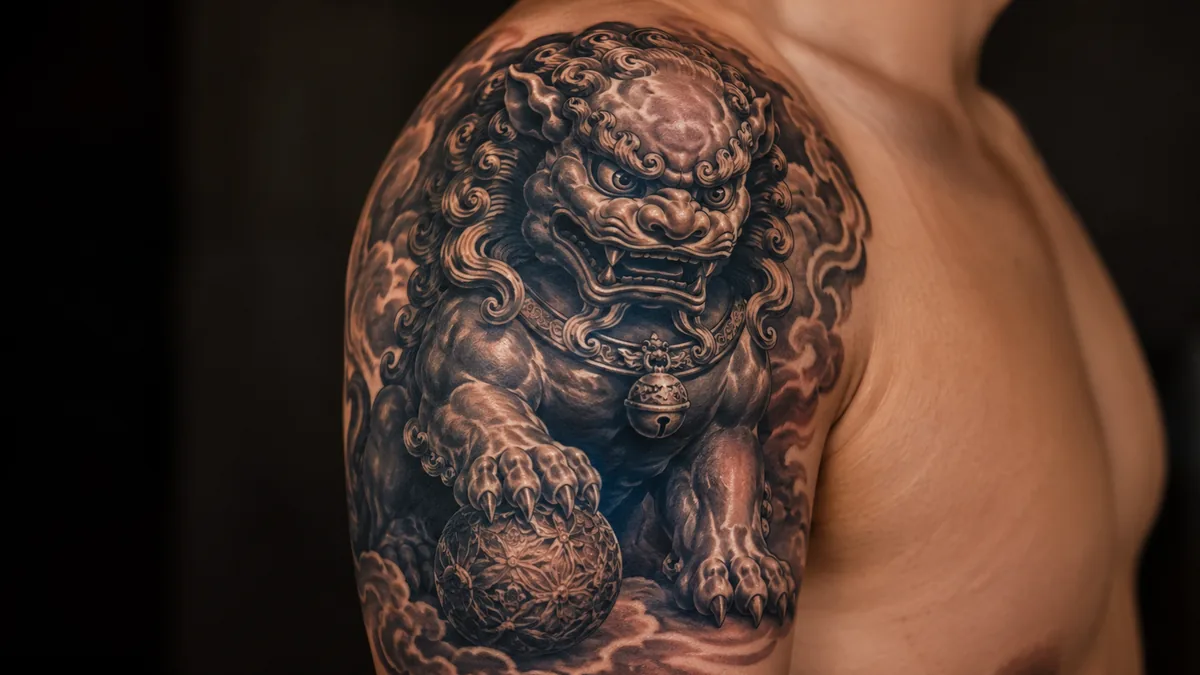
Traditional and neo-traditional Chinese lion tattoos are the most popular for a reason. Bold outlines, solid fills, heavy black packing in the shadows, and saturated color or rich black and grey. These read from across the room, hold up for decades, and look like they belong on skin. The thick lines lock the design together so it doesn’t blur out as the skin ages. Bold will hold, and this design was built for bold.
Fine line versions are gaining ground, especially for smaller placements. They look crispy fresh off the needle but require a very skilled hand and a low-movement zone to age well. Realism interpretations push toward sculptural shading, mimicking stone statues or painted versions. Some artists do a hybrid, realistic face with stylized, graphic mane. All of these work. Just match the style to the placement and the artist to the style. Don’t ask a bold traditional artist to do your micro-realistic piece.
Color vs. Black and Grey
In color, Chinese lion tattoos often feature red and gold, the most auspicious colors in Chinese tradition. Red means luck and protection, gold signals wealth and imperial power. Some clients go full polychrome with blue, green, and orange accent work on the decorative body patterns. Saturated color pops hard on lighter skin tones, and a great colorist can make this piece look like a painting. It commands attention.
Black and grey is equally valid and arguably more versatile. A skilled artist can get incredible depth in the mane with whip shading, build drama in the face with tight stipple or smooth gradients, and make the whole piece feel three-dimensional without a drop of color. Black and grey also tends to age more predictably. Color can shift over the years, especially reds and yellows. If longevity and a classic feel matter to you, black and grey is a solid call.
Placement, Pain, and How It Ages
The thigh, back, chest, and upper arm are the classic homes for a Chinese lion. These are relatively flat, low-distortion zones with enough real estate to let the design breathe. A Chinese lion crammed into a small space loses all the detail that makes it powerful. This is a piece that wants room. Plan for at least a solid hand-size footprint, ideally bigger. Sizing down too aggressively is one of the most common mistakes clients make with complex cultural imagery.
Pain varies by zone. The outer thigh and outer upper arm are manageable. The chest gets spicy near the sternum and collarbone. The ribs are brutal. The inner arm and inner thigh are sensitive. For aging, flat zones on the outer limbs hold detail the longest. Avoid putting intricate mane work on high-flex spots like the inner elbow or back of the knee. The skin there moves constantly and complex linework blows out faster. Keep the crispy details on stable skin and you’ll be happy ten years from now.
Who Gets Chinese Lion Tattoos and How to Make Yours Personal
People get Chinese lion tattoos for a lot of reasons. Some have Chinese heritage and want to honor it. Some are drawn to the spiritual protection angle after going through something hard, a loss, an illness, a major life shift. Some are martial artists or fighters who connect with the strength symbolism. Some just love the aesthetic. All of these are valid. You don’t need Chinese ancestry to wear this image, but going in with some understanding of what it means is respect well spent.
To make it personal, think about what the lion is protecting for you. Some clients incorporate specific flowers from their family’s region, peonies for prosperity, chrysanthemums for longevity. Others add a name, a date, or a personal symbol in the surrounding design. The pairing matters too. A Chinese lion paired with a dragon reads very differently than one paired with clouds and waves. Talk to your artist about the full composition, not just the lion itself. The context around the main image shapes the whole meaning.