
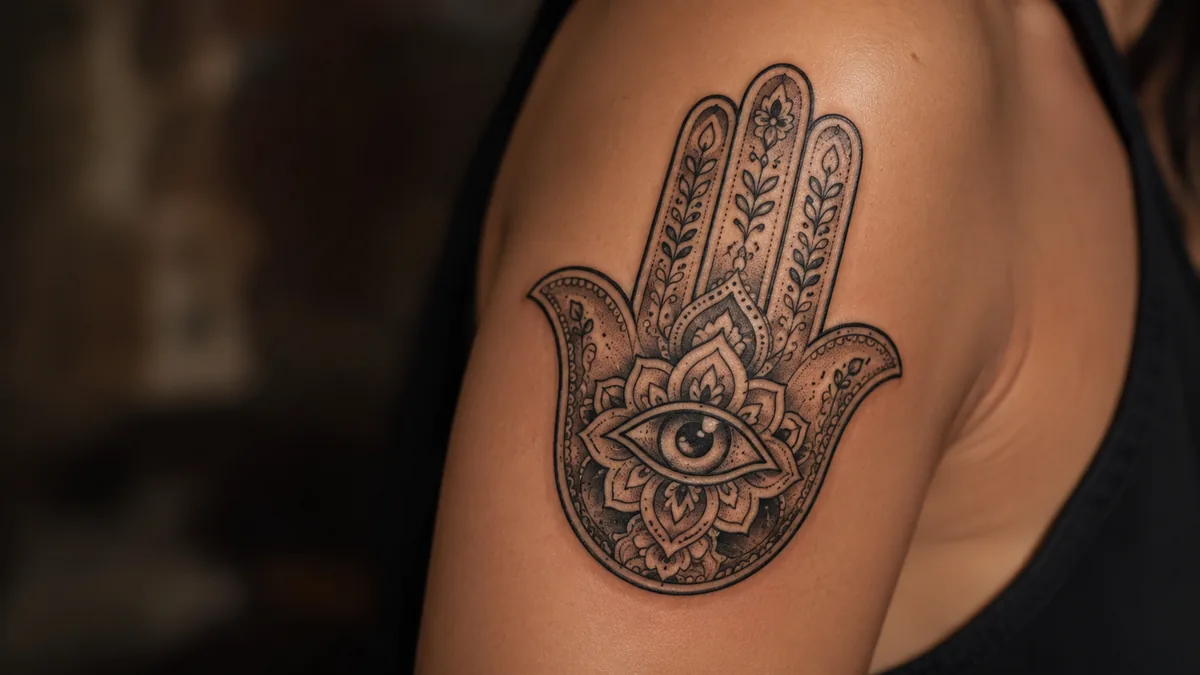
The hamsa is a hand-shaped amulet, palm out, often with an eye at its center. It’s one of the oldest protective symbols still in daily use, and on skin it carries that same core message: keep bad energy away, invite good fortune in. People aren’t getting this tattoo because it looks trendy. They’re getting it because it means something real to them.
As a tattoo, the hamsa works across cultures, body types, and styles. It reads clean in fine line, hits hard in bold traditional, and sits beautifully in black and grey. Before you book your appointment, here’s what the symbol actually stands for and what you need to know to wear it right.
What the Hamsa Actually Means
The hamsa is fundamentally a symbol of protection. The open palm is understood across traditions as a gesture that wards off harm, specifically the evil eye, which is the idea that envy or malicious staring from others can cause real damage to your health or luck. The eye at the center of the hand reinforces that idea: it sees the threat coming and deflects it before it lands.
Beyond protection, the hamsa is widely read as a symbol of blessings, power, and strength. Some people focus on its connection to good fortune and abundance. Others wear it as a reminder to stay grounded and present. The meaning you bring to it matters, but the protective core is consistent across almost every culture that uses the symbol.
Where the Hamsa Comes From
The hamsa does not care what religion you are, it just asks which way you need the hand to face.
The hamsa shows up across multiple ancient cultures in the Middle East and North Africa. It has deep roots in Jewish tradition, where it is called the Hand of Miriam, referring to the sister of Moses and Aaron. In Islam it is known as the Hand of Fatima, honoring the daughter of the Prophet Muhammad. Both traditions use it as a talisman against the evil eye and as a symbol of divine protection and feminine strength.
The word hamsa itself comes from the Arabic and Hebrew word for five, referring to the five fingers of the hand. Archaeological evidence places similar hand symbols in the region going back thousands of years, predating both traditions. The symbol moved through North African Jewish communities into Sephardic culture and spread across the Mediterranean. It is genuinely ancient, genuinely cross-cultural, and not appropriated from a single source.
Which Way Does the Hand Face?
This is a real distinction that matters. When the hamsa faces fingers down, it is traditionally associated with inviting good luck, fertility, and positive energy. When it faces fingers up, palm facing outward, it is read more as an active shield against evil, a stop sign to negative forces. Both orientations are legitimate and both appear throughout the history of the symbol.
Most clients don’t know this going in, and most tattoos show the fingers-up version because it’s visually stronger and more immediately legible as a hand. If the direction has personal meaning to you, decide before you sit down. It changes the composition slightly, but your artist can execute either orientation cleanly in any style.
Design Variations and Tattoo Styles
The hamsa translates across almost every tattoo style. Fine line versions are extremely popular right now, especially with delicate mandala or floral patterning inside the palm. These look crispy fresh but require a skilled hand because the linework is unforgiving. Traditional and neo-traditional interpretations go bolder, heavier outlines, saturated fills, and the image reads from across the room without squinting. Black and grey with whip shading gives it depth and a timeless quality that holds up for decades.
Geometric versions strip it down to clean shapes and sharp angles. Illustrative styles add realistic flowers, moons, lotuses, or evil eye beads around or within the hand. Some people incorporate Hebrew or Arabic script. Watercolor overlays are common but fade faster than solid work in high-wear zones, so factor that into your decision. Whatever style you pick, make sure the eye at the center is executed with enough weight to anchor the whole piece.
Color vs. Black and Grey
Color hamsas lean bold. Blues and teals dominate because of the evil eye connection, which is traditionally depicted in blue. Turquoise in particular carries protective symbolism in Turkish and Middle Eastern folk tradition, so pairing it with the hamsa is historically coherent, not just aesthetic. Gold and warm tones suggest abundance and divine light. If you want saturated color that stays punchy, commit to bold fills with solid black outlines underneath, because thin color without black support fades fast.
Black and grey is the more versatile choice for most placements. It ages predictably, heals reliably, and works well in areas that see a lot of sun exposure or friction. A skilled artist can build dimension through whip shading and layering that gives the hamsa real presence without depending on color. If you’re undecided, black and grey with a single blue eye is a clean middle ground that references the symbol’s protective tradition while keeping the piece tight.
Placement and How It Ages
The hamsa is a symmetrical design, which gives you a lot of flexibility. The inner forearm is the most popular placement because the hand shape is naturally proportional there and the piece stays visible without being aggressive. The sternum works beautifully for larger versions, especially when surrounded by florals or geometric fill. Back of the hand and fingers are high-wear zones where fine line work can spread and blur over time, so go bolder in those spots if you want the design to hold.
Ribs are spicy and the skin there moves a lot, which affects healing. Upper arm and shoulder placements age well and give your artist room to scale the design properly. Ankle and foot placements look clean initially but fade and blowout faster than most people expect because of friction and sun exposure. Wherever you place it, make sure the proportions are right for the space. A hamsa crammed into a spot too small for its detail will look muddy inside of five years.
Who Gets This Tattoo and How to Make It Yours
People from Jewish, Muslim, and Middle Eastern backgrounds often get the hamsa as a direct cultural and spiritual connection. People outside those traditions get it because the symbolism resonates, protection, strength, warding off negativity, regardless of their own background. Both are valid. The symbol has traveled across cultures for thousands of years precisely because its meaning translates universally.
To make it personal, think about what you’re anchoring it to. Adding a specific stone, a birth flower, initials, or script in a language meaningful to you turns a traditional image into something that tells your story. Talk to your artist about how those elements interact with the hamsa’s shape. A solid artist will help you build a composition that holds together as one cohesive piece, not a pile of separate symbols stuck together.









