The hawk is a predator built for speed and precision. People don’t get hawk tattoos because they look cool and that’s it. They get them because the bird carries real weight: sharp vision, independence, fearlessness, and the ability to rise above the noise. That’s a message worth putting on your body for life.
There’s a reason the hawk shows up in Native American traditions, Egyptian mythology, and Celtic warrior culture. This bird has meant something to humans for thousands of years. What it means to you personally can layer right on top of all that. Here’s the full picture.
Core Symbolism: What the Hawk Tattoo Actually Means
The hawk stands for vision above everything else. Hawks see eight times more clearly than humans, so the tattoo naturally carries the idea of seeing what others miss, cutting through distraction, staying focused. It’s a strong choice for someone who prides themselves on clarity and awareness. Add to that: speed, decisiveness, and hunting instinct. Hawks don’t hesitate. They commit.
The other big thread is freedom. Hawks are solitary fliers. They don’t run in packs. That independence reads loud in tattoo culture. A lot of people choosing this bird are making a statement about self-reliance, about living on their own terms. Protection is another layer. Some people get a hawk as a guardian symbol, watching over them or someone they love.
Cultural and Historical Background
A hawk doesn't circle aimlessly, and neither should your ink.
In ancient Egypt, the hawk was sacred. Horus, the god of sky and kingship, had the head of a falcon, a bird closely related to and often grouped with the hawk in symbolic tradition. Egyptian hawk imagery represents divine protection, royalty, and the eternal soul. If you’re drawing from this tradition, the imagery is rich and centuries deep.
Native American cultures hold the hawk as a messenger between the human world and the spirit world. Hawk feathers carry ceremonial significance. The bird is seen as a guide, warning of danger, carrying prayers upward. Celtic warriors wore hawk imagery as a symbol of nobility and hunting prowess. None of these are invented meanings. They’re documented and widely respected. If your design borrows from a specific culture, know what you’re wearing.
Popular Design Variations
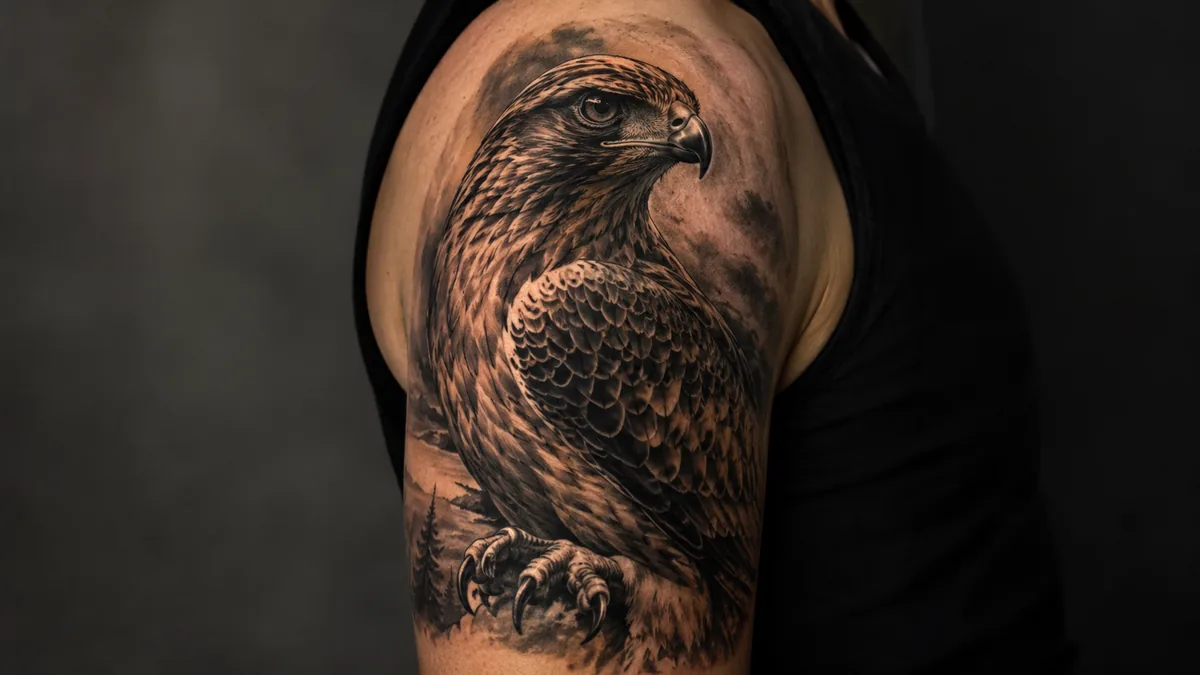
The most common hawk tattoo is the bird in flight, wings spread, talons forward, diving or soaring. That position reads from across the room and works in almost any style. Perched hawks are popular too, especially in realistic black and grey where fine feather detail can really shine. Profile views of the hawk head alone are clean, graphic, and bold enough to hold in smaller sizes.
A hawk clutching prey, typically a snake or rabbit, adds a predator-power angle. Some people go with a geometric hawk, clean shapes and lines, more modern and minimal. Tribal-influenced hawk work pulls from Indigenous American or Polynesian aesthetics. Japanese style hawks in traditional irezumi represent warrior spirit and nobility. Watercolor hawks splash color but tend to fade faster than saturated traditional work.
Color Versus Black and Grey
Black and grey is the go-to for realistic hawk tattoos. The feather texture, the gradient from light to dark across the wing, the depth in the eye, all of that lands best in skilled black and grey. It heals clean and the contrast stays sharp for decades in low-wear zones. A well-executed black and grey hawk is one of those tattoos that still looks solid twenty years out.
Color opens different doors. A red-tailed hawk done in saturated traditional American style, bold black outlines, flat fills, reads strong and graphic. If you want a more illustrative or neo-traditional look, warm browns, burnt oranges, and yellows can pop hard. Just know that yellows and lighter colors fade faster, especially in high-wear spots. Talk to your artist about what will hold long-term based on your skin tone.
Best Placements and How It Ages
The upper arm, forearm, chest, and back are the classic spots for hawk tattoos and they age well. Good muscle and low sun exposure means the ink stays crisp longer. A hawk in flight across a shoulder blade or chest has real presence and gives your artist room to work. The forearm works great for a perched hawk or a hawk head facing up toward the elbow.
Avoid the hands, fingers, and feet if you want longevity. High-wear zones mean constant fading and frequent touch-ups. The ribcage is a popular spot but it’s spicy and the skin moves a lot, which can cause slight spreading over time in fine line work. Bold will hold better there than hyper-fine detail. Thighs and upper arms are some of the best real estate for complex hawk pieces with wing span.
Style Matching: Realism, Traditional, and Fine Line
Realism is the most requested style for hawk tattoos right now. A skilled realist can capture the texture of every feather, the cold focus in the hawk’s eye, the tension in the wings. It takes a specialist. Look at healed work, not just fresh photos. Fresh ink always looks good. Healed realistic work tells you if the artist actually delivers.
Traditional American hawk tattoos, thick black outlines, limited palette, bold composition, age the best of any style. The bold outlines hold the image together even as the skin changes. Fine line hawks look stunning fresh but they require placement in low-wear zones and touch-ups more often than bold work. Neo-traditional splits the difference nicely, more detail and dimension than classic traditional but more structure than realism.
Who Gets Hawk Tattoos and How to Make Yours Personal
Athletes, military veterans, and hunters gravitate toward the hawk for obvious reasons. Speed, precision, power, that’s the core. Spiritual people connect with the messenger and guardian readings. People going through major transitions, career changes, recovery, loss, often get a hawk as a mark of clarity and forward motion. The symbolism is broad enough to be personal without being vague.
To make it yours, think about what element of the hawk resonates most. If it’s the vision angle, a close-up eye detail or a hawk silhouette with a sunrise can reinforce that. If it’s ancestry or culture, work with an artist who knows that tradition. You can add a banner, a date, coordinates, or integrate it into a sleeve with complementary imagery like mountains, clouds, or other animals. Talk it through with your artist before finalizing. Good placement and honest conversation will get you a piece you’re still proud of in thirty years.