
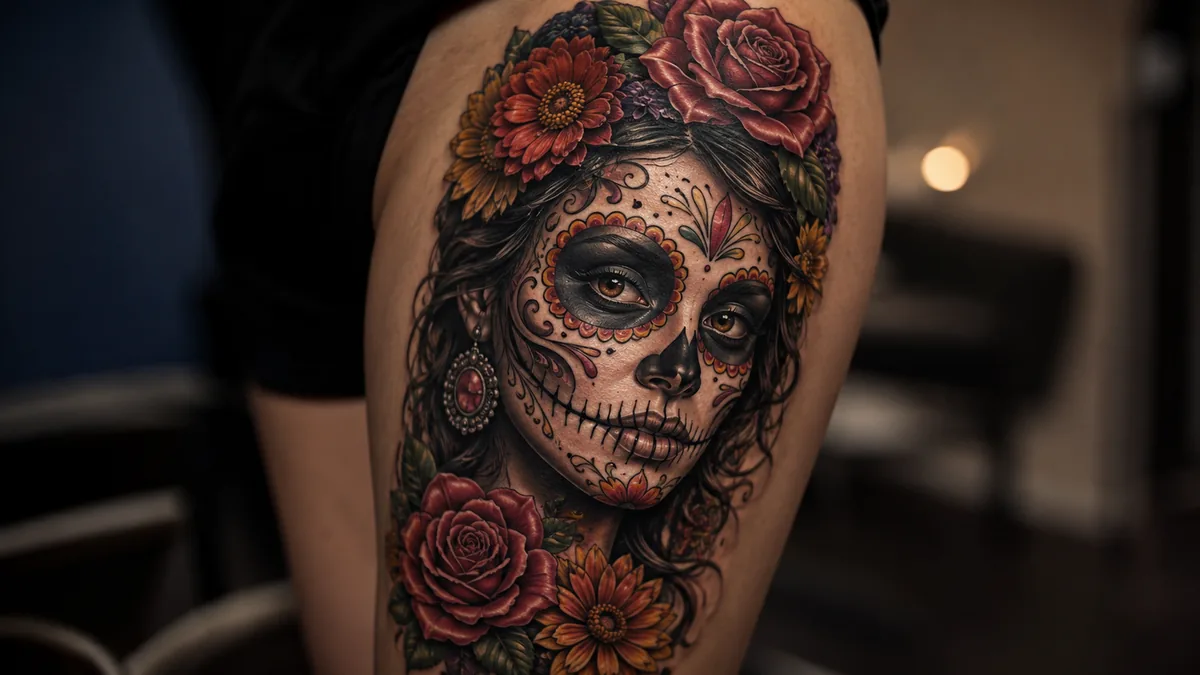
Sugar skull tattoos are one of the most requested designs in any shop, and for good reason. They’re bold, they’re beautiful, and they carry real weight. At their core, a sugar skull represents death and remembrance, not as something dark or morbid, but as a celebration of a life that mattered.
The imagery comes straight from Dia de los Muertos, Mexico’s Day of the Dead tradition. These aren’t horror skulls. They’re decorated, colorful, and full of life, which is exactly the point. You’re not tattooing death on your skin. You’re tattooing memory.
What a Sugar Skull Actually Means
The sugar skull is a symbol of remembrance for someone who has passed. Traditionally, these decorated skulls were placed on ofrendas, the altars built during Dia de los Muertos on November 1st and 2nd. Each decoration on the skull carries intention: flowers for the beauty of life, dots and swirls for celebration, and crosses for the spiritual connection between the living and the dead.
As a tattoo, the meaning stays close to those roots. Most people get a sugar skull to honor a specific person they’ve lost. Others wear it as a broader statement about mortality and the importance of living fully. Either reading is valid, and neither one is wrong. The tattoo works because it holds both grief and joy at the same time.
The Cultural Background You Should Know
A sugar skull without a story is just decoration.
Dia de los Muertos is an Indigenous Mexican tradition, blended over centuries with Catholic influences brought by Spanish colonizers. It’s rooted in Aztec practices of honoring ancestors and evolved into the bold holiday recognized today. The sugar skull specifically comes from the calavera tradition, decorated skulls made from sugar or clay that were gifted to the living and placed for the dead.
If you don’t have Mexican heritage, getting a sugar skull tattoo is one of those conversations worth having honestly. Most Mexican tattoo artists will tell you there’s room for everyone to appreciate the symbolism, but they’ll also appreciate it when you know the real history behind what you’re putting on your body permanently. Do your homework and wear it with respect.
Popular Design Variations
The classic sugar skull is front-facing, symmetrical, and loaded with floral detail, usually roses or marigolds, which are the traditional flower of Dia de los Muertos. Large decorative eyes, often flowers or jewels themselves, are the centerpiece. Spider webs, hearts, candles, and geometric patterns fill the rest of the face. Feminine versions tend to feature more florals and softer linework. Masculine versions often go heavier on geometric fill and bold outlines.
Modern shops have pushed the design in a lot of directions. Neo-traditional sugar skulls use thick outlines and rich color palettes with exaggerated proportions. Chicano-style versions lean into black and grey with fine detail and religious imagery woven in. Watercolor sugar skulls drop the heavy outlines and let color bleed outward. Trash polka mixes the skull with abstract red and black collage elements. There’s a version for every style.
Color vs. Black and Grey
Full color sugar skulls are a showpiece. Saturated marigold yellows, deep magenta pinks, cobalt blues, and bright greens make the design pop hard. Color reads from across the room. The catch is that color needs more maintenance. Bold hues fade faster than black ink, especially in high-wear zones like hands, fingers, and feet. Plan for touch-ups down the road if you go full saturation.
Black and grey sugar skulls age more gracefully on most skin tones. The whip shading and fine linework in a good black and grey piece give you incredible depth without the upkeep. Chicano-style black and grey in particular has a timeless quality that holds up for decades when done right. Bold will hold either way, so make sure your artist isn’t going too fine on the decorative interior lines, or you’ll lose that detail as it heals and settles.
Best Placement and How It Ages
The sugar skull is built for impact, so it needs real estate. The thigh, upper arm, chest, back, and calf are all strong placements. These are lower-wear areas with consistent skin texture, which means the detail stays crisp longer and the healing process is more predictable. A well-placed thigh piece or full sleeve incorporating a sugar skull can be a serious statement that still looks clean ten years out.
Avoid placing highly detailed sugar skulls on the hands, fingers, or the inside of the wrist if you want longevity. High-wear zones break down ink faster, fine lines blur, and you risk blowout from the looser skin. The ribs and sternum are spicy for pain but give you a flat canvas that heals nice if you follow aftercare. Elbows and knees are brutal for both the session and the healing, and the constant movement wrecks fine detail over time.
Making It Personal
The strongest sugar skull tattoos have a specific anchor. Maybe it’s the birthdate of someone you lost worked into the design. Maybe it’s a portrait element, getting their eyes incorporated into the skull’s eye sockets. Some people add a specific flower that meant something to the person, a favorite color in the palette, or a name in script below. These details transform a design that’s everywhere into something that belongs to you specifically.
You can also lean into style to make it personal. If you’re covered in traditional American work, ask your artist to adapt the sugar skull into that aesthetic with bold outlines and a limited palette. If your collection is fine line black and grey, go that direction. A good artist will tell you how to translate the design without losing the core symbolism. Talk to them. That conversation is where the real tattoo starts.
Who Gets Sugar Skull Tattoos
Sugar skull clients are all over the map. Plenty are people with Mexican heritage honoring their culture and their family. Others are tattoo collectors who love the aesthetic and the symbolism of celebrating life in the face of death. Memorial clients who want something more celebratory than a traditional portrait are another big group. The design is flexible enough that it works for a first tattoo or as part of a full sleeve.
Age, gender, and background don’t define who this tattoo is for. What matters is the intention you bring to it. Walk into your consultation knowing what it means to you, whether that’s honoring a specific person, connecting to a tradition, or just carrying a reminder that life is short and worth living loud. Your artist will use that to build something that holds meaning every time you look at it.









