
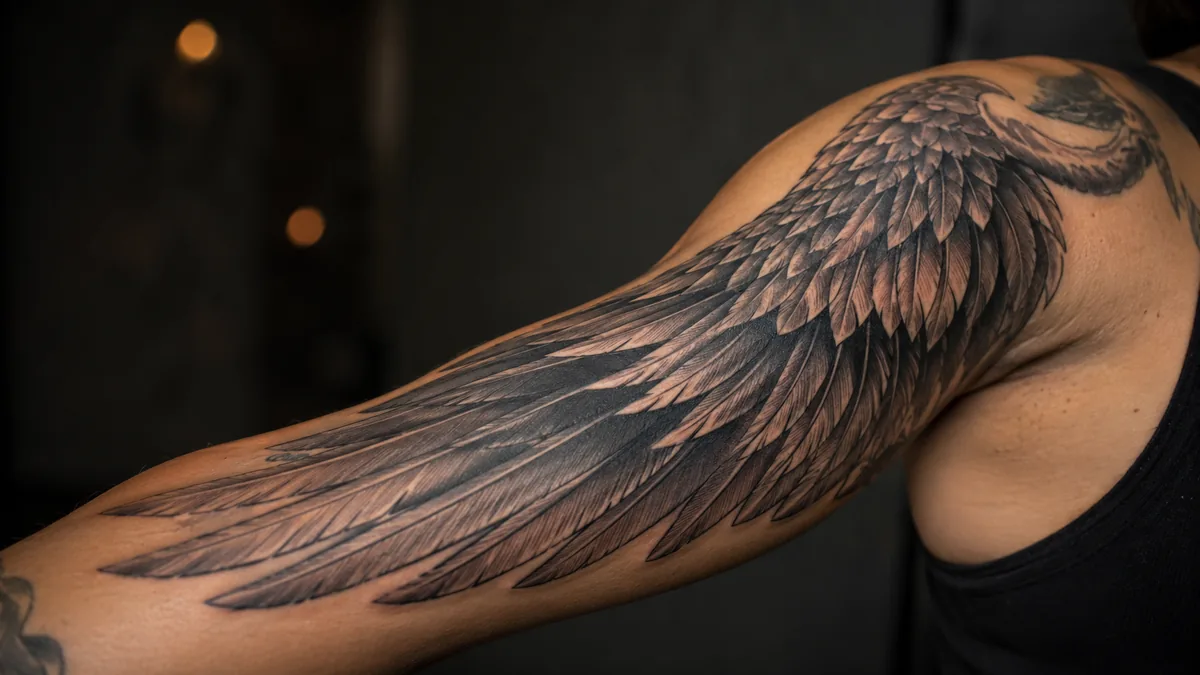
Wings on skin go back centuries and the meaning hasn’t changed much. Freedom. Transcendence. The idea that something or someone has risen above. If you’re going angel wings down your back or a single feathered wing on your forearm, the symbolism is heavy and personal.
That said, wings mean different things depending on the design. Angel wings read differently than demon wings. A single broken wing hits different than a full spread. Before you sit down in the chair, it helps to know what each variation actually communicates, and how to make your piece read exactly the way you want it to.
Core Symbolism: What Wing Tattoos Actually Mean
Wings are one of the oldest symbols humans have used to represent the soul and its movement beyond the physical. At the most basic level, a wing tattoo means freedom. The ability to rise, escape, move beyond whatever is holding you down. It’s aspirational. People who’ve come through addiction, grief, or a rough chapter in their lives often get wings to mark the moment they got out.
The second major meaning is protection. Angel wings in particular carry the idea of a guardian watching over you. A lot of people get them as memorials, honoring someone who passed, believing that person is now watching over them. That dual meaning, freedom plus protection, is why wings have stayed popular across every generation of tattoo culture.
Cultural and Historical Background
The wing you wear tells people exactly what you believe you can escape.
Wings show up across nearly every major culture. In ancient Egypt, the winged sun disk represented divine power and royal protection. Greek mythology gave wings to Hermes, messenger of the gods, and to Nike, the goddess of victory. The Romans carried those same ideas forward. Winged figures have always signaled speed, divine favor, and connection between the mortal world and something higher.
In Christian tradition, wings belong to angels, which is why angel wing tattoos became such a dominant style in Western tattooing. Celtic and Norse traditions had their own winged creatures tied to battle and the afterlife. The bottom line is that no matter where you trace it, wings in human symbolism almost always point upward, literally and figuratively.
Angel Wings vs. Demon Wings: Two Very Different Statements
Angel wings are soft, curved, feathered, and typically rendered in white, light grey, or a clean black and grey. They communicate grace, spirituality, and remembrance. These are the wings people get for lost loved ones, for faith, for a sense of being watched over. They photograph clean, they read clearly from across the room, and they hold up well in most styles from fine line to bold traditional.
Demon wings, sometimes called bat wings, are leathery, veined, and angular. They flip the symbolism toward rebellion, darkness, duality, or an honest acknowledgment that a person carries both light and shadow. Some people pair angel and demon wings together on purpose. One on each shoulder blade. That combo is a direct visual statement about living between two natures, and it hits hard when it’s executed with contrast and intention.
Popular Design Variations and Styles
Single wing tattoos are underrated. One feathered wing on the forearm, the calf, or the chest reads as incomplete by design, which for a lot of people is exactly the point. It can represent a lost partner, a lost self, or something left behind. Spread wings across the upper back are the classic big piece, and when the anatomy is drawn right to follow the shoulder blades, they look incredible in motion. Small wing tattoos on the wrist, ankle, or behind the ear are popular fine-line pieces.
Style matters a lot with wings. Traditional American wings are bold, saturated, outlined hard, and will hold for decades. Black and grey realism gives you depth and texture in the feathers that looks genuinely architectural. Fine line wings are delicate and modern but need a skilled hand and low-wear placement to age well. Neo-traditional adds color and stylized detail without losing legibility. Whatever direction you go, make sure the feathers have structure. Soft blobs that look like feathers in the chair will look like a blur in five years.
Color vs. Black and Grey
Black and grey is the dominant choice for wing tattoos, and there’s a reason for that. Wings have a natural gradient, light at the tips and denser toward the base, that translates perfectly into whip shading and smooth grey washes. A well-executed black and grey wing has dimension, movement, and ages predictably. Bold will hold here when your artist keeps the darks saturated and the contrast crisp.
Color opens up options but adds complexity. White ink for feather highlights on a light grey base can look stunning fresh but fades faster and needs touch-ups, especially on lighter skin. Full color wings in traditional style, yellows, reds, and blues with a solid black outline, are punchy and durable. Soft watercolor wings look beautiful fresh and wash out quickly without a solid anchor. If you go color, talk to your artist about longevity and pick a palette that has enough contrast to read five years from now.
Placement, Pain, and How It Ages
Upper back between the shoulder blades is the classic wing placement and for good reason. There’s real estate there for a full spread, the skin is relatively flat, and it’s a lower-wear zone so the tattoo holds its detail. Pain is moderate, spicier near the spine and the shoulder blades themselves. The ribs, sternum, and inner arm are all higher on the pain scale and thinner skin means more blowout risk with heavy shading. Wrist and ankle placements for small wings are accessible but high-wear, meaning you’ll touch them up more often.
Feather detail is the biggest aging concern with wing tattoos. Fine lines between feathers pack together over time, especially in tight clusters. An experienced artist leaves breathing room in the design so it stays legible as it settles. Ask to see healed photos of your artist’s wing work specifically. Not fresh, healed. A wing that looks crispy in the chair but turns muddy at six months is a design problem, not just a healing problem. Bold outlines and clear separation between feather groups are what keep a wing piece reading clean for years.
Memorial Wings: One of the Most Common Reasons People Get Them
A large portion of wing tattoos are memorials. When someone loses a parent, a child, a partner, or a close friend, getting wings with their name, dates, or portrait is one of the most common ways people choose to mark that loss. The meaning is direct: that person has become an angel, is free from pain, and is watching over the people left behind. It’s a straightforward expression of grief and love, and there’s nothing wrong with that.
If you’re getting memorial wings, think carefully about what you add to them. A name in clean lettering reads forever. A script that’s too thin or too cursive will blur. Avoid cramming too many elements into the piece. The wings themselves carry the weight. A halo, a date, or a small portrait medallion between the wings can be powerful when the layout is clean. More than that and you risk cluttering a piece that works best when it breathes.
Who Gets Wing Tattoos and How to Make Yours Personal
Wings attract a wide range of people. Athletes who see themselves as built for speed and freedom. People of faith marking their spirituality. Survivors marking a chapter closed. Parents memorializing a child. Bikers, veterans, artists. The symbolism is broad enough to absorb a lot of personal meaning without feeling generic, as long as the execution is specific. Generic clip-art wings look generic. Custom wings built around your body, your story, and a real artist’s hand look like they belong there.
To make a wing tattoo yours, bring references that show the specific feeling you want, not just photos of wings. Bring a photo that captures the mood. Tell your artist what the piece means. A good tattoo artist will use that to inform the weight of the lines, the softness or sharpness of the feathers, and the overall composition. Wings are one of those designs that can be deeply personal or completely throwaway. The difference is in the conversation you have before anyone picks up a machine.









