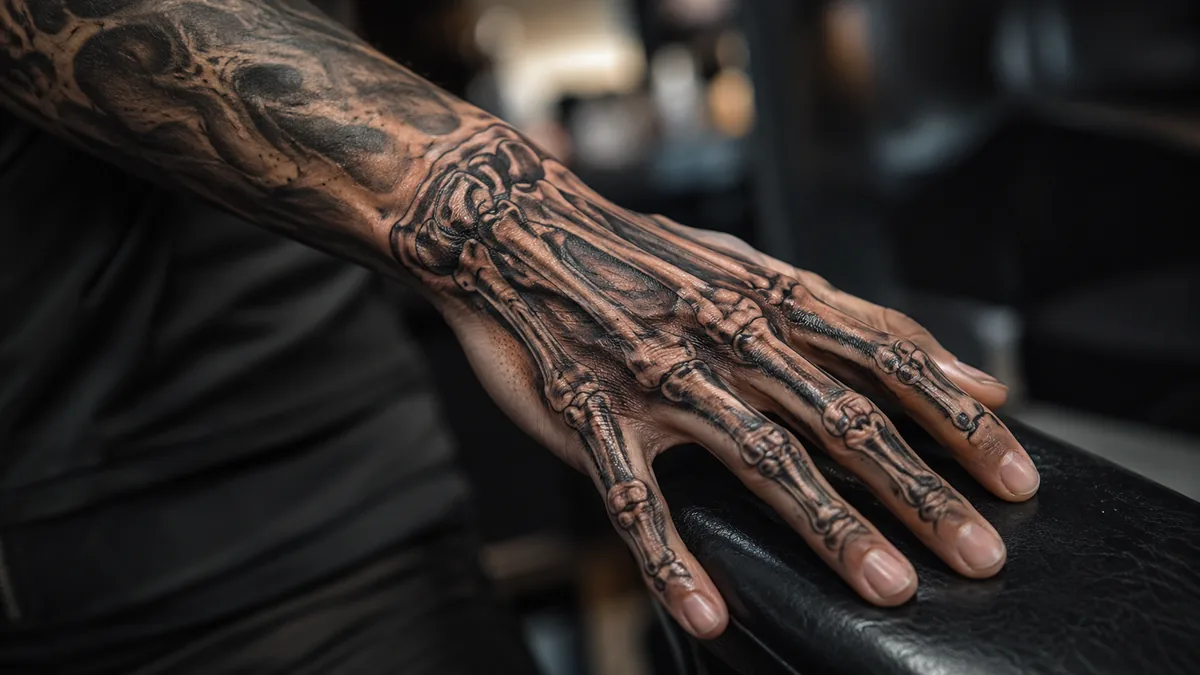
A skeleton hand tattoo is one of the most direct statements you can put on your skin. No guessing, no subtlety required. Bones are what remain when everything soft is stripped away, and that’s exactly the point.
Whether it’s wrapping your wrist, reaching across your chest, or pointing across your ribs, the skeleton hand carries real weight. Here’s what it actually means, where it comes from, and how to get it done right.
The Core Meaning: Mortality and What Lasts
The skeleton hand is first and foremost about mortality. It’s a reminder that life ends, that the flesh is temporary, and that the bones underneath are the final truth. A lot of clients who come in for this piece aren’t being dark or edgy. They’ve been through something real, a loss, a close call, a serious health scare, and they want something that holds that experience permanently.
That memento mori angle is the oldest and most honest read of this tattoo. It’s not nihilistic. For most people it’s the opposite. Staring at your own skeleton hand on your skin is a daily reminder to live fully, to not waste the time you have. That’s a solid reason to get inked.
Defiance, Strength, and Refusing to Quit
A skeleton hand doesn't mean you worship death, it means you don't forget it.
The second major meaning is straight-up defiance. Skeleton hands are often read as a refusal to be broken. You’ve gone down to the bone and you’re still standing. That resonates hard with people who’ve survived addiction, illness, grief, or abuse. The skeleton doesn’t flinch. It just exists, stripped bare, without apology.
Some clients pair the skeleton hand with a gesture. The middle finger reads as pure rebellion. An open palm or pointing finger carries more authority and mystery. A fist with rings reads tough and grounded. The gesture does a lot of work here, so think carefully about what posture actually reflects your attitude before you commit.
Cultural and Historical Roots
Skeleton imagery in tattoo culture has deep roots in Dia de los Muertos, the Mexican celebration of the dead that honors ancestors rather than fearing death. That tradition treats skeletal figures as joyful, connected, and present. The skeleton hand in that context is about remembrance and continuation, not horror. It’s a fundamentally different emotional register than the Western grim reaper reading.
In Western folk art and medieval European iconography, skeleton imagery, often called danse macabre, served as a reminder that death comes for everyone regardless of wealth or rank. Sailors, soldiers, and laborers carried memento mori tattoos for centuries. The skeleton hand fits cleanly into that long tradition of people marking themselves with the one truth nobody escapes.
Duality: Life and Death on the Same Hand
One of the most popular design concepts with skeleton hands is the half-and-half split, where one side shows living skin and the other shows exposed bone. This reads as duality, the coexistence of life and death, the visible and the invisible, the temporary and the permanent. It’s a powerful concept because it’s literally true of every hand you’ve ever shaken.
That split design works especially well on the forearm where the artist has room to blend the transition. Done in black and grey with solid whip shading, the contrast between soft tissue detail and clean bone structure is striking. It reads from across the room and it ages well because the bold bone outlines hold through years of wear.
Style Variations: Fine Line vs Bold Traditional
Fine line skeleton hands are everywhere right now. The delicate linework, micro-detail in the knuckle joints, subtle shading in the palm hollows, all of it looks sharp fresh out of the studio. But be honest with yourself about longevity. Fine line on high-wear zones like fingers and palms blurs over time. The lines spread, the detail fades, and in five years it can look muddy. That’s not fear-mongering, that’s physics.
Bold traditional or neo-traditional skeleton hands age dramatically better. Thick outlines hold their shape, saturated blacks stay rich, and the graphic quality stays crisp for decades. Black and grey realism is a strong middle ground. The shading gives depth without relying on hairline strokes that blow out. Whatever style you choose, find an artist whose portfolio shows healed work, not just fresh photos.
Placement, Pain, and How It Ages
The most common placements are the hand itself, the forearm, the upper arm, the chest, and the ribs. The hand placement is the boldest choice, direct and unmissable, but hands are high-wear and they fade fast. Expect to touch up hand tattoos more often than anywhere else on your body. The knuckles especially chew through ink. Your artist should warn you upfront.
Forearm placement gives the design room to breathe and ages well. Ribs are spicy but the skin is clean and the piece heals beautifully if you keep it out of the sun. Upper arm is the easy choice, low-wear, good canvas, holds detail long-term. Pain levels scale from moderate on the forearm to genuinely rough on the ribs and over the knuckle bones. Come fed, rested, and hydrated for any session over two hours.
Who Gets This Tattoo and How to Make It Personal
Skeleton hand tattoos cut across every demographic in the shop. Bikers, nurses, veterans, artists, teachers, parents who lost a child. The symbolism is universal enough to hold almost any personal story. The clients who walk out happiest are the ones who come in with a specific meaning already locked in, not just an aesthetic they liked on Pinterest.
To make it yours, think about what the skeleton hand is doing in your design. Add a flower it’s holding for life growing through death. Include a name or date in the bones for memorial work. Incorporate cultural symbols that actually belong to your background. Talk to your artist about gesture, composition, and what secondary elements reinforce your specific meaning. A solid concept always produces a better tattoo than a reference image alone.