The blue jay is one of those birds that refuses to be ignored. Loud, smart, territorial, and drop-dead gorgeous in blue. When people get a blue jay tattoo, they’re usually claiming something about themselves: that they speak up, that they protect what’s theirs, that they’re not here to blend into the background.
There’s real substance to this bird as a tattoo subject. The blue jay carries layered meaning across North American culture, folklore, and personal identity. It reads clean as a design, holds well in most styles, and carries enough visual pop that it works from sleeve filler to bold standalone piece.
Core Symbolism: What a Blue Jay Tattoo Actually Means
The blue jay is most commonly associated with boldness, confidence, and fearlessness. These birds are small but they do not back down. They’ll chase off hawks twice their size. As a tattoo, that translates to someone who stands their ground, speaks their mind, and doesn’t shrink under pressure. It’s a strong choice for people who’ve had to fight for their place or who’ve learned to use their voice.
Communication is the other big one. Blue jays are vocal and expressive. In tattoo culture, people link this to speaking truth, boundary-setting, and owning your perspective. Some clients pair the bird with lettering or sound wave details to reinforce that angle. It’s also linked to intelligence and adaptability since jays are genuinely one of the more cognitively complex songbirds.
Protection and Loyalty: The Family Side of the Symbol
A blue jay never apologizes for being loud, neither should you.
Blue jays are aggressively protective of their nests and their flock. That behavior maps directly onto a loyalty meaning that a lot of people want tattooed on them. Clients who get a blue jay to represent family, chosen or biological, are working with real bird behavior, not invented symbolism. This isn’t a stretch. The bird literally guards its own.
Memorial pieces use the blue jay a lot for this reason. If a loved one was known for being fiercely protective or deeply loyal, a blue jay captures that without being heavy-handed. Add a birth flower, a name, or a date and you’ve got a memorial that actually says something about who that person was. It’s personal without being sentimental in a generic way.
North American Folklore and Cultural Background
In several Indigenous North American traditions, the blue jay is a trickster figure, clever, noisy, and a little mischievous. It’s not malicious trickster energy. More like a sharp wit and the ability to navigate tricky situations. Some tribal stories connect the jay to communication between the living and the spirit world, which feeds into the memorial use of the image.
In broader American folk tradition, blue jays have a mixed reputation. Some people saw them as omens of good news coming, while others considered them bad luck or signs of a coming storm. None of these readings are dominant enough to define the tattoo today, but they add texture if you’re building a piece with a specific narrative. Know what the bird means in the tradition you’re drawing from.
Design Variations: Styles That Work for This Bird
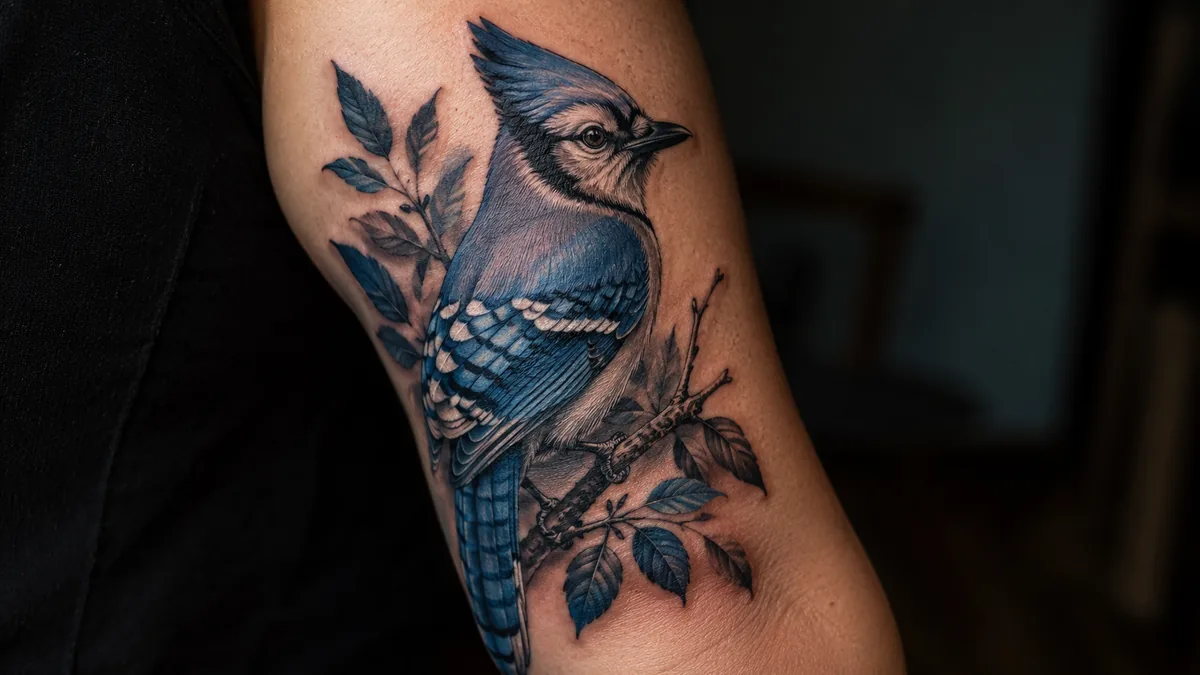
Blue jays are built for color work. That iridescent blue, the black necklace marking, the white face, the barred wings: there’s a lot of visual information packed into a small bird. Neo-traditional and new school styles let you push the saturation and exaggerate the shapes. The result is bold, graphic, and reads from across the room. Solid black outlines with heavy fill hold up well long-term.
Fine line and black and grey versions are popular too, especially for a softer or more delicate look. A whip-shaded grey wash with fine linework can look clean on smaller placements like the wrist or inner arm. Just know that very fine detail on feather texture can feather out over time, especially in high-movement zones. Talk to your artist about line weight before committing to a hyper-detailed design.
Color vs. Black and Grey: Which Holds Better
Color blue jays are stunning when done right. Saturated cobalt and royal blue with good contrast in the black markings will pop hard and stay readable for years if the artist lays the pigment solid and the client follows aftercare. Avoid muddy mid-tones in the blue. You want depth, not flat color. A good artist will layer the blue to get that natural iridescence without it washing out.
Black and grey blue jays trade the wow-factor of color for longevity and versatility. Grey wash holds cleaner over time than light blues in certain skin tones. If you’re placing the piece somewhere that gets a lot of sun exposure, arms and hands especially, black and grey is the safer long-game bet. The bird still reads. The markings are distinctive enough that you don’t need color to identify it.
Placement: Best Spots and How the Tattoo Ages
The blue jay works across a wide range of placements. The upper arm, shoulder, chest, and thigh are all low-wear zones where detail holds well. A perched or mid-flight blue jay fits naturally on the forearm too, though that’s a higher-wear zone so keep the lines bold enough to stay crispy after a decade. Back placement gives you room to go bigger with a full scene, branch, nest, or background elements.
Ribs, inner bicep, and sternum are spicy placements for this one because you’re working near bone. They look incredible but come with real discomfort during the session. The hands, fingers, and neck are high-wear and prone to fading fast, so fine line blue jays in those spots need touch-ups. A solid, well-packed color piece with clean black outlines will outlast a delicate fine-line version in any high-movement area.
Who Gets This Tattoo and How to Make It Personal
Blue jay clients tend to be people who’ve had to find or defend their voice. Teachers, mothers, advocates, people who’ve come through situations where they were talked over or dismissed. The bird’s energy matches that. It’s also popular with bird enthusiasts who want something with genuine visual impact rather than a generic sparrow or swallow.
Making it personal is straightforward. Add the bird’s habitat, oak branches, acorns, fall leaves, and you’ve got something rooted in place. Pair it with specific colors tied to a person or a memory. Put it mid-flight to suggest momentum or perched to suggest watchfulness. The pose alone changes the whole tone of the piece. Bring reference photos of real blue jays to your consultation. The more visual info your artist has, the more accurate and personal the design gets.