The clover tattoo is one of those designs that looks simple but carries real weight. Most people immediately connect it to luck, but there’s more going on depending on if you’re looking at three leaves or four, how it’s rendered, and what the person wearing it brought to the table.
Three-leaf or four-leaf, green or black and grey, tiny fine-line or bold traditional, the clover says something specific. This is what it actually means, where it comes from, and how to wear it well.
Core Meaning: Luck, Hope, and More
The four-leaf clover is the heavy hitter. Each leaf carries a traditional meaning: faith, hope, love, and luck. That’s the reading most people know, and it’s the reason this is one of the most requested good-luck tattoos in any shop. People get it before a big life change, after surviving something rough, or just because they want a daily reminder that fortune favors the bold.
The three-leaf shamrock sits in a different lane. It’s tied to Irish heritage and St. Patrick’s use of it to explain the Holy Trinity. Faith, hope, and love again, but without the luck angle. Both designs are rooted in real, documented tradition. Neither one is made up.
Irish and Celtic Roots
Three leaves honor where you came from. Four leaves change where you're going.
The shamrock is the national symbol of Ireland. St. Patrick used the three-leaf clover in the 5th century to illustrate the concept of the Holy Trinity to the Irish people. That connection is legitimate history, not folklore invented for gift shop merchandise. For anyone with Irish ancestry, a shamrock tattoo is a genuine cultural marker, not just a trendy botanical piece.
Celtic knotwork versions of the clover push that heritage angle further. The knot-integrated shamrock shows up in traditional Irish tattooing and connects to broader Celtic symbolism around eternity and interconnection. If you want that lineage to read clearly, a knotwork treatment communicates it better than a plain outline.
Four-Leaf Clover: The Luck Symbol
Finding a four-leaf clover in nature is rare, roughly 1 in 5,000 plants. That rarity is exactly where the luck association comes from. It’s not spiritual in the same way the shamrock is. It’s practical superstition, the kind humans have carried forever. A tattoo of one says you’re either someone who believes in fortune or someone who’s decided to claim it.
The fourth leaf traditionally represents luck, added onto the faith, hope, and love of the three-leaf version. Some readings also tie it to God’s grace. Different sources vary on that last point, so don’t let anyone tell you there’s one single definitive meaning. The core is luck. Everything else is personal.
Design Variations and Styles
Traditional American style clover tattoos hit bold, with thick black outlines, solid green fills, and clean saturated color that reads from across the room. That style ages the best. Bold will hold. Fine-line single-needle clovers look incredible fresh but require a skilled hand, and they need a low-wear zone to stay crispy long-term. Watercolor treatments are popular but the color migration over time is real.
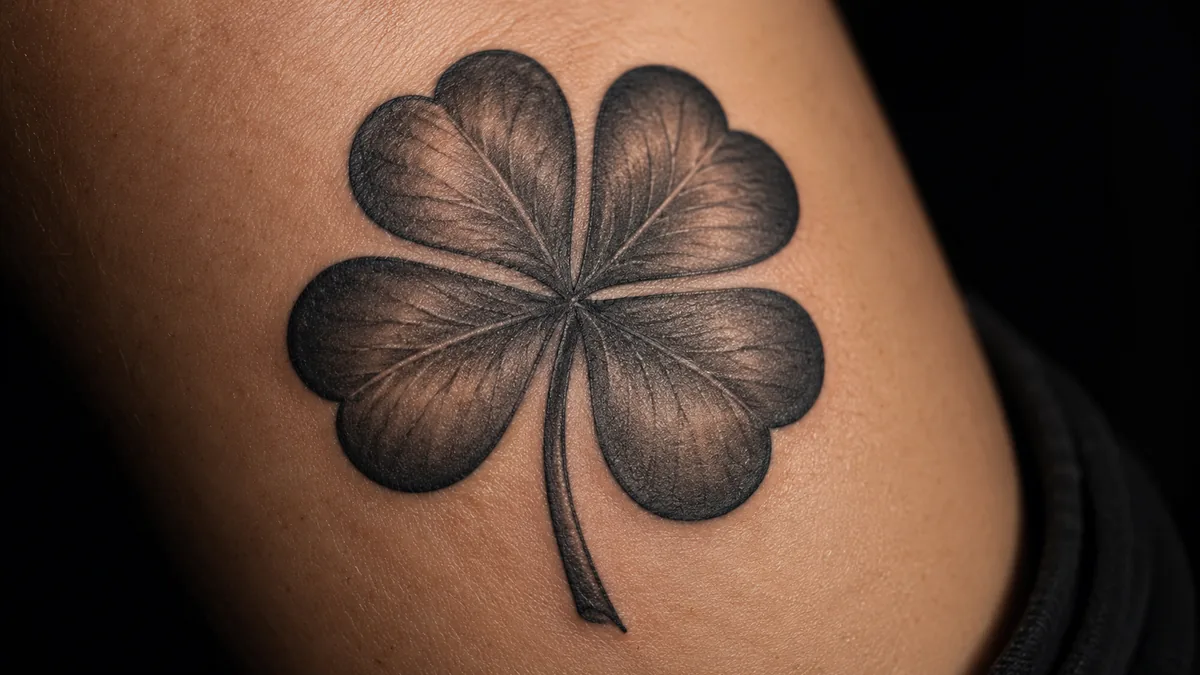
Geometric and minimalist versions, usually single-needle black ink, are all over right now. They look sharp on wrists and ankles but watch for blowout on thinner skin. Illustrative botanical styles with detailed leaf veining and shading are another strong direction, especially in black and grey, where whip shading gives the leaves real dimension without needing color.
Color vs. Black and Grey
Green is the obvious choice for a clover, and a well-saturated traditional green holds up better than people expect if it’s packed in properly. The problem is undersaturated green, which fades to a murky yellow-grey after a few years in the sun. If you’re going color, go bold or go home. Soft pastels on a clover are going to look tired within five years.
Black and grey is a solid alternative that sidesteps the color fade issue entirely. A black and grey clover leans more botanical and refined, less Irish pub, which some people prefer. It also fits more placement options without clashing with surrounding tattoos. For fine-line styles, black ink is almost always the smarter call over color unless you’re committing to frequent touch-ups.
Placement and How It Ages
Small clovers do well on the wrist, inner arm, ankle, and behind the ear. Wrists and ankles are high-wear zones, which means fine detail will soften faster there from sun exposure and friction. If you’re going fine-line, the inner bicep or the sternum area gives it the best shot at staying clean. Behind the ear is cute but spicy, and the skin is thin, so keep the design simple.
Larger clover pieces, like a bold traditional shamrock with banner or a full botanical illustration, work well on the forearm, calf, upper arm, or thigh. These areas have more real estate and the skin heals nice. A four-leaf clover with detailed shading needs enough space to breathe or the leaves visually compress over time and the design loses definition.
Who Gets Clover Tattoos and How to Make Yours Personal
Clover tattoos cross every demographic. Irish-Americans getting a shamrock to honor ancestry. Gamblers and risk-takers claiming the four-leaf luck symbol. People coming through hard times who want a permanent reminder that things can turn around. Athletes who are superstitious about game day. The meaning bends to whoever is wearing it, which is part of why it stays popular.
To make it yours, think about what you’re actually putting into it. A shamrock with your family’s county of origin, birth year, or a short phrase in Irish underneath is entirely different from a generic flash piece. Adding a banner, integrating it into a larger sleeve, or pairing it with a meaningful date gives the design a story. A clover on its own is clean and classic. A clover with context is a real tattoo.