
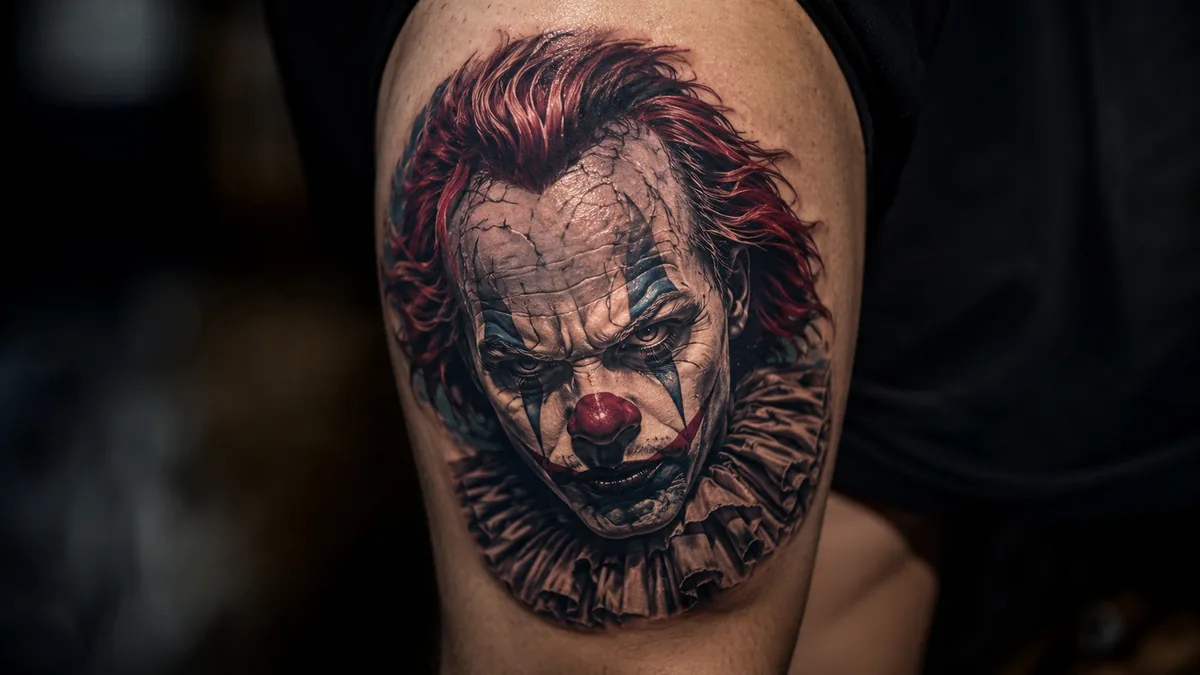
A clown tattoo isn’t a joke. It carries serious weight, and most people who get one know exactly why. The core tension, laughing on the outside while something else runs underneath, is what pulls people to the image. It’s one of the most layered symbols in tattooing.
That duality is the engine of every clown tattoo. Happy or sinister, traditional or horror, the design asks a question about performance and identity. What face do you show the world, and what’s sitting behind it? That’s why this image hits differently than a lot of flash.
Core Meaning: Duality and Masking Pain
The most common reading of a clown tattoo is simple: hiding pain behind a smile. Laugh now, cry later. That phrase has been tattooed a thousand different ways, paired with comedy and tragedy masks, or just a grinning clown face with tears running down one cheek. It resonates with people who’ve had to keep performing when life was hard.
Beyond that personal layer, it also represents transformation and the space between two truths. A person can be joyful and broken at the same time. The clown holds both without resolving the tension. That’s emotionally honest, and tattoos that tell the truth tend to hit harder and age better in the culture.
The Laugh Now Cry Later Tradition
The clown does not perform happiness, it performs survival.
Laugh now, cry later tattoos, often showing two clown faces side by side, have roots in Chicano tattooing culture going back decades. They carried themes of street life, doing time, and the duality of surviving in hard circumstances while keeping your composure. The imagery moved from prison tattoos into broader tattoo culture and stuck because the message is universal.
You’ll see these rendered in bold Chicano blackwork with crisp lettering, or in full color traditional American style with thick outlines and saturated fills. Both read strong from across the room. The bold will hold over years on skin, which is part of why that classic style keeps getting chosen for this subject matter.
Clowns as Symbols of Dark Humor
Not every clown tattoo is heavy. Some people get it as a straight-up embrace of dark humor, the idea that life is absurd and the only sane response is to laugh at it. A sinister or creepy clown, Pennywise style or original horror clown imagery, signals that the wearer doesn’t flinch from uncomfortable things.
This reading has grown since horror clown imagery went mainstream in the 80s and 90s. It’s become its own lane. These pieces tend to go bigger, full sleeve panels or chest pieces, because the detail in a well-executed horror clown, the texture of face paint, the exaggerated features, needs room to breathe and show off clean rendering.
Design Variations: From Traditional to Illustrative
Traditional American clown tattoos use bold black outlines, limited palette, and exaggerated features. They heal clean, stay readable for decades, and suit smaller formats well. Neo-traditional builds on that with more line weight variation and richer color work. Both styles handle the clown subject matter well because the bold graphic quality of the image plays to their strengths.
Black and grey realism is where horror and sad clown tattoos really shine. Whip shading on a clown face can produce incredible texture on the greasepaint, the tears, the costume details. Fine line clown tattoos exist but they’re a gamble long-term. Fine linework in expressive, detailed faces tends to spread over years on skin, and a blurry clown face loses its whole impact.
Color vs. Black and Grey
Color clown tattoos pop hard when they’re fresh. Saturated reds and yellows on a traditional clown read from across the room. The catch is maintenance. Color fades faster than black and grey, especially in high-wear zones like hands, fingers, or the back of the arm. If you want longevity, black and grey with strategic spot color holds up better over a lifetime of sun exposure and skin aging.
Black and grey clown portraits, especially large format, give an artist room to show real skill. The contrast between deep blacks and clean skin breaks, especially in the face, is what makes the piece. A solid black and grey clown heals nice, ages well, and looks just as intentional at year fifteen as it did at week two. Ask your artist which approach suits your skin tone too, that matters.
Placement and How It Ages
Forearm and upper arm are the go-to spots for clown tattoos. The forearm gives the face room and stays visible, which suits a piece you want people to see and respond to. The upper arm and shoulder handle larger compositions, and the skin in these zones holds ink well with minimal distortion over time. Chest placements work for big horror clown scenes with a lot of environmental detail.
Avoid small, fine-detail clown faces on the hand, finger, or inner wrist if you want them to stay crispy long-term. Those areas are spicy to tattoo and they’re high-wear zones, meaning the ink breaks down faster. A clown face that loses its line definition just looks muddy, and the whole emotional read of the piece depends on that face being clear. Size up if you can.
Who Gets Clown Tattoos and How to Make It Personal
People who’ve been through it tend to be drawn to clown imagery. Performers, comedians, people who’ve dealt with depression while keeping a public face, artists who live in contradiction. It also attracts people who just love horror culture or classic flash with no deeper agenda, and that’s equally valid. A tattoo doesn’t have to carry your whole biography to be worth getting.
To make it personal, think about which version of the clown speaks to you. Sad, sinister, joyful, absurd. Bring reference images and talk to your artist about what you want the face to communicate. A great tattoo artist can dial the expression to hit exactly the tone you want. The difference between a clown that looks tragic and one that looks threatening is subtle, and that nuance is worth talking through before the machine runs.









