
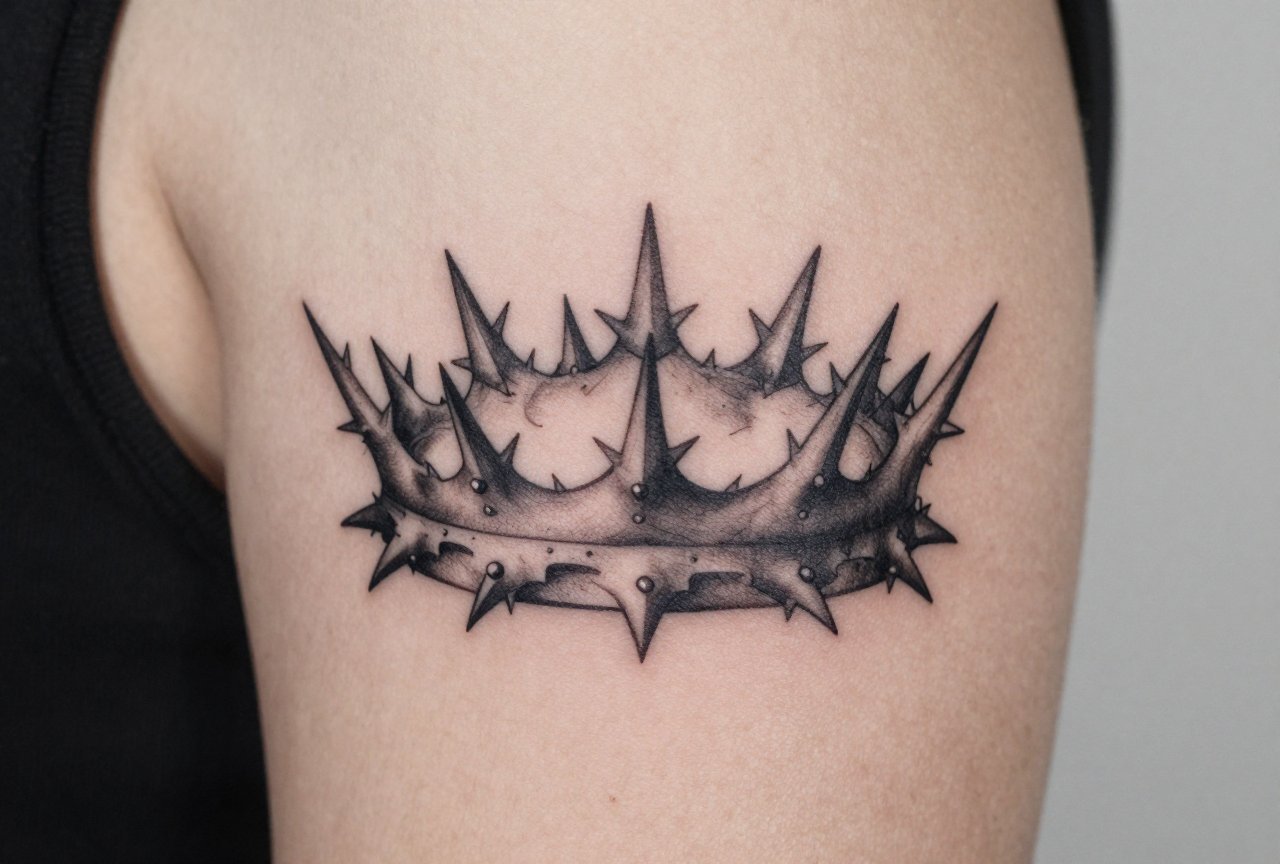
A crown of thorns tattoo primarily represents the suffering and sacrifice of Jesus Christ in Christian tradition, but it has evolved to symbolize personal endurance, spiritual devotion, and the strength to overcome hardship. For many wearers, it serves as a permanent reminder of faith tested through pain, or of their own capacity to endure and transcend difficult chapters. The imagery carries weight across religious and secular contexts alike, making it one of the most emotionally layered designs in tattoo art.
Symbolism & History
The crown of thorns originates from the biblical account of Christ’s crucifixion, where Roman soldiers placed a woven circle of thorns upon his head to mock his claim of kingship. In tattoo art, this symbol has traveled far beyond its religious roots:
- Christian devotion: Believers often choose this design to express gratitude for salvation, commemorate spiritual rebirth, or acknowledge Christ’s sacrifice as central to their identity.
- Suffering and redemption: The thorns represent pain that precedes transformation, a narrative arc that resonates with anyone who has endured trauma, addiction, loss, or profound struggle.
- Mortality and humility: Unlike a golden crown signifying earthly power, the crown of thorns inverts regal imagery, embracing vulnerability and the finite nature of human existence.
- Art historical lineage: The motif appears in centuries of religious painting, sculpture, and stained glass, giving tattoo artists a rich visual tradition to draw from.
Historical tattooing among Christian Coptic communities in Egypt and Ethiopia occasionally incorporated sacred imagery, though the crown of thorns gained mainstream popularity in Western tattooing primarily from the 1990s onward as religious and memorial tattoos expanded beyond traditional demographics.
Common Variations & Styles
Tattoo artists interpret the crown of thorns through diverse aesthetic lenses, each carrying subtle shifts in emphasis:
- Realistic black and grey: Detailed thorns with blood drops or shadowing emphasize the visceral reality of suffering, often paired with portraits of Christ or scripture references.
- Minimalist line work: A simple circular band of thorns reduces the symbol to its essential form, suited for smaller placements and understated personal reminders.
- Integrated with roses: Combining thorns with blooming roses creates tension between pain and beauty, death and life, popular in neo-traditional and illustrative styles.
- Wrapped around the arm or leg: A three-dimensional rendering that appears to encircle the limb, transforming the wearer’s body into the bearer of the crown.
- With script or names: Dates, Bible verses, or memorial text anchor the symbol to specific personal narratives or lost loved ones.
- Geometric or abstract: Some artists deconstruct the crown into angular patterns or dotwork, appealing to those who want symbolic resonance without literal religious representation.
Best Placements
The crown of thorns adapts to numerous body locations, with placement often amplifying its meaning:
- Forearm or wrist: Highly visible, serving as a constant personal reminder and conversational entry point about faith or survival.
- Bicep or upper arm: Allows for detailed wrapping effects; the circular form naturally complements the muscle’s cylindrical shape.
- Chest or over the heart: Emphasizes devotion and emotional centrality, often chosen for memorial or deeply spiritual pieces.
- Calf or thigh: Accommodates larger, more elaborate compositions with additional elements like crosses, angels, or landscape backgrounds.
- Behind the ear or neck: Intimate placement for smaller, simpler designs; the proximity to the head echoes the crown’s original placement on Christ.
- Hand or finger: Emerging trend for small band-style crowns, though these require more frequent touch-ups due to skin regeneration rates.
Who Chooses This Tattoo / Personal Meanings
The crown of thorns attracts a remarkably diverse range of individuals, united by the theme of struggle rather than uniform religious affiliation:
- Reformed or recovering individuals: Those who have survived addiction, incarceration, or destructive life patterns often select this symbol to mark their transformation through suffering.
- Military and first responders: Some choose it to process experiences of sacrifice, moral injury, or the weight of protecting others at personal cost.
- Grieving family members: Parents who have lost children, or spouses mourning partners, sometimes adopt the crown as an emblem of bearing pain with grace.
- Devout practitioners: Christians across Catholic, Protestant, and Orthodox traditions use it as public testimony of faith.
- Spiritual but non-religious: Individuals drawn to the archetype of the wounded healer or the hero’s journey through ordeal find secular meaning in the thorns.
- Artists and musicians: The symbol’s dramatic visual power and cultural resonance in rock, metal, and hip-hop aesthetics attract creative professionals.
Similar Symbols
Those drawn to the crown of thorns often explore related imagery that shares thematic DNA:
- The Sacred Heart: Another Catholic emblem of suffering love, often depicted with thorns encircling the heart itself.
- Phoenix or ouroboros: Symbols of death and rebirth cycles, appealing to similar narratives of destruction preceding renewal.
- Broken chains or shackles: More explicit liberation imagery that pairs well with the crown for those emphasizing freedom from past pain.
- Stylized crosses: From simple Latin forms to ornate Celtic or Russian Orthodox designs, cross tattoos share the crown’s devotional territory.
- Skulls with roses: Memento mori tradition addressing mortality and beauty’s fleeting nature, sometimes preferred by those seeking less explicitly Christian symbolism.
- Barbed wire: A more contemporary, secular equivalent suggesting boundaries, protection, or confinement survived.
Final Thoughts
The crown of thorns endures as tattoo imagery because it refuses easy interpretation. It is simultaneously about defeat and victory, humiliation and exaltation, the particular and the universal. Whether rendered in photorealistic detail or a single elegant line, it asks the viewer to consider what burdens the wearer has carried and what meaning they have forged from that weight. For those contemplating this design, the most resonant pieces emerge when personal story and artistic tradition intersect with unflinching honesty.
Related Tattoo Meanings
- Queen of Hearts Tattoo Meaning: Power, Love Rebellion
- Queen of Spades Tattoo Meaning: Symbolism Significance
- Leaf Tattoo Meaning
- Explore all tattoo symbol meanings









