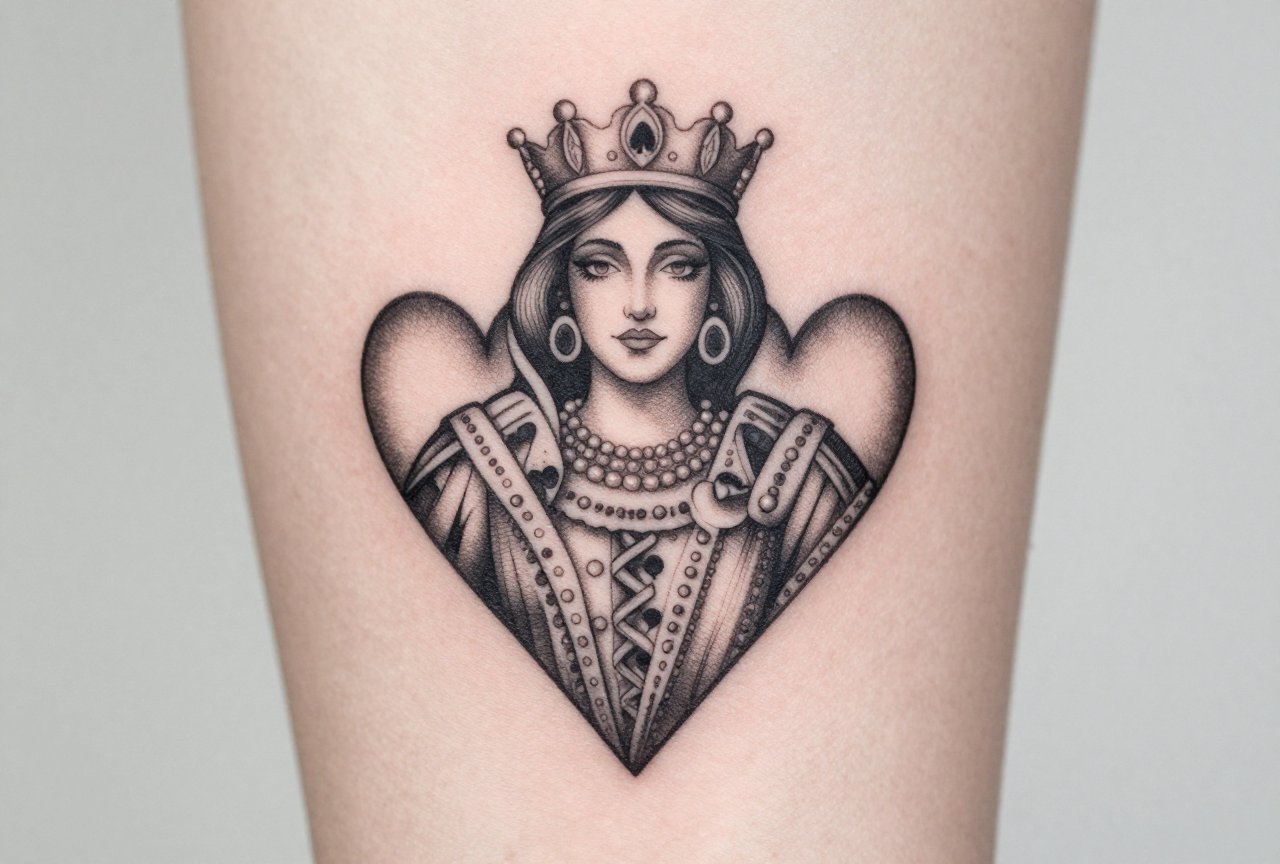
The queen of hearts tattoo most commonly represents feminine power, passionate romance, and fearless authority. Drawing from playing card imagery, this design channels the commanding presence of the only queen in a standard deck while carrying layers of meaning from literature, pop culture, and personal narrative. For many wearers, it serves as a declaration of self-worth, romantic intensity, or the courage to lead with emotion rather than suppress it.
Symbolism & History
The queen of hearts occupies a unique position in Western symbolism. In card games, she holds the second-highest face value, signifying influence and strategic importance. Her historical roots trace to medieval European court cards, where each queen represented a mythological or biblical figure; the hearts suit connected to the church and the season of spring, embedding associations with growth, renewal, and emotional life.
Literature amplified her cultural weight dramatically. Lewis Carroll’s 1865 “Alice’s Adventures in Wonderland” transformed the queen of hearts into an iconic figure of volatile, absolute power. The character’s famous “Off with their heads!” command made her a lasting symbol of:
- Untamed feminine authority that refuses to shrink itself
- The danger and allure of emotion-driven leadership
- Rebellion against rigid social hierarchies
Modern tattoo culture has reclaimed this figure from villainy to empowerment. The design often signals that the wearer owns their emotional intensity rather than apologizing for it.
Common Variations & Styles
Artistic approaches to this tattoo vary enormously, each carrying subtle shifts in meaning. Traditional American style emphasizes bold outlines, limited color palettes, and the classic portrait orientation, often pairing the queen with roses, daggers, or banners bearing names or dates. This version leans heavily into vintage gambling and sailor tattoo heritage.
Neo-traditional and illustrative styles allow for more elaborate detail: ornate crowns, flowing hair with heart-shaped accessories, or the queen holding a realistic anatomical heart instead of the standard playing card symbol. Some artists incorporate elements from Carroll’s depiction, including the heart-shaped scepter or Tudor-inspired collar and gown.
Minimalist and fine-line interpretations strip the image to essential geometry, a single heart integrated into crown imagery, or the letter Q combined with the heart suit symbol. These quieter versions suit professionals seeking meaningful but understated body art. Black-and-grey realism creates dramatic, photograph-like portraits that can resemble specific individuals, personalizing the archetype.
Best Placements
The queen of hearts adapts to nearly any body location, though certain placements emphasize particular aspects of its meaning. The upper arm or forearm provides excellent canvas for detailed portrait work and signals visible confidence. This placement historically connects to strength and action, amplifying the design’s assertive energy.
The chest over the heart location offers obvious literal resonance, creating a direct metaphor of emotional centrality. Rib placements suit elongated, full-body queen portraits following the natural vertical line of the torso. Smaller versions behind the ear, on the wrist, or along the collarbone work beautifully for minimalist or single-card designs, offering intimacy and personal significance rather than public declaration.
Thigh and calf placements accommodate larger compositions and carry distinctly feminine associations in contemporary tattoo culture, often chosen by those emphasizing the design’s gendered power aspects.
Who Chooses This Tattoo / Personal Meanings
Wearers of queen of hearts tattoos span demographics but share certain psychological profiles. The design particularly attracts individuals who have navigated relationship challenges and emerged with clarified self-worth. Common personal narratives include:
- Survivors of emotional manipulation reclaiming their right to feel deeply
- Partners commemorating passionate, committed relationships where both people maintain individual power
- Parents honoring daughters, mothers, or female mentors who modeled emotional courage
- Card players and magicians marking professional identity or lucky talismans
- Advocates for women’s leadership in traditionally male-dominated fields
The tattoo frequently appears after significant life transitions, divorces, career changes, or recovery periods. It functions as a permanent reminder that softness and strength coexist, that leading with heart requires rather than diminishes bravery.
Similar Symbols
Several related designs share thematic territory with the queen of hearts. The king of hearts tattoo offers masculine counterpart energy, though interestingly, the king of hearts is sometimes called the “suicide king” in card lore due to his sword appearing behind his head, adding melancholy complexity absent from the queen’s imagery.
Other queen cards, particularly the queen of spades, carry entirely different connotations in tattoo culture, sometimes signaling specific lifestyle or relationship preferences that the queen of hearts generally avoids. The joker or wild card tattoo represents unpredictability and outsider status, contrasting with the queen’s established authority.
Non-playing-card alternatives include crowned heart designs, anatomical heart with crown compositions, and various queen or goddess imagery from world mythologies. The queen of hearts distinguishes itself through its specifically Western cultural literacy and the layered history of the playing card tradition.
Final Thoughts
The queen of hearts tattoo endures because it refuses single definition. It is simultaneously romantic and fierce, traditional and customizable, public statement and private reminder. Whether rendered in bold traditional color or whisper-fine linework, it announces that the wearer claims their emotional life as territory worth defending, decorating, and celebrating. In an era of increasingly fluid gender expression, this design also evolves, chosen by people of any gender who identify with its core message: that power and tenderness need not be enemies, and that the heart, when queenly, commands the room.