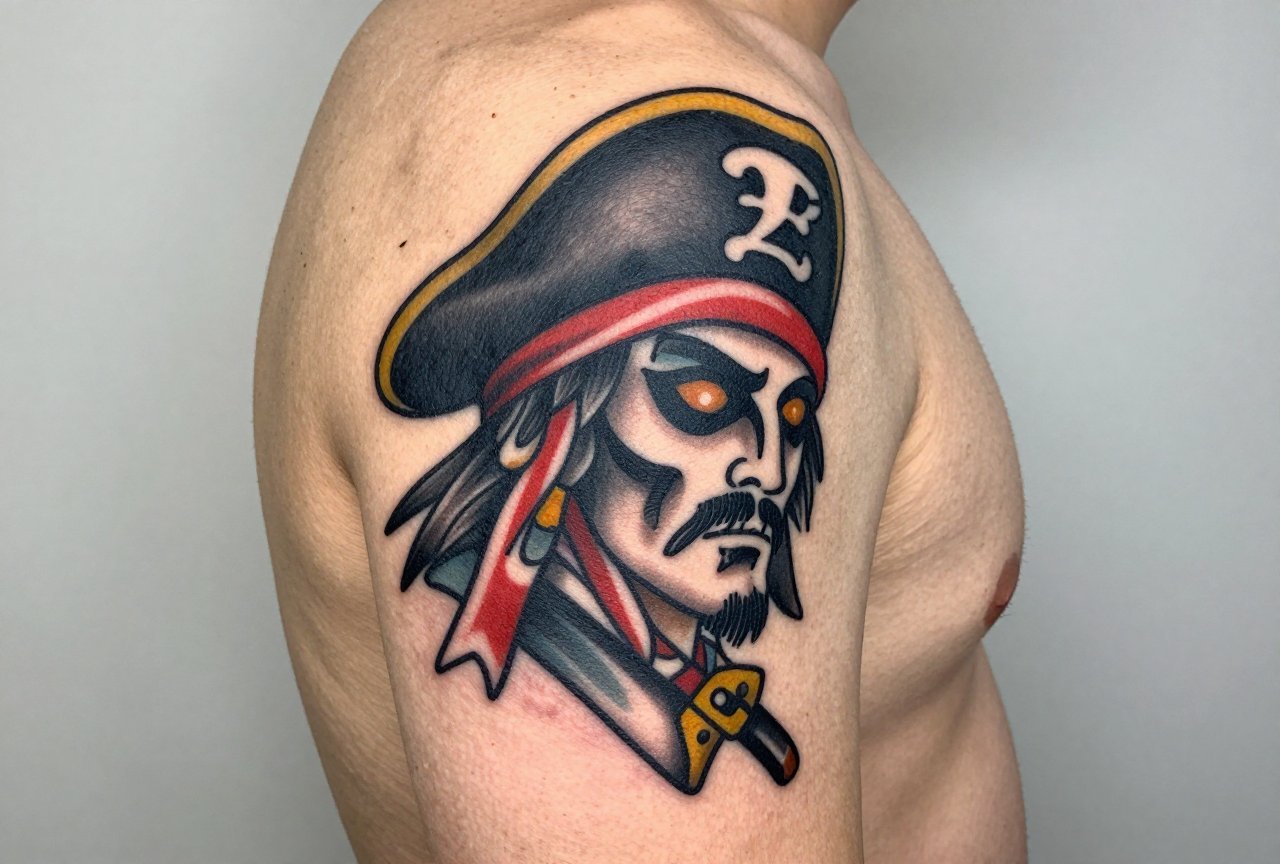
What Defines a Traditional Pirate Tattoo
Traditional pirate tattoos occupy a distinctive corner of American and European tattoo history. Bold black outlines, limited color palettes of red, green, and yellow, and iconic imagery distinguish this style from naval or merchant marine traditions. You will recognize anchors, swallows, clipper ships, and mermaids rendered with the characteristic “spit-shaded” gradients that give traditional work its weight and readability.
The visual language developed organically through centuries of maritime labor. Sailors carried designs between ports, and tattooists adapted imagery to skin with the constraints of available pigments and healing conditions at sea. What emerged was a coded system of experience, superstition, and identity that still informs contemporary traditional work.
Line Weight and Color Discipline
Authentic traditional pirate tattoos rely on specific technical choices. Heavy black outlines, typically 7-14RL depending on scale, create the structure that allows these pieces to age gracefully. Color sits within these boundaries without soft edges or realistic blending. The aesthetic demands confidence: a wobbly line or muddy green destroys the graphic impact that makes this style endure.
- Black: carbon-based or modern stable blacks for all outlines and shading
- Red: vermillion or cadmium derivatives, applied in solid fields
- Green: often malachite or chromium-based historically; modern equivalents maintain the same flat saturation
- Yellow: sparingly used, typically for highlights rather than large fills
Common Motifs and Their Origins
Specific images recur across surviving flash sheets and documented sailor tattoos. The clipper ship indicated seafaring experience, often with full-rigged vessels reserved for those who rounded Cape Horn. Swallows, typically placed on fists or chest, measured nautical miles traveled: one for 5,000 miles, two for 10,000. Anchors signified stability or specific rank, with crossed anchors denoting a boatswain’s mate.
Mermaids and hula girls reflected time in specific ports, particularly Pacific crossings. The pig and rooster combination, often tattooed on feet, derives from wooden crates that frequently floated free from shipwrecks, animals that supposedly carried similar protective luck. These images were never merely decorative; they constituted a visual resume and protective talisman simultaneously.
Historical Context Without Mythology
The connection between piracy and tattooing is often linked to the early 18th century, though documentary evidence remains scattered. Captain James Cook’s voyages brought Polynesian tattooing practices to European attention in the 1770s, yet maritime tattooing likely predates this contact. Port cities from Bristol to Nassau developed tattooing cultures before formal documentation captured them.
What distinguishes pirate-specific tradition from general maritime tattooing is the concentration of outlaw identity. Pirates operated outside naval hierarchy, so their tattoos emphasized individual achievement and crew affiliation rather than rank. The Jolly Roger, skull imagery, and weapons appear more frequently in pirate-associated designs than in naval counterparts.
Sources and Their Limitations
Surviving evidence comes from several categories: court records describing identifying marks on captured pirates, occasional mentions in captivity narratives, and the broader tradition of maritime tattooing that pirate culture participated in. Samuel O’Reilly’s electric machine patents (1891) postdate the golden age of Atlantic piracy, so earlier work was entirely hand-poked or hand-tapped.
You should approach romanticized accounts with appropriate skepticism. Many “pirate tattoo traditions” circulating online conflate Victorian naval imagery with earlier periods, or project modern traditional tattoo aesthetics backward without historical basis. The designs you execute today are necessarily interpretations, filtered through Samuel Steward’s flash, Sailor Jerry’s innovations, and subsequent traditional revivalists.
Designing for Contemporary Clients
Clients requesting pirate-themed traditional tattoos today want authentic aesthetic impact without historical reenactment. Your task involves translating visual vocabulary into compositions that read clearly on modern skin, often in locations and scales that differ from historical practice.
Placement affects readability significantly. Historical maritime tattoos favored visible locations: hands, neck, forearms. These communicated status to fellow sailors immediately. Contemporary clients may prefer upper arms, thighs, or chest pieces that accommodate larger, more complex compositions while maintaining professional flexibility.
Balancing Iconography and Originality
Direct reproduction of classic flash maintains appeal for purists. However, many clients want personalized elements within traditional constraints. Effective approaches include:
- Substituting specific vessel types that hold personal significance while maintaining rigging accuracy
- Incorporating initials or dates in banner scrollwork that respects traditional lettering proportions
- Adjusting figure poses within established compositional frameworks
- Selecting specific marine life (swordfish versus shark, particular shell varieties) that reference individual experience
The constraint of traditional rules actually supports creative problem-solving. Limited color, bold line, and restricted subject matter force solutions that read instantly and age well. Abandoning these constraints for illustrative realism sacrifices the very quality that attracts clients to this style.
Technical Execution for Longevity
Traditional pirate tattoos must survive decades of sun exposure, skin changes, and time. Pack solid blacks fully without overworking skin. Color saturation requires sufficient passes without causing excessive trauma that leads to fallout during healing. The traditional aesthetic permits some intentional “folk art” imperfection, but unplanned blowouts or patchy fills indicate technical failure, not style.
Needle grouping selection matters. 14RL or 18RL for major outlines, 7RL or 9RL for secondary details, 5RS or 7RS for color packing. Magnum shaders have limited application in strict traditional work; the style predates their common use. Whip shading with round liners creates the characteristic gradient that distinguishes traditional from neo-traditional approaches.
Aftercare and Aging Considerations
Traditional tattoos age differently than fine-line or watercolor work. The heavy black infrastructure provides structural integrity that lighter styles lack. However, improper aftercare or sun exposure still degrades color saturation and line crispness.
Advise clients to keep fresh work moisturized but not suffocated, avoiding petroleum-based products that can trap bacteria and draw ink. The thick scabbing that sometimes forms on heavy blackwork requires patience; premature picking removes pigment with the scab. Once healed, consistent SPF application preserves the contrast that makes traditional work striking.
Touch-Up Strategy
Traditional pieces typically need refreshment after 10-15 years depending on placement and sun exposure. The bold original structure makes touch-ups straightforward compared to delicate work. Plan initial applications with this in mind: slightly heavier lines than strictly necessary accommodate future refinement without appearing crude when fresh.
Building Your Reference Library
Competent traditional pirate tattooing requires substantial visual research. Collect and study original flash sheets from Bert Grimm, Sailor Jerry, and earlier maritime sources. Museum collections, particularly the Romonov collection and items held by the Maritime Museum of San Diego, provide documented historical examples.
Contemporary practitioners worth studying include those who maintain strict traditional parameters while avoiding mere pastiche. Examine how artists like Capilli Tupou or Chad Koeplinger handle classic imagery with personal voice intact. The goal is not replication but understanding: why specific proportions, specific color relationships, specific compositional rhythms achieve the immediate graphic impact that defines successful traditional work.
- Original flash sheets and acetate stencils from 1920-1960
- Documented sailor tattoos in maritime museum collections
- Contemporary traditional artists’ healed portfolio photography
- Japanese tebori and horimono references for cross-influence on American traditional development
Final Thoughts
Traditional pirate tattoos connect contemporary skin to centuries of maritime visual culture. The style’s persistence testifies to the effectiveness of its constraints: bold line, limited color, immediate readability, symbolic density. Your responsibility as a working artist involves honoring these technical and aesthetic parameters while finding space for individual expression within them.
The best traditional pirate tattoos do not merely decorate. They carry forward a visual language developed through labor, risk, and superstition, adapted to contemporary lives that still seek meaning through permanent marking. Execute with technical precision, research with genuine curiosity, and respect the tradition as living practice rather than museum piece. The clients who seek this work recognize authenticity; they will return to artists who deliver it consistently.
Frequently Asked Questions
How do I distinguish between historical pirate tattoos and naval tattoos in design?
Pirate-associated work typically emphasizes outlaw identity over institutional rank. Look for skull imagery, crossed weapons, the Jolly Roger, and crew-specific markers rather than anchors with naval insignia, crossed anchors denoting rank, or monarch-related symbols. Historical pirate work also shows less formal composition due to the absence of standardized naval tattooing traditions.
What needle configurations work best for authentic traditional pirate tattoo outlines?
Standard round liners in 7RL through 18RL depending on scale and placement. Major structural outlines demand 14RL or 18RL for the weight that ages properly. Secondary details use 7RL or 9RL. Avoid relying on magnum shaders for this style; traditional work achieves gradients through whip shading with round liners, maintaining the characteristic graphic flatness.
Can I use modern pigments while maintaining historical authenticity in appearance?
Yes. Modern stable blacks and cadmium-based reds, greens, and yellows achieve the same visual effect as historical pigments without the toxicity or instability. The aesthetic goal is flat saturation and clear color separation, not specific chemical composition. Document your palette choices to ensure consistency across multi-session pieces.
How should I handle client requests for historically inaccurate pirate imagery?
Explain the distinction between historically documented imagery and pop-culture additions with clarity rather than condescension. Offer to incorporate personal elements within traditional compositional frameworks, or execute anachronistic requests in a different stylistic approach entirely. Preserving the integrity of traditional parameters matters more than accommodating every request within a style that depends on specific constraints for its impact.