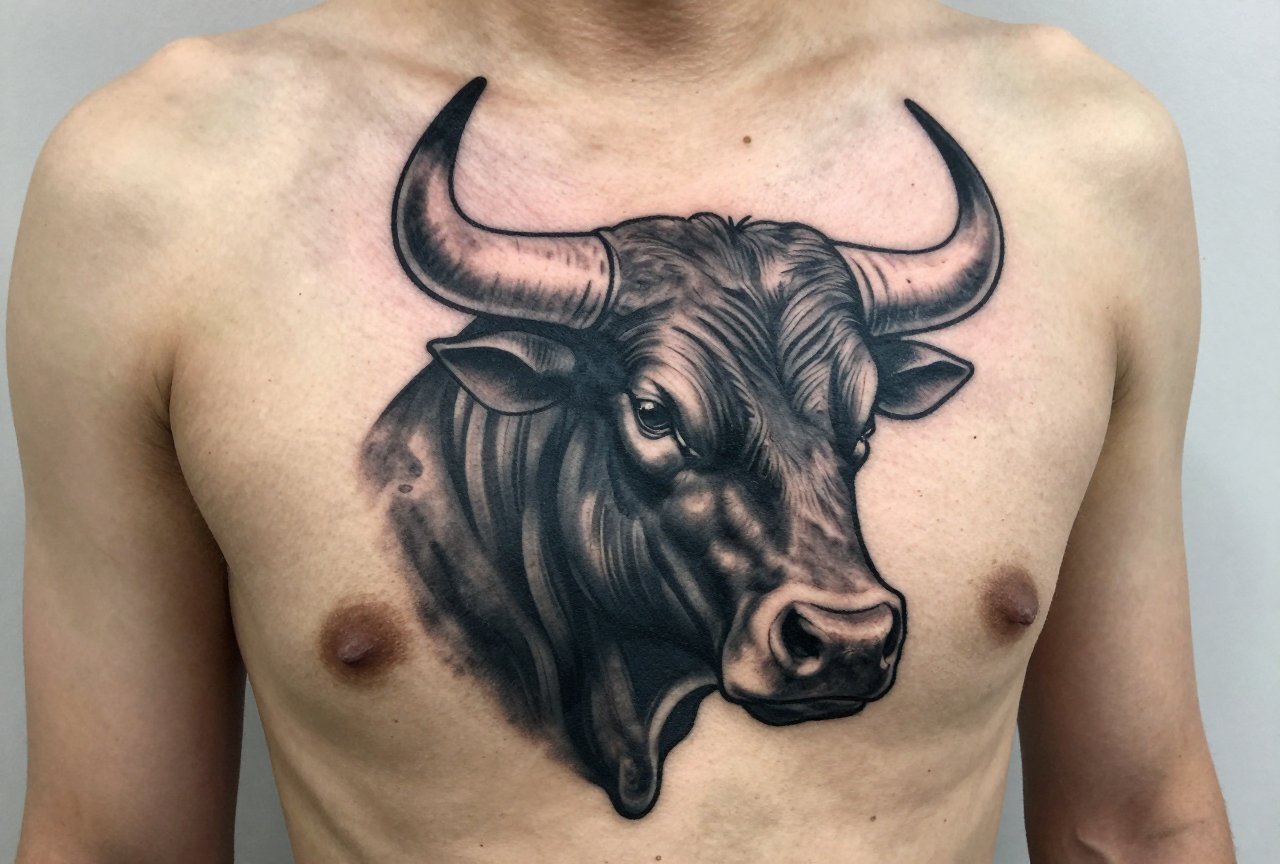
A realistic bull tattoo isn’t some flash-sheet cartoon with horns and a ring through the nose. It’s a portrait of an animal that weighs close to a ton, built from muscle and bone and that particular flat-eyed stare that makes you step back. Done right, the piece should feel like you could reach out and feel the coarse hair along the shoulder hump. Done wrong, you’ve got a muddy brown blob that looks like a deflated parade float in five years. I’ve tattooed bulls across chest pieces, calves, and full backs over fifteen years in shops from Portland to Austin, and the difference between a piece that holds and one that doesn’t comes down to understanding what realism actually means on living skin.
Origins & History
The bull as image runs deep. Cave paintings at Lascaux show aurochs with that same forward-thrusting energy. Spanish bullfighting culture, Greek myth with the Minotaur, Wall Street’s bronze Charging Bull, this animal carries weight across cultures. But realistic rendering of bulls in tattooing is a relatively recent development, tied to the rise of photorealism in the 1990s and early 2000s.
From Flash to Photo Reference
Traditional bull tattoos were bold outlines, heavy black, stylized horns. Sailor Jerry style. The shift happened when artists started working from actual photographs, studying the way light falls across a Hereford’s forehead, the texture of a Brahman’s dewlap, the specific curve of a Texas Longhorn’s span. I keep a folder of reference shots from my cousin’s ranch outside San Antonio. Live animals, not Google images. The way a bull lowers its head before charging, the dust rising, that’s the moment you want to capture.
Symbolism That Actually Matters
Clients come in with stories. A bull for their father’s ranch, for a Taurus birthday, for surviving something that required stubbornness. I tell clients: the symbolism only works if the image itself works. A weak realistic bull with heavy-handed symbolism feels like a motivational poster. The image has to stand alone first.
Key Characteristics & Motifs
Realistic bull work lives or dies in the details. The shoulder hump on a Zebu-type bull. The ridge of the spine. The way the neck muscles attach to the skull. These aren’t decorative flourishes, they’re structural realities that inform how the tattoo reads from ten feet versus ten inches.
- Eye detail: The bull’s eye is smaller and more deeply set than people expect. Overrendering it creates a cartoonish stare. I use fine single-needle work for the catchlight, nothing heavier.
- Horns: Growth rings, subtle color shifts from base to tip, the way light transmits through thinner areas. These read as realism or fail entirely.
- Nose and muzzle: Wet texture, coarse hair transition, the heavy fold of skin above the nostrils. This area needs patience. I’ve seen artists rush it and lose the whole piece.
- Hide texture: Short hair on the face, longer and coarser on the neck and shoulders. Varying needle groupings, tight 3s for fine detail, looser 7s or 9s for broader texture.
Color vs Black and Grey
This is the question I get most in consults, and my answer frustrates some people: black and grey ages better for bull work, but color can be stunning if you’re willing to maintain it.
Black and Grey Realism
The natural tones of most bulls, charcoal, rust, cream, black, translate beautifully through value alone. A Hereford’s white face reads as negative space or very light grey wash. The red body builds from dark brown-black up through mid-tones. No color needed. I’ve got a black and grey bull on a client’s thigh from 2014 that still reads clean. The key is sufficient dark anchoring. Without deep blacks, the piece goes flat and grey overall.
Color Realism
When I do color bulls, I think about what will happen to those pigments. The reds in a Santa Gertrudis? They’ll warm and possibly shift slightly orange. The creamy whites on a Charolais? Those hold but need contrast against darker surroundings. I use color for specific moments: the pink of a nose interior, the amber of an eye, the subtle blue-white where horn meets skull. Strategic, not saturated. Full color bull portraits are a commitment to future touch-ups. I make sure clients understand that.
Best Placements
Bulls need room. The image is horizontal by nature, that wide stance, the spread of horns. Vertical placements fight the form.
- Thigh: My favorite for medium-scale work. The muscle curve complements the bull’s shoulder. Enough flat area for detail, enough flow for the form to breathe.
- Chest: Classic for the charging pose, head lowered, dust kicked up. The pectoral shelf gives natural ground plane. I’ve done two full chest bulls where the horns wrap slightly onto the shoulders, dramatic, but requires planning for future work.
- Calf: The wrap potential. A bull moving across the outer calf, the tail disappearing toward the back of the knee. Clients love this for visibility. I warn about the pain near the shin bone and the Achilles.
- Back: For the serious collector. Full shoulder-to-shoulder piece with environment, dust, sky, fence line. I’ve done three in my career. Each took 20+ hours. Each was a collaboration with someone who understood the investment.
- Upper arm: Possible but tight. The cylinder shape limits the wide stance. Better for a head-and-shoulders portrait than full body.
Hands, feet, neck? I talk people out of these. The detail required for realism doesn’t hold at small scale, and the high-movement areas blur the fine work that makes the piece.
Who It Suits
Not everyone. I say this directly in consults. The bull is masculine-coded, aggressive, associated with brute force. If your energy is softer, more fluid, there might be better animal choices. But I’ve also tattooed bulls on women who grew up ranching, who’ve loaded cattle at 5 AM, who understand the animal beyond the stereotype. The tattoo should match the person’s relationship to the image, not just the image itself.
Skin tone matters for realism generally. On darker skin, I adjust contrast, push the darks deeper, use the skin’s natural warmth as a mid-tone rather than trying to build it. The bull form reads through silhouette and value range. I’ve had beautiful results on deep brown skin by emphasizing the horn curvature and the eye’s catchlight against deep blacks.
Modern Variations
The field has opened in the last decade. Artists are combining realistic bull portraiture with other approaches.
Double Exposure and Composite
Bull skull overlaid with living face. Landscape visible through the form, Texas hill country, Spanish olive groves, Midwestern cornfields. These work when the realism in each element is consistent. Nothing kills it faster than a photoreal bull with a painterly background that doesn’t match.
Geometric Integration
I’ve done pieces where the bull’s form breaks into geometric facets at the edges, or where sacred geometry underlays the realistic rendering. The contrast of organic and structured can be striking. Requires an artist comfortable in both languages.
Neo-Traditional Realism
Not quite the heavy black outlines of true neo-traditional, but borrowing the bold composition and limited palette while pushing the rendering toward photorealism. Strong graphic impact with dimensional form. This is where I find myself working most lately.
Choosing an Artist
This is the most important section. A realistic bull is not a walk-in piece. You’re looking for specific evidence.
- Animal portfolio: Not just one bull. Multiple animals, showing understanding of fur texture, eye structure, how different species carry weight differently. A great dog portrait artist might struggle with the heavier bone structure of cattle.
- Healed photos: Any artist showing only fresh work is suspect. I keep healed photos from six months, a year, two years. The smooth gradients of fresh work tell you nothing about how the piece lives.
- Reference handling: Do they work from a single photo or build composite understanding? I sketch from multiple angles, study video of movement, then compose. A bull standing in a field and a bull about to charge are different energies.
- Shop culture: Do they listen? I’ve seen artists bulldoze clients with their own vision. The best pieces come from real dialogue. I spend an hour in consult minimum for large realism work.
Budget realistically. Good realism isn’t cheap. A thigh piece from me runs 8-12 hours at my rate. Chest work, 15-25. The artist who quotes you three hours for a realistic bull is either doing something very small or very wrong. I’ve fixed enough rushed realism to know.
Final Thoughts
A realistic bull tattoo should feel inevitable on the skin, like the animal was always there, waiting to be revealed. That takes technical skill, sure, but also patience and respect for the subject. I’ve watched this style evolve from the early photo-reference experiments to something more nuanced, more personal. The best bull work I’ve seen lately doesn’t just reproduce a photograph. It captures the particular gravity of the animal, that sense of mass and will and something almost ancient.
Take your time finding the right artist. Bring reference that means something, your own photographs, your own history. Be ready for multiple sessions, for the healing process, for the piece to settle and soften and become truly yours. Realism isn’t about perfection on day one. It’s about building something that endures.
Frequently Asked Questions
How long does a realistic bull tattoo take to heal?
Expect two to three weeks for the surface to close, with full settling at six to eight weeks. I tell clients to keep it clean and moisturized, avoid direct sun, and not to judge the piece until it’s fully healed, fresh realism always looks sharper than the final result.
Will a realistic bull tattoo blur over time?
All tattoos spread slightly as skin ages, but realistic work holds if the artist builds proper contrast and doesn’t rely on extremely fine detail in high-movement areas. The dark anchors, deep blacks in the eyes, nostrils, shadowed areas, keep the form readable for years.
Can you add a background later to a bull portrait?
Yes, but plan for it from the start. I leave subtle compositional space in standalone portraits so environment can be integrated later without crowding the form. Adding background to an already-crowded piece rarely works well.
What’s the most painful placement for a bull tattoo?
The chest center near the sternum and the inner calf near the bone are toughest in my experience. The thigh outer muscle is most manageable for large pieces. Everyone’s different, but bone and thin skin over tendons are consistently rough.
Related Style Guides
- Realistic Crow Tattoos: Complete Style Guide
- Realistic Jaguar Tattoos: Complete Style Guide
- Realistic Portrait Tattoos: A Working Artist s Guide
- Explore more