I’ve tattooed a lot of religious imagery over the years, and Christ portraits consistently hit different than other subject matter. People don’t walk in asking for Jesus on a whim, there’s usually a story, a moment, a person they lost, or a faith they found. That weight matters in my chair. I’ve seen grown men shake before we start, and I’ve watched someone finally relax mid-session like they were unloading something they’d carried too long. If you’re thinking about a Christ tattoo, here’s what I’ve learned from actually doing them, not from scrolling Pinterest.
Popular Styles That Actually Work
Not every style translates well to religious portraiture. I’ve watched beautiful watercolor concepts age into unrecognizable blobs because the client wanted something “soft” for a face that needs structure. Here’s what holds up in real skin.
Black and Grey Realism
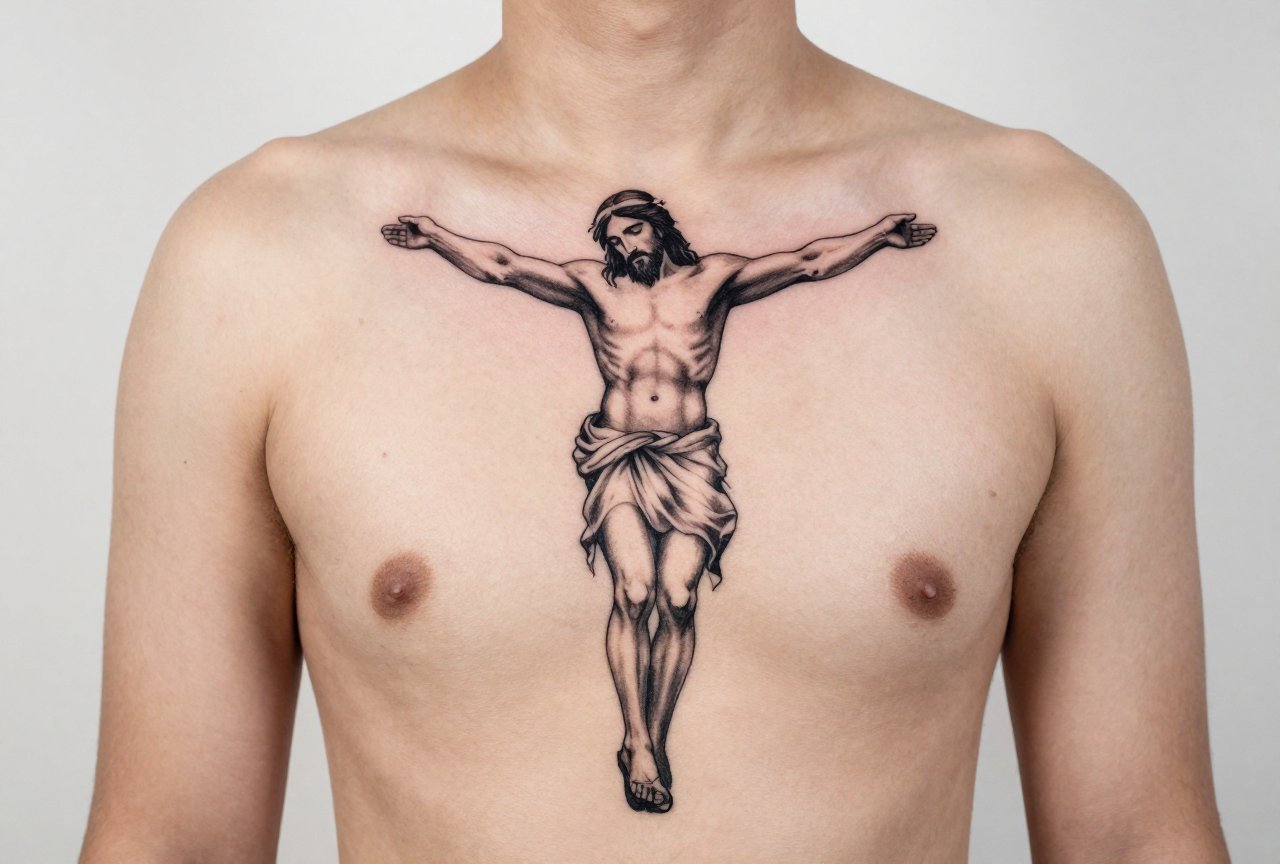
This is the bread and butter of Christ tattoos. The dramatic lighting, think Caravaggio, think those old church paintings, translates incredibly well to tattooing. I use whip shading for the softer transitions, solid black for the background depth, and really lean into the contrast. A good greywash Christ piece should look like it’s glowing from within when it heals. The trick is not going too dark too fast; I always tell clients we’ll need a second pass to push those blacks where they need to be.
Neo-Traditional and Illustrative
These work when you want something more stylized. Bold outlines, limited but saturated color palette, maybe some decorative elements like roses or banners. I’ve done Christ as the Sacred Heart with flames that wrap around the forearm, thick lines, readable from across the room. The advantage here is longevity. That black outline holds the design together as the color softens over decades. We see this a lot with clients who work outside, whose tattoos take more sun damage.
Linework and Etching Style
Delicate, crosshatched, almost like an old engraving. This is for the person who wants subtlety. I did one on a woman’s ribcage, just fine lines depicting the face of Christ emerging from negative space, no solid black at all. Gorgeous. But I was honest with her: in ten years, those hair-thin lines will soften, the image will become more suggestive than literal. She was okay with that. You have to be.
Design Ideas That Mean Something
There’s a difference between a cool Jesus tattoo and one that actually connects to your life. I push clients toward specificity.
- Crown of Thorns: Often wraps as a forearm band or circles the wrist. I’ve done these for people who’ve struggled with addiction, who describe it as bearing something painful that became sacred. The thorns need to be sharp, well-defined, blunt thorns look like bad antlers after a few years.
- Sacred Heart: The exposed heart, flames, thorns, sometimes a cross emerging from the top. Classic Catholic imagery, heavy on symbolism. I usually place these on the chest, upper arm, or thigh where there’s enough real estate for the detail to breathe.
- Christ the Redeemer silhouette: The open arms, the Rio statue reference. Simpler, more graphic, works great on calves or shoulders. Good for someone who wants the recognition without the intensity of a portrait.
- Ecce Homo (“Behold the Man”): The suffering Christ, crowned with thorns, often with a rope or reed. Powerful, somber. I’ve done these for clients who’ve lost children. The emotional sessions, the ones I remember.
- Good Shepherd: Christ carrying a lamb. Gentler imagery, often chosen by people who found faith through vulnerability rather than crisis. I love tattooing these, the lines flow, the composition feels natural.
Best Placements for Longevity
Where you put it determines how it ages as much as how you care for it. I don’t sugarcoat this.
Upper Arm and Shoulder
The classic canvas. Skin here is relatively stable, not too much stretching, not too much sun exposure if you wear sleeves. I’ve got clients with ten-year-old Christ portraits on their delts that still read clean. The muscle movement actually adds life to the image, especially with the turned-head compositions.
Forearm
Visible. Bold statement. But also: sun exposure, constant washing, more abrasion. I do a lot of forearm religious work because people want to see it, want it as a reminder, want it as a conversation. I just make sure they understand the maintenance, sunscreen, moisturizing, touch-ups eventually. The inner forearm ages better than the outer, less sun, but also less visibility. Trade-offs.
Chest and Back
For the big pieces. Full chest plates, back pieces with Christ at the center surrounded by angels or clouds. The skin here can be tricky, chests stretch with age, especially if you gain and lose weight. I tattoo slightly tighter on chests, knowing it’ll settle. Backs are more forgiving but harder to heal; you can’t see them, you can’t reach them well, and clients always underestimate how much sleeping sucks for two weeks.
Ribs and Sides
Popular, painful, and the skin moves constantly with breathing. I don’t love ultra-detailed portraits here because the distortion is real. But for simpler compositions, script integrated with image, or something more symbolic than realistic? The ribs work. Just expect a longer session. I had a guy tap out on a rib piece after three hours; we finished it six months later and the line quality was slightly different because his body had changed.
Color Choices: What I Actually Use
Most Christ tattoos I do are black and grey. That’s the honest truth. But color has its place.
When I do use color, it’s strategic. Blood reds for the Sacred Heart, the wounds, the crown of thorns. A single gold halo in an otherwise grey piece, that pop draws the eye, creates hierarchy. Skin tones are the hardest; I mix peach, raw sienna, a touch of magenta for undertones, but every person’s skin is different. The tattoo isn’t on white paper; it’s on living skin with its own pigment. I always test my flesh tones on a small area first.
Blue for Mary’s mantle if she’s included. Green for the vines in some compositions. But I warn against too much color in a portrait, you want the face to read, not the rainbow around it. I’ve seen full-color Christ pieces that looked like airbrush art from a carnival. Not the vibe.
Tips for Choosing Your Artist
This matters more than your design concept. A bad artist can ruin a good idea. Here’s what I tell friends who ask.
- Look at healed work, not just fresh photos: Every tattoo looks good the day it’s done. Ask to see something from a year ago. The greywash should still have range, the lines should still be crisp, the face should still look like a face.
- Find someone who does faces regularly: Portraiture is a specific skill. I’ve turned down Christ tattoos when I knew my realism wasn’t at the level the client needed. A good artist will be honest about their strengths.
- Bring reference, not demands: I love when clients bring a painting, a statue, a photograph that moved them. I hate when they want it copied exactly. Tattoo is translation, not photocopy. The image has to work on skin, at the size you want, in the style I work in.
- Be ready for multiple sessions: A solid Christ portrait takes time. Rushing it for a single session discount is how you get something you’ll cover later. I’ve done cover-ups of other artists’ rushed religious work; it’s depressing for everyone.
- Think about your future self: The 22-year-old getting a neck tattoo of Christ and the 42-year-old parent attending parent-teacher conferences might be different people. I don’t judge placements, but I ask the question. Not to talk you out of it, to make sure you’ve actually considered it.
Final Thoughts
I’ve tattooed Christ on bikers and pastors, on teenagers and grandmothers, on skin that’s seen prison and skin that’s seen seminary. The common thread is that people want something permanent to mark something they can’t quite explain. That’s valid. That’s the whole point of tattooing, really.
What I ask of my clients, and what I’ll ask of you: come with intention, not impulse. Find an artist whose healed work you trust. Be patient with the process. And understand that whatever you get will change, your body changes, your beliefs might shift, the tattoo will soften and settle. But done right, with honesty between you and the artist, a Christ tattoo becomes part of your story rather than just an image on your skin. That’s what we’re actually doing in the shop. Not decorating bodies. Telling stories that won’t wash off.
Frequently Asked Questions
How much should I expect to pay for a quality Christ portrait tattoo?
For a realistic Christ portrait from an experienced artist, you’re typically looking at $500-$1500+ depending on size and location. Good portraiture takes time, expect to pay for the hours, not the image. I won’t do a detailed face in under four hours, and most run longer.
Will a Christ tattoo on my forearm affect job prospects?
It depends on your field and location, but visible religious tattoos can be polarizing. I’ve had clients move them to upper arms for professional reasons. Think about your specific industry, creative fields generally care less than conservative ones.
Can you tattoo a photograph of Jesus exactly as it appears?
I can use it as reference, but exact reproduction rarely works. Photos have resolution and lighting that doesn’t translate directly to skin. I need to interpret it for tattoo, adjust contrast, simplify detail, make it readable at the size you want. Trust the translation.
How do I care for a religious tattoo during healing without it feeling disrespectful?
The care itself isn’t disrespectful, keeping it clean is respectful. I’ve had clients worry about showing the image while it’s peeling or scabbed. Cover it with loose clothing if you’re uncomfortable, but follow standard afterwash: gentle washing, thin moisturizer, no picking, no sun. The image will settle into what it’s meant to be.
More Tattoo Ideas
- 500 Designs Tattoo Ideas
- Biblical Tattoo Ideas That Actually Work on Skin
- Religious Tattoo Ideas That Actually Mean Something
- Explore more