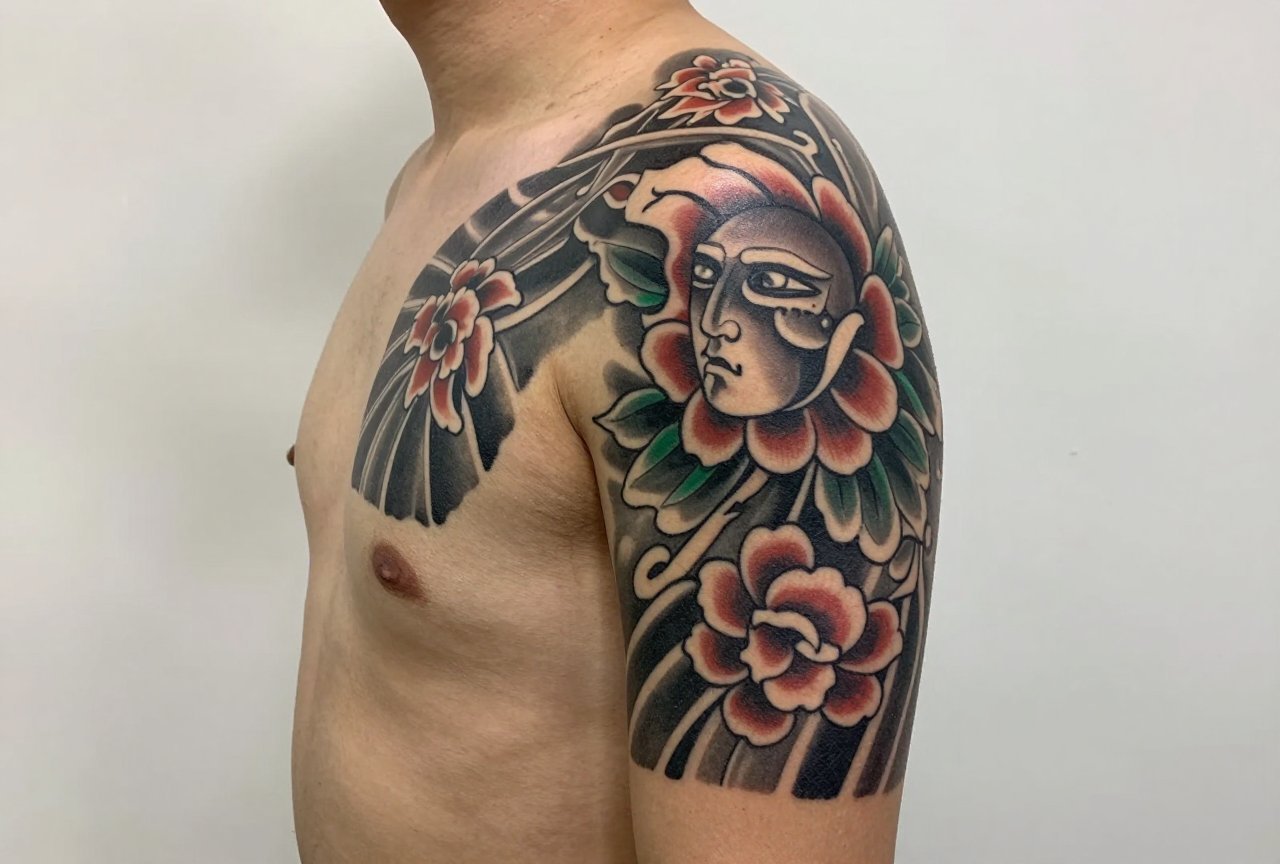
When a guy walks into my shop asking for “something traditional,” I know we’re probably talking about American traditional, bold black outlines, limited color palette, imagery that’s been knocking around tattoo culture since the early 1900s. Sailor Jerry. Bert Grimm. The stuff that looked tough on dockworkers and still looks tough today. I’ve tattooed enough eagles, anchors, and pin-up girls to know this style inside out. It’s not about being retro-cool. It’s about work that reads from across the room and stays readable for decades.
Origins & History
American traditional didn’t emerge from some art school. It came from sailors, soldiers, and circus folk getting marked by guys who learned on the job. The style crystallized in the early 20th century when electric tattoo machines became reliable enough for street shops. Norman “Sailor Jerry” Collins in Honolulu, Don Ed Hardy in California, Bert Grimm in Chicago and later Long Beach, these were working-class artists serving working-class clients. The constraints were real: limited colors available, customers who needed something finished in one sitting, skin that was going to take a beating.
Those constraints became the style’s superpower. Bold lines because fine detail blurs. Saturated reds, greens, yellows, and blacks because those were the pigments that held. Simple, readable imagery because a tattoo had to communicate something immediately, your service branch, your loves, your superstitions, your willingness to take pain.
Why It Still Matters
I tell clients: traditional isn’t nostalgia. It’s tested. I’ve seen 40-year-old sailor tattoos that still punch. I’ve seen delicate watercolor pieces from five years ago that look like bruises. The old timers figured out what works on human skin, and that knowledge compounds. When you choose traditional, you’re tapping into a century of trial and error.
Key Characteristics & Motifs
Walk into any reputable shop and you’ll recognize traditional work immediately. Here’s what defines it:
- Heavy black outlines: Usually 7-14RL needles, built up to create a border that contains the color
- Limited palette: Red, green, yellow, blue, black. Maybe purple or brown in newer work
- Minimal shading: Mostly flat color with simple “whip shading” for dimension, not smooth gradients
- Stylized imagery: Not photorealistic, graphic, almost cartoon-bold
- Visible skin breaks: Strategic negative space keeps the design from becoming a blob
The classic motifs are classics for a reason. Eagles mean freedom, patriotism, don’t-mess-with-me energy. Anchors are stability, often with “Mom” or a partner’s name. Snakes are wisdom or danger. Skulls are mortality, memento mori that sailors carried into war. Roses are love, beauty, the fleeting thing you’re trying to hold. Pin-ups are desire, the girl back home, the fantasy. I’ve tattooed all of them hundreds of times, and they still work because the symbolism is immediate and universal.
What “Traditional” Doesn’t Mean
Not every bold tattoo is traditional. I’ve had guys bring in neo-traditional or Japanese-influenced work asking for “that old school style.” Japanese has its own rules, different imagery, different flow, different color theory. Neo-traditional loosens the constraints: more colors, more detail, more realistic rendering. Both are valid. Neither is what we’re talking about here.
Color vs Black and Grey
This is the question I get most in consultations. Here’s my honest breakdown from watching these age in real skin.
Color traditional is the classic choice. Those saturated reds and greens pop against most skin tones. The yellows are tricky, some brands fade to a mustardy stain, others hold bright. I use specific brands I trust after years of seeing healed results. On darker skin, color can be stunning but needs more planning. I adjust values, sometimes lean harder on red and green over yellow, make sure the black outline does the heavy lifting.
Black and grey traditional is underrated. It’s not “less than.” It’s a different mood, tougher, more graphic, closer to the Sailor Jerry flash that was often just line drawings with minimal shading. On guys who work outdoors, who don’t want to think about sun protection constantly, black and grey ages more forgivingly. No color to fade, just black that settles to a soft grey and keeps its structure.
My advice: if you want the classic Americana look, go color. If you want something harder, more versatile with your wardrobe, more forgiving of sun exposure, black and grey won’t disappoint.
Best Placements
Traditional tattoos were designed for the body. The imagery, the proportions, the way the design wraps, these artists understood anatomy because they had to.
- Upper arm/shoulder: The classic. Flat plane, good visibility, easy to show or hide. Eagles, ships, and girls look natural here
- Forearm: Increasingly popular, increasingly visible. Great for longer designs, snakes, daggers, banners with script
- Chest: Bold statement piece. Anchors, eagles with spread wings, compasses. Hurts more, but the canvas is worth it
- Back: Big traditional pieces shine here. Full back pieces with multiple elements, traditional Japanese influence sometimes creeps in
- Hands and neck: The “job stoppers.” Traditional imagery works here because it stays readable at small sizes, small eagles, spiders, dice, hearts
I steer guys away from spots where the skin stretches and shifts too much, inner bicep right in the crease, sides of the stomach if they’re planning weight changes. Traditional can handle some distortion, but why fight your own body?
Who It Suits
Traditional doesn’t care about your aesthetic tribe. I’ve tattooed it on finance guys, construction workers, musicians, dads getting their first piece at fifty. The style communicates confidence, permanence, a certain straightforwardness.
It suits men who want their tattoo to be a tattoo, not a secret, not a delicate illustration, not a philosophical puzzle. Something that looks like it belongs on skin, that embraces the medium rather than fighting it. If you want your piece to look like a photograph, traditional will disappoint you. If you want it to look like a tattoo, there’s nothing better.
Skin tone matters less than people think. The black outline carries the design. I’ve done stunning traditional on very dark skin by leaning into contrast and choosing motifs that don’t depend on subtle color shifts. A good artist adjusts; the style adapts.
Modern Variations
The scene has evolved, and traditional has daughters, not sons, styles that carry DNA but do their own thing.
Neo-traditional keeps the bold outline but adds more detail, more color, more realistic rendering. Think illustrative rather than graphic. I do plenty of this. It’s beautiful, it’s popular, but it’s not what we’re discussing here.
Traditional with personal twists is what I see most in my chair now. A guy wants his kid’s name in a banner under a classic eagle. His dog’s portrait rendered in traditional style. His heritage flag worked into a ship’s sails. The structure is traditional; the content is personal. This is where the style stays alive.
European traditional (sometimes called “old school” in a different context) draws from British and Scandinavian flash. Slightly different color preferences, different motifs, less sailor, more working-class symbolism. Worth exploring if American imagery feels too specific.
Choosing an Artist
This is where I get passionate. Not every artist who can do bold lines should do your traditional piece. Here’s what I look for when I recommend colleagues:
- Portfolio depth: Do they have healed photos from a year out? Five years? Fresh tattoos look like everyone else’s; healed work reveals understanding
- Line quality: Consistent weight, confident flow, no wobbles or blowouts. Look at their blackwork close up
- Color saturation: Solid, flat fills without patchiness. Traditional color should look like it was painted with a brush that held enough ink
- Historical knowledge: Do they know why Sailor Jerry used certain designs? Can they explain the difference between their work and neo-traditional? This matters because it shows they respect the lineage
- Shop culture: Are they in a street shop that still does walk-ins, or a private studio that only books months out? Both can work. Traditional thrives in both environments
Ask to see their flash collection, original designs they draw for clients to choose from. Real traditional artists still draw flash. It’s part of the practice.
Final Thoughts
I’ve been in this trade long enough to see trends come and go. Biomechanical was huge in the 90s. Tribal had its moment. Watercolor and geometric had their runs. Traditional never left. It doesn’t need to be “revived” because it never died. Guys keep asking for it because it works, on the skin, in the world, over time.
If you’re considering your first piece or your tenth, traditional offers something rare: certainty. You’ll know what you’re getting. Your artist will know how to give it. And in thirty years, when you catch your reflection, you’ll still recognize the choice you made. That’s not boring. That’s integrity.
Frequently Asked Questions
How painful is a traditional tattoo compared to other styles?
The pain comes from placement and your personal tolerance, not the style itself. Traditional can actually be easier because the bold lines and solid fills mean less needle time going over the same area repeatedly. Fine detail work often hurts more.
Can traditional tattoos be covered up or modified later?
Absolutely. The bold black outlines and saturated color make traditional excellent for cover-ups. I’ve reworked plenty of old pieces, traditional’s density can hide older tattoos that lighter styles couldn’t manage.
How much should I expect to pay for a quality traditional piece?
Shop minimums typically run $150-250 for small work. Larger pieces are hourly, often $150-300 depending on the city and artist’s experience. Good traditional isn’t cheap; the skill in those clean lines and solid fills takes years to develop.
Do traditional tattoos need special aftercare?
Standard tattoo aftercare applies: keep it clean, moisturized, and protected from sun while healing. The real difference is long-term, traditional’s bold structure ages gracefully, but sun protection preserves color. I tell every client: sunscreen is your tattoo’s best friend after it heals.
Related Style Guides
- Realistic Moon Tattoos: Complete Style Guide
- Realistic Skull Tattoos: A Working Artist s Guide
- Japanese Warrior Tattoos: Style Guide
- Explore more