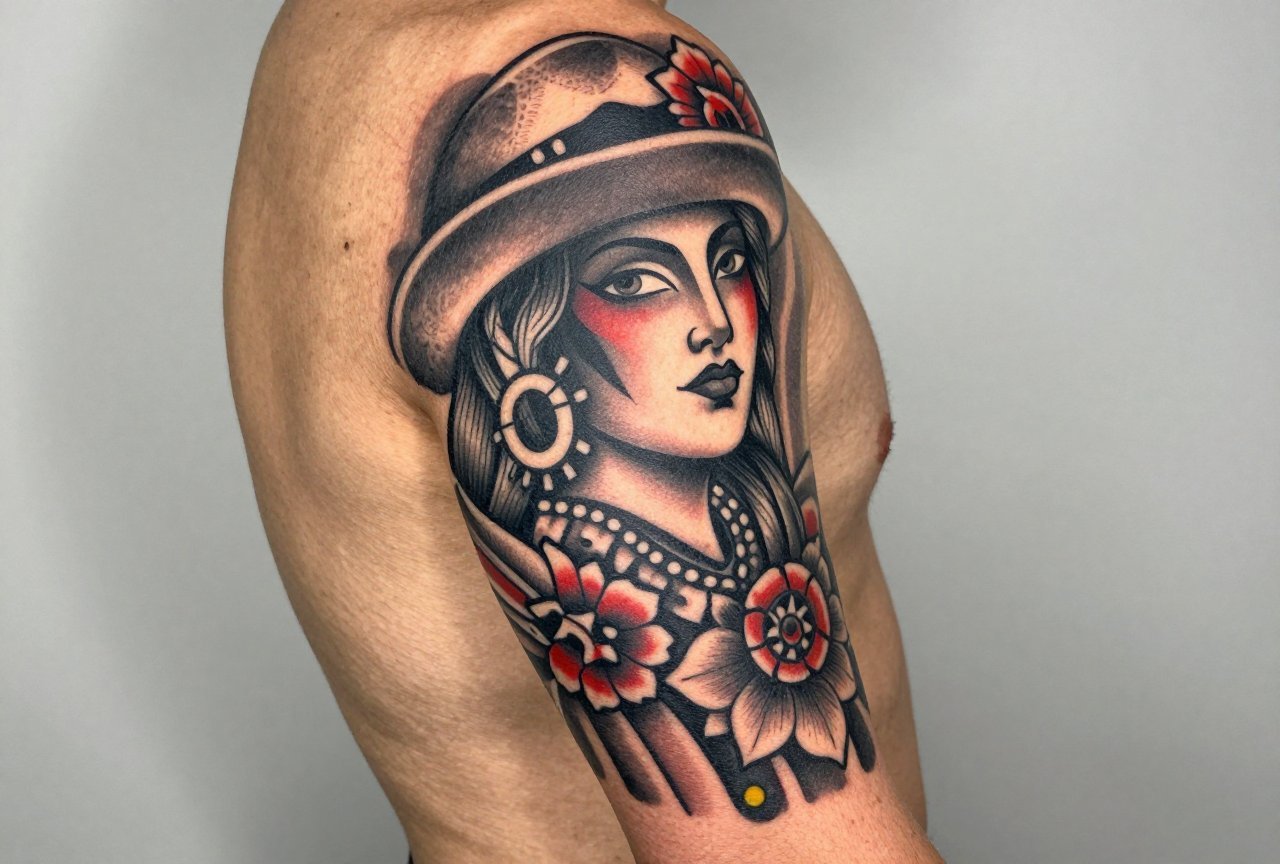
Chicano tattooing isn’t a trend you pick off a Pinterest board. It’s a visual language born in East LA barrios, refined in prison yards, and later polished in legitimate shops like the one I apprenticed in. A Chicano sleeve tells a story, religious devotion, street life, family, loss, pride, rendered in smooth black and grey with a realism that makes the skin look like aged parchment. I’ve tattooed these pieces for fifteen years, and I can tell you: when done right, they flow like liquid around the arm. When done wrong, they look like a sticker collection. This guide is straight from the chair.
Origins & History
The style emerged from Chicano culture in the 1940s and 50s, forged by Mexican-American identity in a country that often demanded assimilation. Pachucos wore their pride in zoot suits and eventually on skin. By the 70s and 80s, the aesthetic had migrated into prison tattooing, where limited supplies, ballpoint pen ink, guitar strings, homemade machines, forced artists to master greywash with nothing but black ink and water. That constraint became the style’s signature.
I apprenticed under a guy who did time in Pelican Bay. He taught me that the softness of Chicano greywork wasn’t a choice, it was survival. You had one color. You made it sing. That ethic still runs through every legitimate Chicano sleeve I’ve seen.
From Street to Shop
The transition happened in the 90s. Artists like Freddy Negrete, Jack Rudy, and later Mister Cartoon brought the style into professional shops. They kept the subject matter, religious icons, lowriders, clown faces, fine line lettering, but raised the technical execution. Suddenly you saw smooth gradients that took six hours instead of thirty minutes with a guitar string. The soul stayed. The craft grew.
Key Characteristics & Motifs
Chicano sleeves have a grammar. Break it and the piece looks touristy.
- Religious iconography: Virgin Mary, praying hands, rosaries, crosses, Christ heads. These aren’t decorative, they’re devotional. I’ve had clients cry in my chair while we tattooed a portrait of Our Lady of Guadalupe for their abuela.
- Clown faces: The laughing now/crying later duality. Smile now, cry later. Sometimes split faces, sometimes two separate masks. The line work here is everything. One wobble and the expression dies.
- Payasa girls: Beautiful women with dramatic makeup, bandanas, tears. They represent lost love, mothers, sisters, the neighborhood. The eyes are the hardest part, too dark and they look hollow, too light and they look blind.
- Lettering: Script so fine it looks like it was written with a single hair. Names, dates, neighborhoods, quotes. “Mi Vida Loca.” “South Side.” “RIP.” The letters must flow with the muscle, not fight it.
- Lowriders, dice, money, guns: Street culture rendered with reverence, not glorification. Context matters. I’ve turned down clients who wanted these symbols without understanding their weight.
The Flow Problem
A sleeve isn’t a collection. It’s a mural that wraps. The best Chicano sleeves I’ve done or seen use the negative space between images as deliberately as the ink itself. Smoke, clouds, drapery, filigree, these connect the heavy moments. Without them, you get what we call “patchwork panic.” The arm looks like a scrapbook.
Color vs Black and Grey
Here’s where I get opinionated. Traditional Chicano work is black and grey. Period. I’ve seen artists try color Chicano sleeves, and occasionally it works, Mister Cartoon’s color pieces are gorgeous, but it’s a different animal. The emotional temperature changes. Black and grey feels like old photographs, like memory, like stone saints in a dim church. Color feels like a car show.
Technically, black and grey demands more from the artist. You’re building value with wash consistency, needle grouping, hand speed. Too fast and you get peppery grey. Too slow and it muds out. I tell clients: a good black and grey sleeve looks finished at every stage. A color piece hides its flaws until the end.
Healing is another factor. Black and grey ages with dignity. The contrast softens but stays readable. Color Chicano work, especially if it uses bright reds or blues, can fade to a murky mess in ten years if the artist doesn’t understand how those pigments settle in brown and black skin specifically.
Best Placements
The full sleeve is the classic canvas, but let’s break it down.
- Full arm: Shoulder to wrist. This is the statement. Room for a large central image, Virgin, Christ, payasa, surrounded by supporting elements. The forearm gets the most viewing, so many artists place the most detailed work there, with slightly softer focus on the upper arm.
- Half sleeve: Shoulder to elbow, or elbow to wrist. The elbow-to-wrist version is what you’d see if you rolled up a long-sleeve shirt. It’s practical for clients who need coverage for work. The shoulder-to-elbow version is less common but can be stunning with the right jacket or tank.
- Three-quarter: Shoulder to mid-forearm. Leaves room for a watch or bracelet. I’ve done this for guys in corporate jobs who can cover with a button-down but still want the full experience.
Flow is physical, not just visual. The inner bicep hurts more and the skin stretches differently. The ditch, the inner elbow, can be tricky for fine line. The wrist bone creates a natural stopping point that good artists use, not fight.
Who It Suits
I’ll be direct: this style carries cultural weight. I’ve had conversations with clients who wanted Chicano sleeves because they looked “cool on Instagram.” I ask them what the imagery means to them. Sometimes they have genuine connection, grew up in the culture, lost someone, found faith. Sometimes they don’t, and I suggest styles that fit their actual story.
That said, the style has influenced global tattooing. Japanese artists, European artists, Australian artists, all have done beautiful work in the Chicano tradition, often with their own cultural overlays. The key is respect and understanding, not just technical copying.
Skin tone matters for greywash. On very dark skin, the subtle gradations can be harder to achieve and may heal slightly warmer. Experienced artists adjust their wash ratios and sometimes use a touch of white highlight to create pop. I always do a small test patch if I’m unsure.
Modern Variations
The style keeps breathing. I’ve seen Chicano sleeves mixed with Japanese irezumi background patterns, clouds and wind bars replacing traditional filigree. I’ve seen photorealistic portraits in the center with Chicano lettering and ornamental frames. Some artists are doing “Chicano new school” with bolder lines and more graphic composition.
One trend I’m watching: fine line single needle Chicano. Takes the softness to an extreme. Gorgeous when fresh, but I have concerns about how those hair-thin lines age. I’ve seen five-year-old single needle work that looks like a bruise. The traditional slightly bolder line weight, maybe 3RL or 5RL, holds better long-term.
Another variation is the “Chicano ornamental” sleeve: all filigree, lettering, and decorative pattern without figurative imagery. It’s less common but can be striking for clients who want the aesthetic without specific iconography.
Choosing an Artist
This is where sleeves live or die. Not every black and grey artist understands Chicano culture. Not every Chicano artist can execute a sleeve that flows.
- Look at healed work: Fresh photos lie. Ask for one-year-healed images. The grey should have settled, not disappeared.
- Check their lettering: Bad script kills a Chicano piece. Their letters should look like they were drawn with a calligraphy pen, not scratched with a fork.
- Ask about their background: Where did they learn? Who influenced them? Real Chicano artists can name their lineage. Freddy Negrete. Jack Rudy. Their own mentor from the neighborhood.
- Consultation quality: Do they sketch custom flow for your specific arm? Or pull a generic design? Your sleeve should fit your muscle structure, your story, your skin.
- Shop culture: The best Chicano work I’ve seen comes from shops where the style is lived, not just sold. Walk in. Feel the vibe. Listen to the music, the conversations, the respect level.
I tell clients: budget for the artist, not the session. A full Chicano sleeve from someone who knows the work runs $3,000-$8,000+ depending on size, detail, and location. That’s 20-40 hours of someone’s life. The guy offering $800 for a full sleeve is cutting corners you’ll wear forever.
Final Thoughts
A Chicano sleeve is a commitment to a visual tradition that carries blood in its history. Done right, it’s one of the most beautiful, readable, emotionally resonant styles in tattooing. Done wrong, it’s cultural tourism with a needle.
I’ve watched clients sit through thirty hours for these pieces. The ones who understand what they’re asking for, the weight, the lineage, the craft, they sit differently. They heal differently. They wear the work with a pride that shows.
If you’re considering this path, do the research. Find the artist whose healed work makes you stop scrolling. Save up. Wait for the appointment. And when you’re in the chair, remember: you’re not just getting decorated. You’re joining a conversation that started decades before you were born, in neighborhoods where pride had to be carved into skin because the outside world refused to see it.
Frequently Asked Questions
How long does a full Chicano sleeve typically take to complete?
Most full sleeves run 20 to 40 hours across multiple sessions, usually spaced 2-4 weeks apart for healing. I rarely do more than 4-5 hours in one sitting, swelling and skin trauma make the greywash harder to read after that.
Can I add to an existing patchwork arm and make it a cohesive Chicano sleeve?
It’s possible but challenging. I need to work around existing tattoos, using background elements like smoke, clouds, or ornamental filigree to bridge gaps. Sometimes we need to blast over old pieces entirely. Come in for a consultation with clear photos.
Why do some Chicano sleeves look blurry after a few years?
Usually it’s too much greywash packed too tightly, or single needle work that spread under the skin. The best aging sleeves have breathing room, contrast between dark blacks, clean mid-tones, and skin tone highlights. Dense, muddy grey everywhere turns to mush.
Is it disrespectful to get a Chicano sleeve if I’m not Mexican-American?
Respect and connection matter more than ethnicity. I’ve tattooed Chicano sleeves on people from many backgrounds who grew up in the culture, lost family to the lifestyle, or genuinely understand the history. What doesn’t work is treating it as a “style” like picking a font. If you can’t explain why these symbols matter to you, I’d suggest a different direction.
Related Style Guides
- Traditional Military Tattoos: Complete Style Guide
- Tennessee Tattoo Ideas for Locals and Transplants
- WWE Tattoo Ideas That Actually Hold Up
- Explore more