
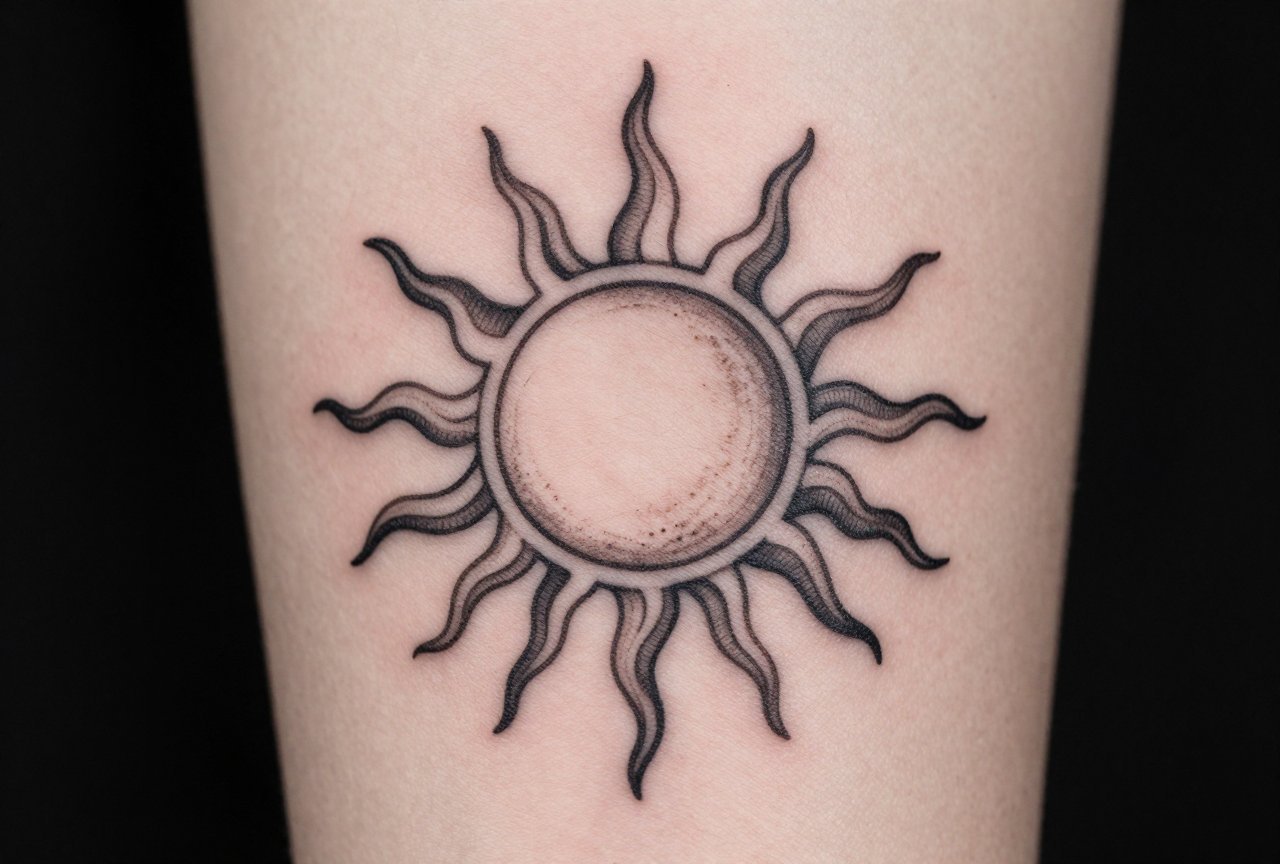
I’ve tattooed a lot of suns over the years. Rays bursting from shoulders, delicate linework wrists, full color back pieces that take six hours and leave both of us sore. Sunlight designs keep walking through the door because they mean something universal, warmth, growth, getting through the dark stuff. But here’s the thing: not every sunlight tattoo holds up. I’ve watched fine-line sun rays blur into fuzzy lines after two summers. I’ve seen solid black suns crack and fade where the skin sees the most sun. In my chair, I tell clients the truth about what works, where, and why. This guide pulls from real shop experience, not Pinterest fantasy.
Popular Styles
Style choice changes everything. A sunlight tattoo can read as spiritual, geometric, nostalgic, or purely decorative depending on how you build it. These are the approaches I see actually working in real skin, not just on Instagram.
Traditional and Neo-Traditional
Thick bold lines, limited color palette, that classic sailor vibe. Traditional suns with faces, smiling, scowling, indifferent, heal incredibly well. The heavy black outlines hold contrast for decades. I’ve got clients whose traditional suns from fifteen years ago still read clean from across the room. Neo-traditional pushes the color range and detail while keeping that structural backbone. If you want a sunlight design that won’t need constant touch-ups, this is your safest bet.
Fine Line and Illustrative
Delicate rays, single needle work, that sketchy ethereal quality. Beautiful when fresh. Risky long-term. I do these, but I warn people: fine lines in sunlight tattoos blur faster because the design elements are so thin and repetitive. Rays that start as hairline precision can soften into vague stripes. The clients who keep these looking good are religious about sunscreen. If you’re not that person, scale up the line weight or accept the fade.
- Blackwork: Solid black suns, negative space rays, high contrast. Heals tough, reads bold.
- Dotwork: Stippled gradients creating light effects. Stunning in person, tricky to photograph.
- Watercolor: Color bleeding outward from a central sun. Fun, expressive, needs a skilled hand or it looks like a spill.
- Geometric: Sacred geometry meets solar imagery. Linework precision matters enormously here.
Design Ideas
The sun isn’t one image. It’s a concept you can approach fifty ways. These are the directions I see people actually commit to, with notes on what makes them succeed or struggle.
Literal Suns
The classic circular face with radiating points. Simple, readable, iconic. I’ve tattooed these on forearms, calves, behind ears. The small ones behind ears are cute but they fade fast, friction from pillows, less ink in the skin, tricky to touch up. Bigger literal suns on thighs or upper arms give me room to build proper saturation. The face detail is where it gets interesting: angry suns, sleepy suns, third-eye suns. Each one tells a different story.
Abstract Light
Not a sun shape but sunlight itself. Rays breaking through clouds. Light refracting through a prism. Dawn light on a horizon line. These designs need careful composition or they look like random lines. I spend extra time drawing these, mapping how the light source hits, where the darkest darks anchor the piece. A sunlight beam through forest canopy, I’ve done that three times now, each one different because each person’s forest means something different.
- Sun and moon pairings: Balance, duality, relationship symbolism. Works great as matching tattoos or single compositions.
- Sunrise/sunset horizons: Color gradients are the challenge here. Yellow to orange to red to purple, if the transitions aren’t smooth, it looks like stripes.
- Minimalist line suns: Half circle, few rays, done. Clean, fast, but the simplicity leaves nowhere to hide shaky lines.
- Sun as background element: Behind a portrait, framing a scene, creating atmosphere. The sunlight becomes environment rather than subject.
Best Placements
Where you put it changes how it ages, how much it hurts, how often you see it. I have opinions based on watching these heal over years.
Upper arm and shoulder: Classic for a reason. Good skin quality, easy to work on, heals relatively predictably. The shoulder cap gives me a natural curve for a circular sun design. I’ve done dozens here. They hold.
Forearm: High visibility, which people love or regret. Sunlight tattoos here get sun exposure constantly unless you’re long-sleeved. That matters. A yellow and orange sun on a forearm will shift toward brown and dull faster than the same design under a shirt.
Ribcage and side: Painful. Stretchy skin that moves a lot. But the canvas is large and the placement feels personal, hidden. I’ve done sunlight breaking through ribcage “bars”, very literal, very effective for that client.
Back of neck and upper back: Great for larger pieces with rays extending outward. The flat plane lets me build detail. Downside: you can’t see it without mirrors. Some clients love that, others realize too late.
Ankle and foot: I try to talk people out of these for sunlight designs. The skin is thin, the healing is rough, the fade is real. If you must, keep it bold and simple. No fine rays.
Color Choices
Yellow is harder than people think. Straight yellow pigment is notoriously finicky, some brands fade to almost nothing, others heal too green or too orange. I mix my yellows, layer them, build from a warm base.
Classic Warm Palette
Golden yellow, deep orange, touches of red. The traditional solar colors. These read immediately as sunlight. In my experience, orange holds better than pure yellow. I often use orange as the structural color and highlight with brighter yellow. The red keeps it from looking like a traffic cone.
Unexpected Approaches
Black and grey sunlight. Sounds wrong, works beautifully. Negative space creates the “light,” black shading defines the rays. Heals incredibly well, no color fade concerns. I’ve also done blue-white suns, purple-pink sunsets, green-tinted aurora-style light. The sun doesn’t care what color you make it. The design just needs internal logic.
- White ink highlights: Pop on darker skin, invisible on pale skin after healing. I use white sparingly, knowing it yellows or disappears.
- Skin tone negative space: Letting your natural skin be the light source. Elegant, subtle, requires surrounding saturation to work.
- Full saturation vs. muted: Bright and punchy or dusty and vintage. Both work, but don’t mix them without intention.
Tips for Choosing
After all these years, the consultations I remember are the honest ones. Here’s what I tell people who sit in my chair asking about sunlight designs.
Think about your actual lifestyle, not your ideal one. Outdoor workers need different tattoos than night owls. The sun tattoo on a farmer’s arm ages differently than the same design on a programmer’s. That’s not judgment, it’s physics.
Consider the emotional weight, not just the aesthetic. Sunlight means hope for some people, grief for others, morning light after someone’s gone. I’ve had clients cry in my chair explaining why they need this. The design should carry that, not just look pretty.
Size matters for detail. A sun the size of a quarter can’t have twenty individual rays with shading. It becomes mud. I show people healed photos of small complex tattoos so they understand. Sometimes scaling up is the answer. Sometimes simplifying is.
Find an artist who has done sunlight work you can see healed. Fresh tattoos are lies. Six months to a year tells the truth. Ask to see healed examples. Any artist worth your money will have them or be honest about their timeline.
- Bring references but not blueprints: I need to know what you love, then I need to draw something that works for your body.
- Plan for the long heal: Sunlight tattoos with color need careful aftercare. That first month affects the next decade.
- Budget for quality: This isn’t a place for bargain hunting. Bad sunlight tattoos look like infected wounds or blurry coins.
- Be open to placement advice: The spot you want might not be the spot that serves the design. Trust the professional you chose.
Final Thoughts
Sunlight tattoos keep coming because light is something we all need to carry. I’ve watched people get them after depression, after loss, after ordinary Tuesdays when they just wanted something warm on their skin. The best ones aren’t the most complicated. They’re the ones where the person wearing them still looks at it years later and feels something. That’s the goal. Not Instagram likes, not shop portfolio glory. A tattoo that does its job quietly, every day, as you move through your actual life.
Pick the style that fits your maintenance tolerance. Place it where your life won’t destroy it. Choose colors that mean something to you, not just what’s trending. And work with someone who’ll tell you the truth before the needle starts. That’s how you get sunlight that lasts.
Frequently Asked Questions
Do sunlight tattoos fade faster because of the subject matter?
Not automatically, but they often do in practice. Yellow pigments are inherently less stable than black or blue, and people tend to place sun designs on exposed areas like forearms that get constant UV. A black sun on your back will outlast a yellow one on your hand every time.
Can I get a realistic sun tattoo that looks like a photograph?
Realism isn’t the usual approach for suns because the sun itself is basically a blinding light source, no texture to capture. What works is realistic light effects, like how sunlight actually falls on objects or skin. That takes a skilled artist and usually works better as part of a larger scene than as a standalone sun.
How do I keep my colored sunlight tattoo bright over time?
Sunscreen is non-negotiable. I tell clients SPF 30 minimum on tattooed areas, reapply every two hours if you’re outside. Moisturize regularly. And accept some mellowing, tattoos age, that’s part of their character. Touch-ups every few years can refresh the color if it matters to you.
Is a sun tattoo too common or basic?
Common isn’t the same as bad. I’ve tattooed roses, skulls, suns, names, thousands of times each. The difference is in the specific design, the personal meaning, and the execution. Your sun with your story, drawn for your body, by an artist who cares, isn’t basic. It’s yours.
More Tattoo Ideas
- Realistic Crow Tattoos: Complete Style Guide
- Knuckle Tattoo Ideas That Actually Work
- Irezumi: The Complete Guide to Japanese Traditional Tattooing
- Explore more









