
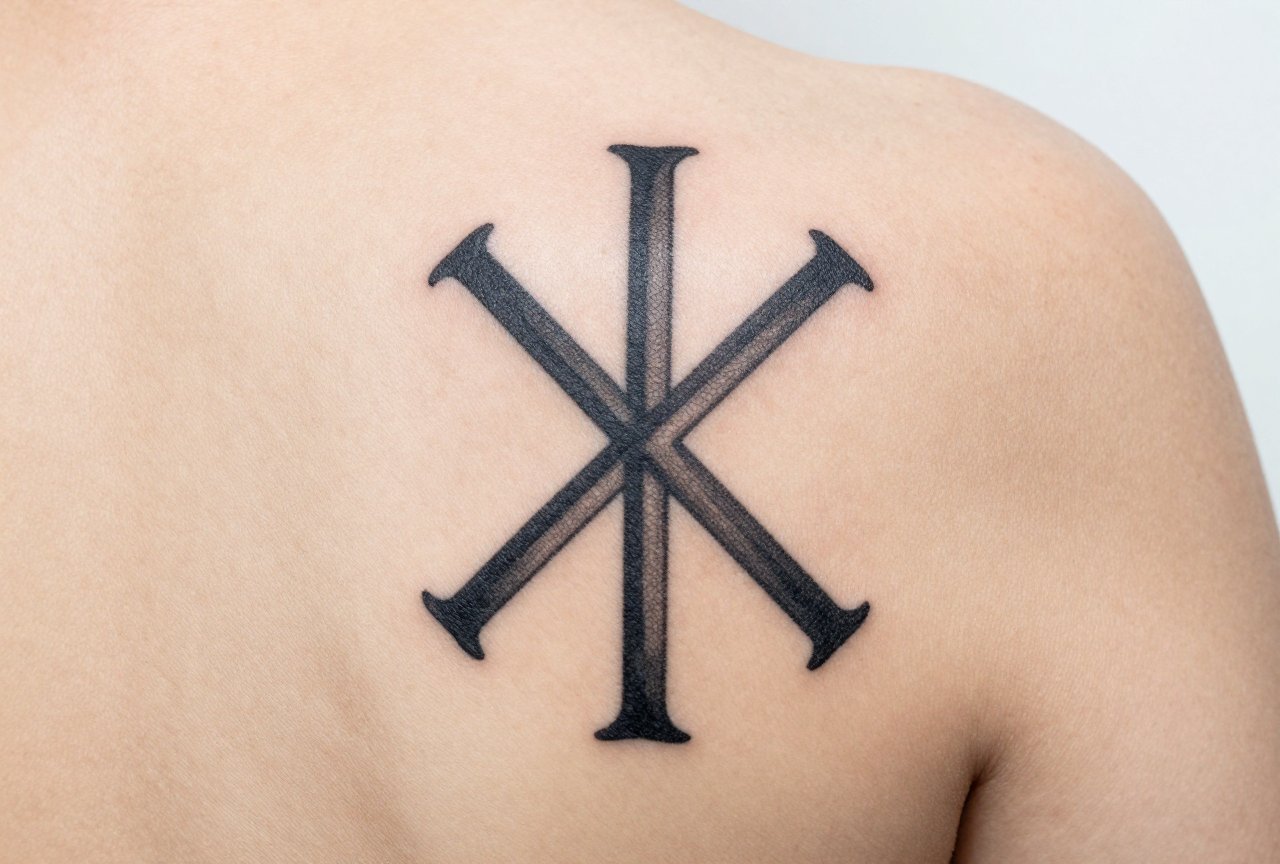
The Chi Rho tattoo carries deep meaning for Christians and history enthusiasts alike. It’s formed from the first two Greek letters of “Christ”, Chi (X) and Rho (P), overlaid to create a monogram that’s been used since the 4th century. For most people who sit in my chair asking for this, it represents personal faith, spiritual protection, or a connection to something ancient and enduring.
Symbolism & History
Where It Comes From
The story most clients reference is Constantine’s vision before the Battle of Milvian Bridge in 312 AD, “In this sign, conquer.” Whether you buy the historical details or not, the symbol’s power comes from its endurance. I’ve tattooed this on people who’ve researched early church history more than their pastors. The Chi Rho predates the cross as a Christian identifier. That’s significant. It wasn’t a tool of execution; it was a mark of identity, a secret sign among believers, then later an imperial standard.
What strikes me is how many people want the historical context, not just the religious one. They’ll bring in reference images from catacombs, from mosaic floors in Ravenna, from the Book of Kells. The symbol carries weight because it survived. Rome fell. The Chi Rho didn’t.
What It Represents Today
- Faith and devotion to Christ
- Protection and spiritual guidance
- Connection to early Christian history
- Identity within a faith community
- Perseverance through struggle (the “conquer” aspect)
I did one on a guy who’d recovered from addiction. He didn’t want a cross, too common, too many associations he wanted to leave behind. The Chi Rho felt like his own discovery. That’s the personal layer that makes this symbol work in skin.
Common Variations & Styles
Classic and Minimal Approaches
The simplest version is just the two letters interlocked. Clean lines, black ink, no embellishment. This ages beautifully. I’ve seen Chi Rho tattoos twenty years old that still read clearly because the design doesn’t depend on fine detail. The X and P have natural structure, the diagonal crossbar, the loop of the Rho. Even with some spread, you recognize it.
Some clients want it enclosed in a circle or wreath, referencing the labarum (Constantine’s military standard). Others add Alpha and Omega on either side, which completes the Christological statement. That variation gets requested by people who’ve thought it through, they want the full theological package, not just the abbreviation.
Ornamental and Decorative Styles
- Interwoven with Celtic knotwork (popular with Irish heritage clients)
- Surrounded by laurel or olive branches
- Combined with ichthys (fish symbol) or anchor
- Stone-carved texture, mimicking ancient inscriptions
- Watercolor backgrounds (though I caution against this, more below)
The stone texture approach works surprisingly well in tattoo form. We can build up graywash to mimic weathered marble, keep the edges slightly irregular. It honors the archaeological reality of the symbol. I’ve done two of these on archaeology students, actually. They wanted the patina of age.
Watercolor behind a Chi Rho? I’ve done it. I don’t love it. The symbol wants definition. Blurred color fields behind crisp lines create a tension that doesn’t serve the design. If you want color, I’d suggest limited palette, a thin red line, a gold halo effect. Restraint reads as reverence here.
Best Placements
The Chi Rho adapts to placement better than most religious symbols. Its compact geometry fits small spaces without losing impact.
- Inner forearm: Most common. Visible for personal reminder, easy to cover. The slight curve of the forearm actually complements the diagonal of the Chi.
- Behind the ear / side of neck: Small, intimate. I’ve done several here for people who want the symbol close but not broadcasting.
- Chest, over heart: The traditional placement for devotion pieces. Works well larger, with the Alpha/Omega extension.
- Upper arm / shoulder: Classic military placement, referencing the labarum carried into battle. Guys who’ve served often gravitate here.
- Ankle or wrist: Delicate, personal. More women request these placements, though that’s shifting.
One consideration I always mention: the Chi Rho contains a cross shape. Some clients with existing cross tattoos want this nearby, and we have to talk about composition. Two crosses in close proximity can compete. Better to separate them or integrate them deliberately.
Who Chooses This Tattoo / Personal Meanings
The Faithful and the Seekers
Not everyone who gets a Chi Rho is conventionally religious. I’ve tattooed this on a woman who called herself “culturally Christian, spiritually uncertain.” She wanted the symbol because her grandmother had a Chi Rho pendant from Greece. The tattoo connected her to family history, not doctrine. That’s valid. The meaning lives in the wearer.
Conversely, I’ve done this for seminary students, priests, people who can parse the Greek. They want the earliest symbol, the pre-Constantinian simplicity before Christianity became empire. There’s a purism to that choice I respect.
What Clients Actually Tell Me
- “I wanted something Christian that wasn’t a cross everyone has.”
- “It reminds me that my faith is older than my denomination.”
- “I saw it in a museum in Rome and couldn’t stop thinking about it.”
- “My sponsor had one. It meant something to him, now it means something to me.”
- “I’m a history teacher. I want to wear what I teach.”
The recovery connection comes up more than you’d expect. The “conquer” narrative resonates. I’ve had clients specifically reference wanting to “conquer” their past, not in a violent way, but in the sense of overcoming. The symbol’s military origin becomes personal metaphor.
Similar Symbols
Clients sometimes arrive confused between related early Christian symbols. Worth clarifying:
- Ichthys (fish): Earlier than Chi Rho, more secretive. Acrostic for “Jesus Christ, God’s Son, Savior.” Less formal visually, more conversational.
- Alpha and Omega: Often paired with Chi Rho, but can stand alone. Represents Christ as beginning and end.
- Staurogram (Tau Rho): Less common. Combines cross (T) with Rho. More explicitly about crucifixion. We see this in biblical manuscripts, rarely requested as tattoo.
- Chi Rho with INRI: I’ve been asked for this exactly once. The combination felt heavy, almost aggressive. We talked the client toward a simpler Chi Rho with a personal element instead.
If you’re drawn to the Chi Rho but want something more distinctive, consider your heritage. Greek Orthodox clients sometimes want the symbol in a Byzantine frame. Coptic Christians might incorporate specific color traditions. The core symbol holds, but the surrounding visual language can personalize it without diluting it.
Final Thoughts
The Chi Rho endures because it’s both specific and flexible. Two letters, one person, centuries of meaning. As a tattoo, it rewards simplicity. I’ve watched it age well on skin because the design doesn’t fight the body’s changes. The diagonal lines, the enclosed loop, these structures hold.
What I appreciate most is the intentionality of people who choose it. They’re rarely impulse tattoos. Someone who researches early Christian symbols, who wants the pre-cross identifier, who brings in photos from Roman catacombs, that’s someone who knows why they’re there. The tattoo becomes part of their thinking, not just their skin.
If you’re considering this, spend time with the historical images. Not just the polished reconstructions, but the worn ones, the faded paint on plaster, the chipped stone. The Chi Rho was born in impermanence, hidden in homes, scratched on walls, buried with the dead. Your tattoo continues that lineage. Make it honest. Make it yours.
Frequently Asked Questions
Does the Chi Rho tattoo have to be Christian?
Not necessarily. While the symbol is deeply rooted in Christian history, some people choose it for its historical significance, personal connection to early Christianity, or family heritage without active religious practice. The meaning lives in what you bring to it.
How big should a Chi Rho tattoo be to stay clear over time?
For clean aging, I recommend at least 2-3 inches in the largest dimension. The interlocking letters need enough space to maintain their distinct shapes. Too small, and the Chi and Rho blur together into an unrecognible mark.
Can I add color to a Chi Rho tattoo?
You can, but I’d keep it restrained. Gold or deep red accents work well. Avoid watercolor backgrounds or heavy color fills, they compete with the symbol’s structural clarity and tend to age poorly on a design that depends on crisp geometry.
What’s the difference between Chi Rho and a regular cross tattoo?
The Chi Rho predates the cross as a Christian symbol and carries different energy, identity and devotion rather than sacrifice and execution. It also reads as more historically rooted and less universally recognized, which appeals to people wanting something specific rather than generic.
Related Tattoo Meanings
- Cleopatra Tattoo Meaning: Power, Beauty Legacy
- Crab Tattoo Meaning: Symbolism, Styles What It Says About You
- Equal Sign Tattoo Meaning: Love, Equality Identity
- Explore more









