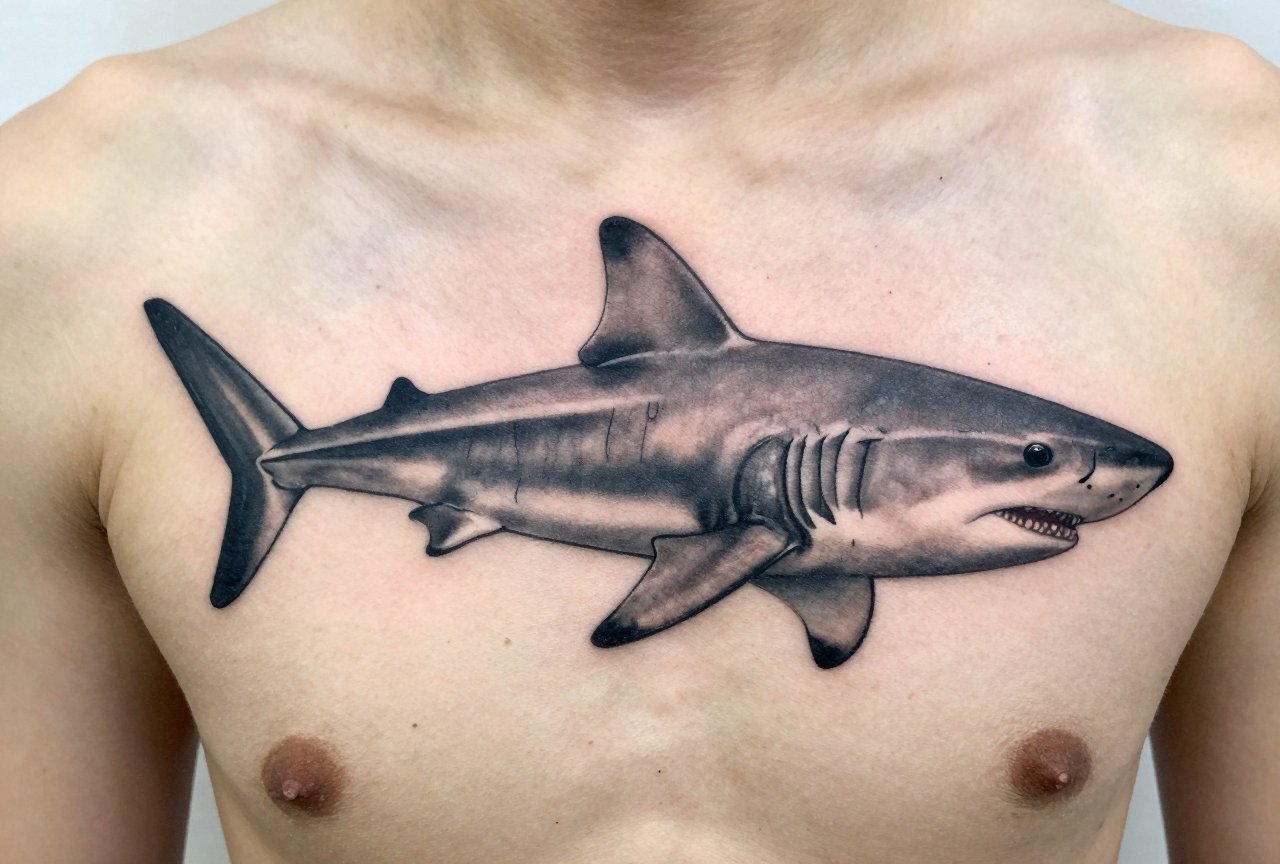
A realistic hammerhead shark tattoo captures one of the ocean’s most alien-looking creatures with photographic precision. The cephalofoil, that wide, flattened head, gives artists a dramatic subject with built-in geometry and shadow play. I’ve tattooed these on divers, marine biologists, and people who just think they’re badass. The style demands technical skill: you need someone who understands fish anatomy, water movement, and how to make grey ink read as wet, living skin rather than flat illustration.
Origins & History
Realistic marine tattoos exploded in the 1990s with the refinement of black and grey techniques in Southern California and Hawaiian shops. Before that, sharks were mostly traditional flash: bold outlines, limited shading, more symbol than portrait. The hammerhead specifically gained traction as tattoo equipment got finer, rotary machines and premium needles let us render the complex head shape without muddying it.
From Sailor Jerry to Photorealism
Old-school shark tattoos were shorthand. You knew it was a shark because of the fin, the teeth, the cartoon menace. Realistic hammerhead work flipped that script. Clients started bringing underwater photography, National Geographic spreads, drone footage of schooling scalloped hammerheads. The goal became accuracy, species-specific, even individual-specific if they had a reference from a dive.
In my chair, I’ve heard every origin story. The guy who swam with a great hammerhead in Bimini and couldn’t shake the eye contact. The woman whose grandfather was a commercial fisherman who talked about “the weird ones.” The military diver who wanted something that felt like it saw him back.
Cultural Weight
Hammerheads carry different meanings across cultures. In Polynesian tradition, sharks generally represent protection and guidance, some families trace lineage to shark ancestors. The hammerhead’s specific silhouette appears in Hawaiian petroglyphs. Realistic style doesn’t negate that symbolism; it intensifies it. You’re not wearing a sticker. You’re wearing something that looks like it could swim off your skin.
Key Characteristics & Motifs
What separates a realistic hammerhead from a generic shark piece? Specifics. The cephalofoil width varies by species. Scalloped hammerheads have that central indentation. Great hammerheads are massive, solitary, with a more rectangular head. Eye placement, actual eyes at the far edges of the cephalofoil, not where you’d expect a “normal” shark face, creates that unsettling, almost mechanical stare.
- Skin texture: Dermal denticles create a sandpaper-like surface that catches light differently than smooth fish scales. Good artists render this with stippling, fine line variation, or controlled greywash texture.
- Countershading: Dark dorsal surface, light belly. In realism, this isn’t flat color blocking, it’s gradual, influenced by water depth and light penetration in the composition.
- Gill slits: Five visible slits, positioned laterally. Their spacing and depth are species markers. Sloppy gills ruin the realism instantly.
- Mouth and teeth: Hammerheads aren’t tooth-display predators like great whites. Realistic pieces often show the slight underbite, the triangular serrated teeth only visible with the mouth open.
- Movement: The body isn’t static. Even in portrait-style compositions, there’s tension in the pectoral fins, the tail’s lateral keel, the slight asymmetry of a swimming animal.
Background elements matter too. Open water reads as negative space in black and grey, or deep blue gradients in color. Schooling fish, reef structure, surface light caustics, these ground the shark in environment rather than floating it in void.
Color vs Black and Grey
This is the conversation I have most often in consultations. Both work. Neither is automatically “better.” It depends on your skin tone, pain tolerance, budget, and the specific visual goal.
Black and Grey Realism
Black and grey ages cleaner on most people. The hammerhead’s natural coloration, grey-brown topside, pale below, translates directly. Water environments in greywash can read as atmospheric, moody, technically impressive without competing for attention. I’ve done full-back hammerheads in black and grey where the only “color” is the warm tone of the client’s skin showing through the lightest washes.
The risk: muddy mid-tones. Hammerheads have subtle value shifts. An artist who overworks the grey can flatten the cephalofoil’s dimensionality into a grey blob. Healing tends to settle contrast; what looks crisp at week two might need a touch-up at month six to restore the darkest darks.
Color Realism
Color hammerheads pop. The greenish-brown of a great hammerhead in clear water, the bronze flash of schooling scalloped sharks, the blood-orange of a sunset dive behind the subject. Color allows for environmental storytelling that grey simply can’t.
Downside: color fades, shifts, and requires more sessions. Blues and greens tend to hold; yellows and oranges need more frequent refreshing. On darker skin tones, color realism demands an artist who understands how pigment interacts with melanin, not all “realistic” color artists do. I’ve seen beautiful designs turn ashy because the artist defaulted to the same palette they’d use on pale skin.
Best Placements
The hammerhead’s lateral shape creates natural flow opportunities. The cephalofoil can wrap around a shoulder cap, follow the curve of a calf, or span across the upper back with the tail dropping toward the spine.
- Thigh: My favorite for large-scale work. Enough flat area for detail, enough muscle movement to give the shark kinetic energy when you walk. The cephalofoil sits perfectly across the outer thigh’s broad plane.
- Upper back/shoulder blade: Classic for horizontal swimming compositions. The tail can extend toward the spine or wrap toward the ribs. Pain is manageable; detail holds well in this area’s relatively stable skin.
- Forearm: Better for smaller, portrait-style pieces or the cephalofoil as a focal element. Limited space means sacrificing environment, but the visibility is unmatched.
- Ribcage: Painful. The skin stretches and compresses dramatically. But the curved canvas can make a hammerhead look like it’s banking through a turn. Not for first-timers.
- Chest: Symmetrical cephalofoil placement over the sternum, body dropping toward the stomach. Bold, confrontational, but the area’s frequent movement and sun exposure means faster aging.
I generally advise against the top of the foot or hands for realistic marine work. The detail required doesn’t survive well in those high-wear, thin-skin areas. You’d be touching up every two years minimum.
Who It Suits
Not everyone needs a personal shark story. Some people just respond to the form. The hammerhead’s silhouette is objectively strange, no other shark looks like it, no other animal period. That alien quality attracts people who feel slightly outside standard categories themselves.
I’ve tattooed hammerheads on competitive swimmers who never dive, on people terrified of open water who want to confront that fear, on biologists who can name the species from the cephalofoil shape alone. The common thread isn’t experience. It’s fascination.
Skin type matters practically. Realistic shading needs relatively even canvas. Heavy scarring, keloid tendency, or certain skin conditions can compromise smooth gradation. A good artist assesses this honestly in consultation, we’d rather adjust the design than promise what won’t heal well.
Modern Variations
The style’s evolving. I’m seeing more hybrid approaches that keep the realistic hammerhead as anchor while incorporating other visual languages.
Double Exposure & Environmental Fusion
Hammerhead silhouette containing reef scenes, wave patterns, or celestial maps. The cephalofoil’s broad shape holds interior detail surprisingly well. These read as realistic from distance, symbolic up close. Technically challenging, the interior work must match the exterior’s precision or the whole thing feels like two tattoos colliding.
Biomechanical & Futurist
Hammerhead as machine, exposed mechanical structure within realistic skin, circuit-board patterns in the cephalofoil’s surface. Popular with tech-industry clients. Requires an artist comfortable in both organic realism and hard-edge geometry. Not many exist. I’ve referred these out to specialists rather than attempt outside my range.
Conservation & Memorial
Tag numbers, GPS coordinates, dates of specific encounters integrated subtly into the composition. Scientific notation as aesthetic element. These carry weight beyond decoration, they’re documentary, almost forensic. The realism serves the memory’s accuracy.
Choosing an Artist
This is where I get direct. Realistic marine work is a specialty within a specialty. Not every talented portrait artist can render a convincing shark. Fish anatomy differs fundamentally from mammalian structure. The way light moves through water, the particulate quality of ocean environments, the specific reflectivity of shark skin, this is learned, not assumed.
- Portfolio review: Look for healed photos, not just fresh work. Realism looks crisp immediately; the test is six months later. Ask to see healed marine pieces specifically, not just “realistic” portraits or pets.
- Species accuracy: Can they identify what makes a hammerhead different from other sharks? If their consultation language is generic, “shark tattoo” rather than “scalloped vs. great vs. smooth hammerhead”, that’s a flag.
- Water rendering: How do they handle backgrounds? Empty blue void is boring. Caustic light patterns, particulate depth, surface reflection, these separate marine specialists from general realists borrowing ocean imagery.
- Technical questions: What needle groupings for skin texture? How do they approach the cephalofoil’s flat plane without losing dimension? Their answers should be specific, not confident vagueness.
Budget realistically. A quality realistic hammerhead at palm-size starts around $800-1200 in most major US markets. Full thigh or back pieces run $3000-6000+. The work is slow. Rushing realism produces blown-out lines and muddy values. I’ve fixed enough cheap realism to know: the discount isn’t worth the cover-up cost.
Final Thoughts
A realistic hammerhead shark tattoo is a commitment to technical precision and personal meaning simultaneously. The form is ancient, sharks predate trees, but the style is contemporary, demanding current equipment and evolved technique. What I love about these pieces is the conversation they start. People recognize the shape even if they can’t name the species. They lean in, ask questions, sometimes share their own water stories.
In my years of tattooing, the clients who sit longest for hammerheads rarely regret them. The pain is significant for large pieces, the sessions numerous, the healing meticulous. But the result lives on your body with authority. It’s not a trend. It’s a creature that has survived four mass extinctions, rendered with the care that fact deserves.
Frequently Asked Questions
How long does a realistic hammerhead shark tattoo typically take to complete?
A palm-sized piece takes 3-4 hours in one session. Larger work spanning a thigh or back requires multiple sessions of 4-6 hours each, usually spaced 4-6 weeks apart for healing. I generally estimate 15-25 hours total for detailed full-thigh compositions.
Will a realistic hammerhead tattoo stretch if I gain muscle or lose weight?
Moderate changes won’t destroy the tattoo, but the cephalofoil’s precise proportions can distort with significant size shifts. Thighs and upper arms are relatively stable; stomachs and sides change more dramatically. I advise clients to be near their consistent weight before starting large pieces.
How do I protect my hammerhead tattoo from fading in the sun?
Sunscreen, consistently, forever. UV degrades tattoo pigment regardless of color or black and grey. I tell clients SPF 50 on the tattoo, reapply every two hours of exposure, and accept that some fading is inevitable over decades. Touch-ups every 5-10 years keep the realism crisp.
Can a realistic hammerhead tattoo be covered up or removed later?
Covering realistic work is difficult due to the dense shading and large scale. Laser removal is possible but expensive and incomplete for dark, saturated areas. Think of this as permanent, choose the design, placement, and artist with that mindset from the start.
Related Style Guides
- Realistic Hourglass Tattoos: Complete Style Guide
- Realistic Lighthouse Tattoos: A Working Artist s Guide
- Traditional Duck Tattoos: A Working Artist s Guide
- Explore more