
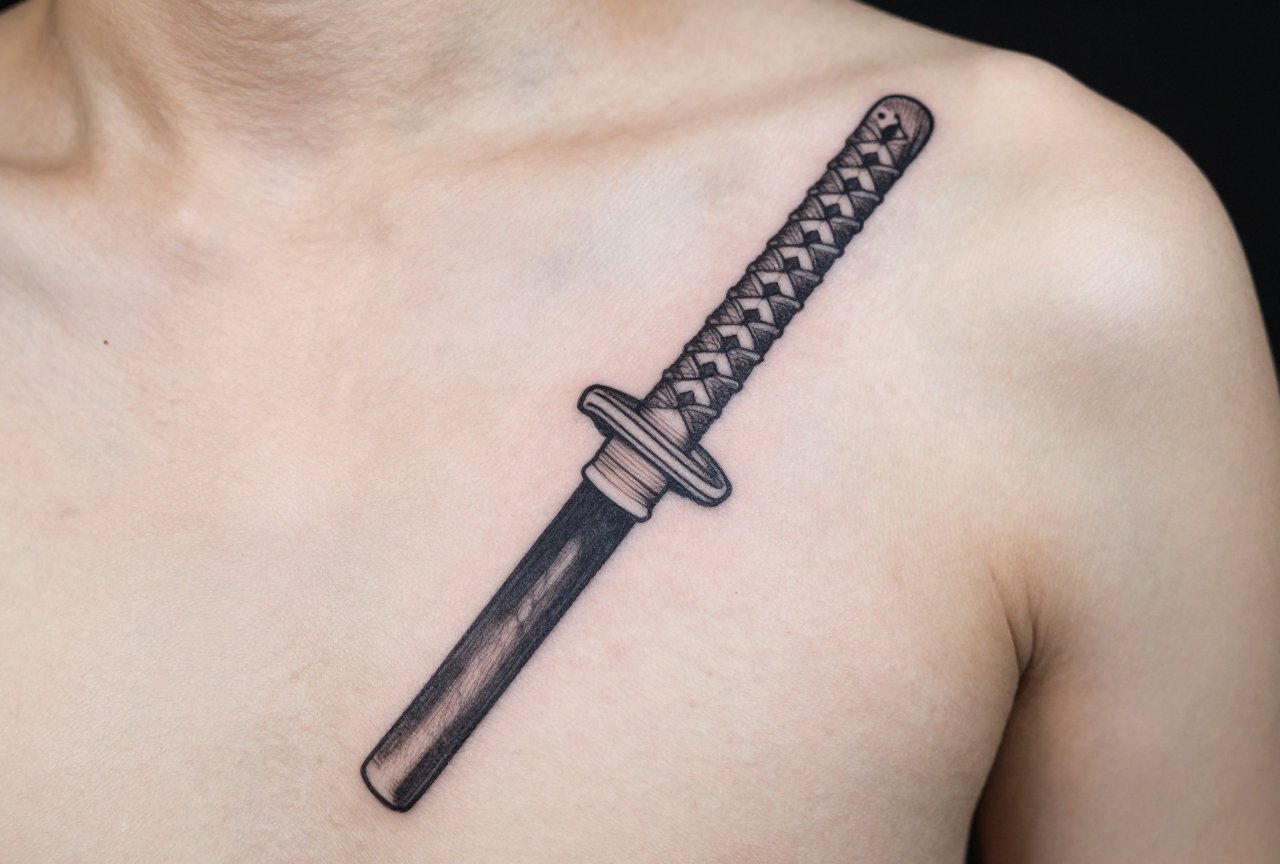
A katana tattoo typically represents honor, discipline, and the warrior spirit, drawing from the Japanese samurai tradition where the blade was considered the soul of the warrior. For many who sit in my chair, it’s less about violence and more about personal code: living with intention, cutting away what doesn’t serve you, and carrying yourself with quiet strength. The meaning shifts depending on what you pair it with, how it’s rendered, and where you wear it.
Symbolism & History
The Blade as Soul
In Japanese tradition, the katana wasn’t just a weapon. Samurai believed their sword held their honor, their spirit, their very essence. I’ve tattooed this blade for veterans who understand that bond between a fighter and their tool, for martial artists who’ve spent decades in the dojo, and for people who’ve never held a sword but know what it means to live by a personal code. The symbolism runs deep: the curve of the blade represents the journey of life, the single sharp edge speaks to focus and precision, and the unsharpened back suggests restraint, the power to harm paired with the choice not to.
There’s a weight to this imagery that I always discuss with clients. The katana carries cultural significance that demands respect. I won’t tattoo a katana with a haphazard dragon or random Japanese characters slapped alongside it, that’s how you end up with something that reads as costume rather than conviction. The artists I respect, we all feel this. We want your tattoo to mean something genuine, not just look cool on Pinterest for three months.
Modern Interpretations
Today the katana has bled into pop culture, anime, video games, Tarantino films. That’s fine. Meaning evolves. I’ve done katanas wrapped in cherry blossoms for someone who survived breast cancer, the blade representing the fight, the blossoms the fragility of what she protected. Another client wanted his katana broken, snapped at the middle, to mark the end of a military career and the start of something uncertain. The traditionalists might wince, but in my shop, your story matters more than orthodoxy.
- Honor and personal code
- Discipline and mastery
- Protection of something valued
- Separation from past self (the “cutting away” metaphor)
- Connection to Japanese heritage or martial arts practice
Common Variations & Styles
Traditional Japanese (Irezumi)
Full sleeves or back pieces featuring the katana within larger narratives, samurai in battle, waves, wind bars. The line work here is bold, the shading built through tebori hand-poking or dense machine packing. These pieces age beautifully if done right. I’ve seen twenty-year-old katana sleeves that still read clear from across the room because the original artist didn’t go too fine, didn’t try to make the blade look like a photograph.
Neo-Traditional & Illustrative
Bolder colors, more stylized proportions, sometimes the blade wreathed in flames or flowers that wouldn’t appear in classical work. This is where I spend most of my time lately. Clients want the symbolism but with personal visual language. A katana piercing a red sun for a Japanophile. A blade wrapped in rope and wild roses for someone who did time and came out the other side. The line work in these pieces needs to be crisp, katanas have straight edges that blur fast if your artist rushes or goes too small.
- Black and grey realism: demands excellent line work, shows every flaw in the steel reflection
- Minimalist single-line: elegant, risky, one wobble ruins the whole piece
- Traditional Japanese with waves or wind: classic, ages well, requires significant skin real estate
- Broken or bloodied blade: specific narrative meaning, often memorial or transitional
Best Placements
The katana’s long, narrow shape dictates where it lives best on the body. I’ve seen them forced into spots that fight the natural flow, and it never works.
Forearm: The most common request. Runs with the bone, reads clearly when you shake hands or gesture. Outer forearm ages better than inner, less sun, less friction from desk work. I tell clients the inner forearm is beautiful but expect touch-ups if you type all day.
Side ribcage: Follows the natural curve, can extend into a full scene. Hurts like hell. I always warn people: rib tattoos don’t just hurt during, they ache for days after. But the placement feels intimate, hidden, something you choose to reveal.
Spine or back: Vertical placement, dramatic, room for detail. The blade can run true north-south, or angled across the shoulder blades like a sheathed sword. I’ve done this for martial artists who want the literal feeling of carrying their weapon.
Thigh: Underrated. Flat canvas, less bone, the artist can really work. A katana running down the outer thigh, emerging from waves or flames, has this powerful forward momentum. Plus you can hide it for work, show it when you choose.
Calf: Good for wrapped compositions, the muscle curve helps with three-dimensional effects. But calf skin can be tricky, tight, sometimes almost waxy. Not every artist loves it. I do, but I adjust my needle depth.
Who Chooses This Tattoo / Personal Meanings
After fifteen years in shops, I see patterns. Not stereotypes, patterns. The people who come in asking for katanas usually have something they’re trying to hold onto or something they’re trying to cut loose.
Military and law enforcement often gravitate here, especially those with Japan service or martial arts backgrounds. They understand the blade as tool, as responsibility, as burden. I’ve tattooed active-duty Marines who wanted the katana alongside their unit insignia, the meaning layered: brotherhood, duty, the warrior code they actually live.
Martial artists are another obvious group. But it’s not just the black belts. I’ve had white belts come in, six months of training, wanting a katana because something finally clicked in their life, discipline, respect, showing up when they used to quit. That’s valid too. The tattoo marks the beginning, not just the mastery.
Survivors of various kinds, addiction, abuse, illness, sometimes choose the broken katana or the blade cutting through chains. The metaphor writes itself, but that doesn’t make it cheap. I’ve watched people cry in my chair getting these. The pain of the needle becomes part of the ritual. I don’t rush those sessions. We take breaks. We talk or we don’t talk. Both are fine.
The pop culture crowd, anime kids, gamers, they’re younger, usually, and sometimes I have the conversation about whether this image will hold meaning in ten years. Sometimes it does. Sometimes they come back for cover-ups. I don’t judge either path. We all start somewhere.
Similar Symbols
If the katana speaks to you but something feels slightly off, consider these alternatives I’ve suggested to clients over the years:
- Wakizashi or tanto: The shorter companion blades. Same tradition, less common, sometimes more personal. I’ve had clients choose the tanto for its intimacy, close-quarters, last resort, the blade you use when everything else has failed.
- Generic longsword or European blade: If your heritage or interest runs medieval rather than Japanese. Same warrior symbolism without the cultural borrowing concerns.
- Arrow or spear: Direction, focus, forward movement. Less aggressive, more about trajectory.
- Broken chain or shattered mask: If your meaning is specifically about liberation rather than the warrior path.
- Fudo Myoo or other protective deity: The sword-bearing Buddhist protector. Deeper religious roots, more complex iconography, but profound for those who connect with it.
I’ve talked people out of katanas when their heart was really elsewhere. I’ve also talked people into them when they were circling the idea but afraid of the cultural weight. There’s no universal right answer. The right tattoo is the one that fits your skin and your story.
Final Thoughts
The katana tattoo endures because it compresses so much into clean, recognizable geometry: discipline, honor, the sharp edge of choice, the weight of carrying something that could cut either way. I’ve watched this design heal beautifully and I’ve watched it blur into regret because someone went too small, too cheap, too fast.
If you’re considering this piece, sit with the meaning longer than you sit in the chair. Research your artist. Look at their healed work, not just fresh photos. Ask yourself if you’re drawn to the aesthetic or the ethic, the look or the lived code. Both can sustain a tattoo, but honesty about which one you’re chasing will help your artist build something that stays true as your skin changes and your years accumulate.
I’ve got a katana flash on my wall that’s been there three years, drawn by a mentor who retired. No one has picked it yet. The right person will. That’s how this works. The blade waits.
Frequently Asked Questions
Does a katana tattoo have to be Japanese style to be respectful?
Not necessarily, but the imagery deserves thought. I’ve done illustrative and neo-traditional katanas that honor the form without pretending to be classical irezumi. The key is avoiding random Japanese characters or mixing sacred symbols carelessly. Talk to your artist about what you’re trying to say, not just how you want it to look.
How well does fine line work on a katana tattoo hold up over time?
Thin lines on straight edges blur faster than you’d think. I usually tell clients to let me go slightly bolder than the reference photo, what looks crisp on paper will soften on skin. A katana needs to read as a blade from ten feet away, not just under bathroom light. Expect touch-ups regardless, but start with enough weight to age gracefully.
Is it okay to get a katana if I don’t practice martial arts or have Japanese heritage?
Yes, but know your why. I’ve tattooed katanas on people with no dojo time and no ancestral connection, and the pieces worked because the personal meaning was genuine, survival, discipline, a code they actually lived. The problem isn’t cultural borrowing, it’s shallow borrowing. Come with substance, not just a screenshot from an anime.
What’s the most painful placement for a katana tattoo?
Ribs win, hands down. The long vertical format of a katana means extended time over bone with thin skin and nerve bundles. I’ve had grown men tap out on rib pieces. Forearm and thigh are more manageable. Wherever you go, the session length matters, big katanas take multiple hours, and pain accumulates. Plan accordingly, eat beforehand, bring headphones.
Related Tattoo Meanings
- Samurai Tattoo Meaning
- Sword Tattoo Meaning
- Anime Tattoos: Styles, Ideas, and How to Get One That Lasts
- Explore more









