
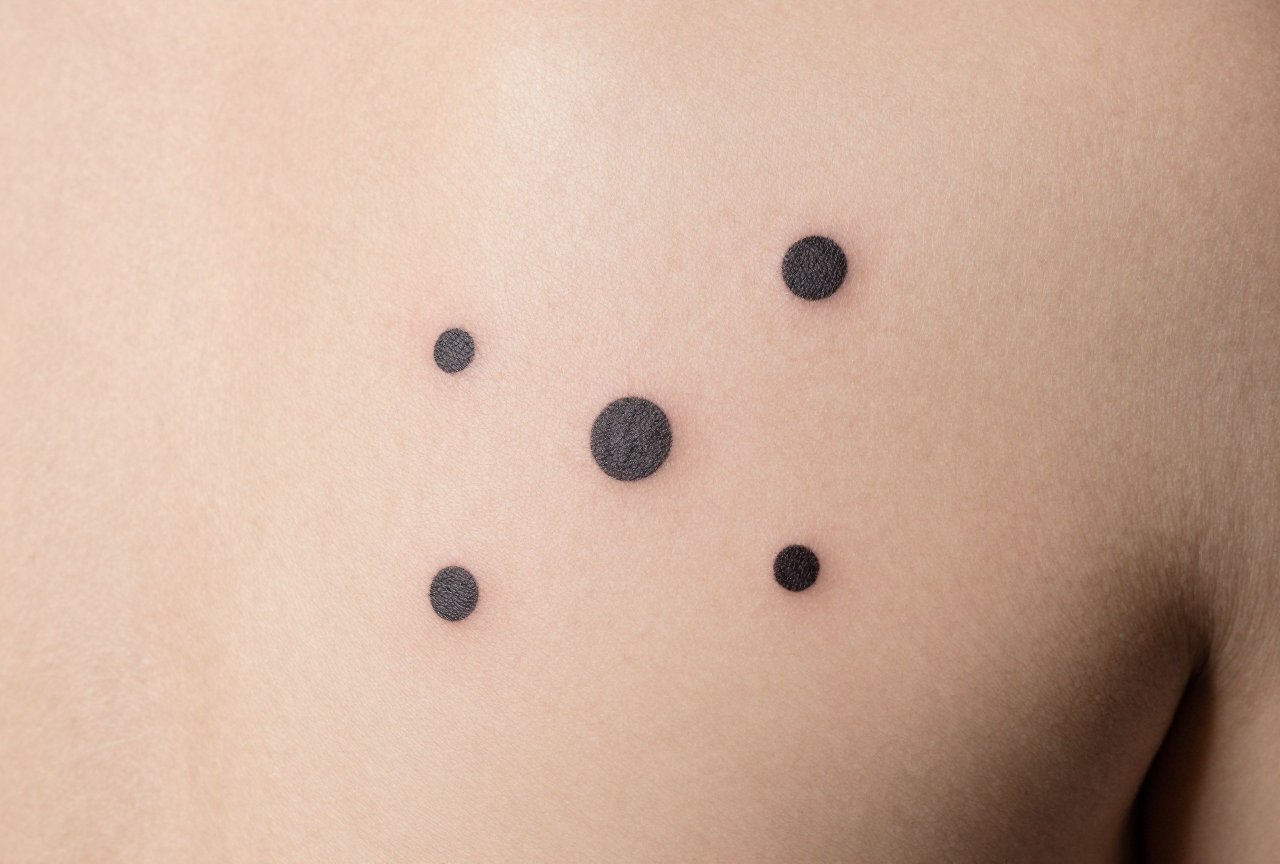
The five dots tattoo, four dots in a square with one centered above, most commonly signals time spent inside, but meanings have shifted. I’ve tattooed this design on hands, knuckles, necks, and hidden spots where only the wearer sees. What it means depends on who’s wearing it, where they got it, and whether they chose it freely or earned it.
Symbolism & History
This isn’t some ancient symbol with a clean lineage. The five dots emerged from prison culture in the 20th century, particularly in the American and British systems. The four outer dots represent the walls of a cell. The center dot? That’s the prisoner.
I’ve had guys in my chair explain it differently though. Some say the four dots are the corners of a room, the center dot alone in the middle. Others flip it: the center dot is the outside world, and the four dots are the ones left behind. Meaning shifts based on who’s telling the story.
From Prison to Mainstream
The migration happened slowly. By the 1990s, hip-hop culture and street photography started showing the quincunx pattern (that geometric arrangement) on musicians and athletes. Not everyone wearing it had done time. Some got it for the aesthetic, some for solidarity, some because they genuinely didn’t know the origin.
I’ve had to have the conversation more than once. Kid comes in, wants five dots on his hand because he saw it on a rapper. I explain what it means in certain contexts. Sometimes they still want it. Sometimes they switch to stars, or Roman numerals, or something personal. That’s the job, inform, then execute what they choose.
Regional Variations
- UK systems: Often called the “quincunx” or “prison dot,” sometimes earned after specific sentence lengths
- US state prisons: Meaning varies by facility; some joints it’s strictly gang-affiliated, others it’s general population solidarity
- Latin American prisons: Can indicate specific cartel or gang ties, this is where I get extra careful about who I’m tattooing
- Scandinavian systems: Less common historically, but growing among immigrant communities in those facilities
Common Variations & Styles
The basic five-dot pattern is simple, but execution varies wildly. I’ve done these with a single needle, machine, even hand-poked in someone’s kitchen when I was starting out (don’t do that, go to a shop).
Technical Approaches
Hand-poked dots hit different than machine work. They sit in the skin with a softer edge, blur less over time, but they take forever. Machine dots are crisp day one, but on high-wear spots like hands, they spread. I tell clients: expect touch-ups. The skin between knuckles moves constantly. Ink doesn’t love that.
Some artists do the dots as perfect circles. Others let them bleed slightly, giving that worn, aged look intentionally. I’ve seen versions where the center dot is larger, or the four corners connect with thin lines forming a square. That square-connected version changes the reading, less prison-specific, more abstract.
Color and Composition
- Black only: Most traditional, most loaded with original meaning
- Red center dot: I’ve seen this to symbolize blood, sacrifice, or a specific loss
- Surrounding imagery: Clock faces, broken chains, roses, context that rewrites the symbol
- Negative space: Dots as skin tone, background filled black, striking visually, less recognizable to those who know the original
Best Placements
Where this goes matters enormously. I’ve refused certain placements, and every ethical artist has lines.
The hand, specifically between thumb and index finger, or across the knuckles, is the classic spot. Visible. Unavoidable. That’s intentional. It says something before you open your mouth.
I’ve also tattooed five dots behind ears, on ribs, on ankles. Hidden placements usually mean personal significance without the public declaration. One client had them on his chest, over his heart, each dot representing a family member who stuck with him through incarceration. That’s a reclamation I respect.
- Hand/web: Most visible, most historically charged, fastest to fade
- Neck/side: Bold statement, harder to cover professionally
- Ribs/chest: Private, personal, holds detail better long-term
- Behind ear: Subtle, easily concealed, growing in popularity among women getting the design
Finger skin is thin. It sheds ink. I’ve seen five-dot tattoos disappear almost entirely in two years. Clients come back confused. I explain: we warned you. Touch-ups help, but some skin just won’t hold it.
Who Chooses This Tattoo / Personal Meanings
In my chair, the reasons vary more than people assume.
Direct Experience
Some wear it because they did the time. It’s a mark of survival, not pride exactly, but acknowledgment. I’ve tattooed men who cried during the session. The dots aren’t celebration. They’re documentation. One guy told me, “I need to remember who I was in there so I don’t become him again out here.”
Family and Solidarity
I’ve done five dots on wives, mothers, sons, family members of the incarcerated. The meaning shifts to loyalty, to waiting, to the invisible labor of loving someone inside. One woman had four dots for her husband’s sentence length, the center dot for herself holding the family together. That’s not the original meaning, but symbols belong to whoever uses them.
Aesthetic and Ignorance
This one’s complicated. Some people just like how it looks. They find it on Pinterest, don’t research, want it small and cool. I don’t shame them, but I explain. Knowledge is part of informed consent. After that, their body, their choice. I’ve had people change their mind. I’ve had people say they don’t care about the history, which is its own kind of statement.
Similar Symbols
Clients confuse these regularly, so let’s clarify.
The three dots in a triangle (mi vida loca) is Chicano gang culture, not prison-specific though there’s overlap. The teardrop under the eye, murder, attempted murder, or loss of a loved one, depending on which side and which city. The five-point crown is Latin Kings. The spider web on the elbow traditionally meant killing, though that’s softened into general edginess now.
I’ve had to gently correct someone who wanted “just the five dots but like, the teardrop version.” They meant three dots. We figured it out. These symbols live in proximity, borrow from each other, get mixed by people outside the original contexts.
The quincunx pattern also appears in alchemy, in sacred geometry, in dice patterns. That broader history lets some people wear five dots while claiming non-prison meaning. Whether that’s accepted depends on who’s looking. Symbols don’t exist in a vacuum.
Final Thoughts
The five dots tattoo carries weight. I’ve watched it mark transition, survival, family, and sometimes just poor research. As an artist, my job is to put it on skin that will hold it, to place it where the client wants, to explain what I know and let them decide.
What I’ve learned in years of shop work: meaning isn’t fixed. The same ink reads differently on different bodies, in different neighborhoods, at different times. The five dots started as prison code. Now they’re also reclaimed, aestheticized, misunderstood, and deliberately redefined. That evolution is how symbols work. They’re alive, which means they’re complicated, which means anyone getting one should know the full conversation they’re joining.
If you’re considering this design, sit with why. Talk to your artist. Good ones will ask questions before the needle touches skin. That’s not gatekeeping. That’s respect, for the symbol, for the history, and for you carrying it forward.
Frequently Asked Questions
Can I get five dots tattooed if I’ve never been to prison?
You legally can, but I’d strongly suggest knowing what you’re carrying. Some people reclaim or recontextualize symbols, but others will read it a specific way regardless of your intent. Your artist should walk you through this before booking.
Do the five dots always mean the same thing in every country?
Not at all. The prison association is strongest in US and UK contexts. In other places, it might read as pure geometry or hold entirely different local meanings. I’ve had European clients surprised by the American prison connection.
How well do five dots hold up on hands over time?
Poorly, honestly. Hand skin is thin, moves constantly, and sheds ink faster than almost anywhere. Expect significant fading in 2-5 years and plan for touch-ups. I always warn clients about this before starting.
What’s the difference between five dots and three dots in a triangle?
Three dots (mi vida loca) comes from Chicano gang culture and means “my crazy life.” Five dots specifically references prison incarceration, the four walls and the prisoner. Different origins, different communities, though they’ve influenced each other over time.
Related Tattoo Meanings
- Flail Tattoo Meaning: Power, Justice Ancient Authority
- Flame Tattoo Meaning: Symbolism, Styles What Fire Represents
- G59 Tattoo Meaning: Suicideboys, Underground Culture Ink
- Explore more









