I’ve tattooed Michael Jackson more times than I can count on both hands. Thriller-era poses, Bad leather jackets, that single glove floating in negative space. Some clients cry in my chair. Some just want the lean from Smooth Criminal frozen mid-air. Either way, MJ ink carries weight. But here’s the thing: not every design that looks killer on a poster works on skin. I’ve seen portrait attempts go muddy, seen the moonwalk look like a guy slipping on ice because the reference was too dark. This is real shop talk on what works, what doesn’t, and how to get MJ on your body without regret.
Popular Styles
Clients walk in with Pinterest boards full of MJ. I flip through and start separating the possible from the “we need to redraw that entirely.” Skin is not paper. Lines spread. Black pools. These styles actually hold up.
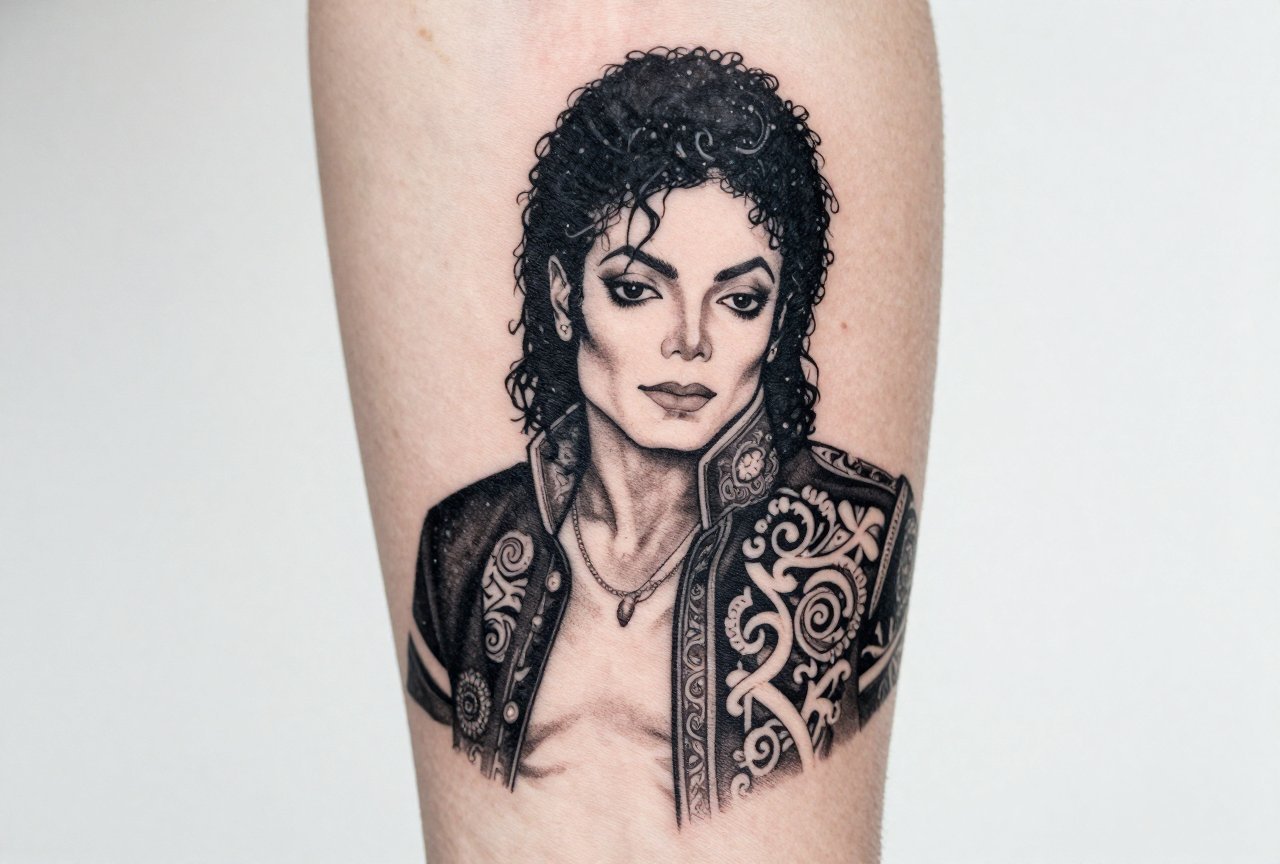
Portrait Realism
The most requested, the most botched. I’ve done maybe two dozen MJ portraits, and only half I’d show in my portfolio. The problem is his features are so specific, those cheekbones, that nose, the soft eyes, that any drift reads wrong. You need an artist who specializes in faces, not someone who “can do realism.” Ask to see healed photos. Not fresh. Healed. A good MJ portrait at 3 years looks softer, more human, often better. A bad one looks like a melted wax figure.
Best approach: go bigger than you think. I tell clients minimum 4-5 inches for a face. Anything smaller and the eyes become dots, the lips blur together. Soft black and grey with warm undertones. His skin had that warmth, cold grey makes him look sick.
Neo-Traditional and Graphic
This is where MJ tattoos get fun. Bold lines, limited color palette, iconic symbols instead of literal face. The single glove. The fedora. The socks and loafers. I’ve tattooed the Thriller jacket as a standalone piece, no face, and everyone knows exactly what it is. These age better. The line weight carries. The read is instant from across a room.
- Single glove, classic, reads at small sizes, works on wrists, ankles, behind ears
- Fedora silhouette, profile view, clean black fill, almost impossible to mess up
- Thriller jacket, V-shaped, red and black, recognizable even simplified
- Moonwalk pose, needs space, minimum 5 inches, but dynamic as hell
Design Ideas
Specific moments that translate to skin. I’ve done these. I know what works.
Album Era References
Off the Wall: young Michael, afro, that smile. Works great in color, warm tones, 70s palette. I’ve done this on upper arms with the rainbow behind him, soft, nostalgic, ages beautifully because the colors are muted already.
Thriller: the red jacket, the zombie eyes, the werewolf transformation. The jacket alone is enough. Full werewolf face? I’ve seen it attempted. Hard to pull off without looking like generic horror. The zombie hands reaching up from ground level, that’s a forearm piece that tells a story.
Bad: the leather, the attitude, the chrome buckles. This era photographs best for reference. High contrast, sharp shadows. Translates to black and grey perfectly. I’ve done the Bad album cover pose, leaning against the wall, arms crossed, maybe six times. Always reads.
Dance Poses
The toe stand. The anti-gravity lean (though I explain to clients that the shoes did the work, not magic). The moonwalk mid-slide. These need length. Forearm, calf, side of thigh. The body in motion needs room to breathe. I did a toe stand on someone’s ribcage once, beautiful, but they said it felt like I was tattooing their lung. Worth it, they said after.
- Smooth Criminal lean, diagonal composition, needs 6+ inches, stunning on ribs or outer thigh
- Toe stand, vertical, works on inner forearm or side of calf
- Billie Jean pose, hat tipped, one glove, iconic and compact
- Beat It jacket, crossed arms, red leather, great for color work
Best Placements
Where you put MJ matters as much as what MJ you get. I’ve watched clients ignore placement advice and come back confused why their detailed portrait looks like a smudge on their inner wrist.
Upper arm/shoulder: The classic. Room for detail, easy to show, easy to hide. I’ve done full sleeve pieces that start with Bad-era Michael and flow into musical notes and album art. The curve of the shoulder fits his profile beautifully.
Forearm: Best for poses, not faces. The long rectangle suits his body in motion. Inner forearm is more painful but more private. Outer forearm is your billboard. I tell clients: if you want to see it, go inner. If you want the world to see it, go outer.
Chest: For the serious fans. Heart over heart, literally. I’ve done two chest pieces, both portraits, both large, both for clients who cried during the session. Not from pain. From the weight of it. Chest skin moves differently, though. It ages faster if you build muscle or gain weight. Plan for that.
Back: Canvas size. Full back pieces with the moonwalk, the spotlight, the stage. I’ve only done one. Took 40 hours. The client flew in from Atlanta for six sessions. Worth every plane ticket, they said.
Hands and fingers: I try to talk people out of this. Not because I won’t do it, because MJ deserves better than a 2-inch finger tattoo that’ll fade in two years. The glove on a hand? Clever concept. Blurry mess in reality. If you must, go bigger. Back of hand, minimum. Not fingers.
Color Choices
Black and grey vs. color. The eternal debate in my shop. For MJ, I have opinions.
Black and grey ages softer. His features in monochrome feel timeless, documentary, respectful. I use warm grey washes, not cool. Cool grey makes everyone look dead. Warm grey keeps life in the skin. For portraits, this is my default recommendation.
Color pops for specific eras. The red jacket demands red. The yellow sweater from the “Leave Me Alone” video. The purple from “The Way You Make Me Feel.” But color fades. Red especially. I’ve seen Thriller jackets go pink in five years. Budget for touch-ups. I tell every color client: this is not once and done. This is maintenance.
Single color accents on black and grey, red glove, gold buckle, that’s the sweet spot. The color draws the eye, the grey carries the form. Best of both. Heals clean. Ages gracefully.
Tips for Choosing
After years of MJ in my chair, here’s what I wish every client knew before they sat down.
Bring good reference. Not a screenshot from a YouTube video. Not a blurry photo your cousin took at a tribute concert. High resolution. Good lighting. Multiple angles. I can redraw, I can interpret, but I need bones to work with.
Think about which Michael you connect with. The kid from the Jackson 5? The 80s icon? The later years? Each version has different visual weight. Different emotional pull. I’ve had clients change their mind mid-sketch because they realized they wanted the joy, not the controversy. That’s valid. Sit with it.
Find an artist who wants this. Not just someone who’ll take your money. MJ tattoos require care. An artist who loves the music will put that into the lines. I’ve turned down MJ pieces when I wasn’t feeling it, referred to friends who were in that headspace. Better that than phoning it in.
- Check healed work, any artist can make fresh ink look good; the healed portfolio tells truth
- Size appropriately, faces need space; symbols can be smaller; know which you’re getting
- Plan for touch-ups, especially color, especially on high-movement areas
- Consider the legacy, MJ’s complicated; make sure your design reflects what he means to you, not just what looks cool
Final Thoughts
I still play “Human Nature” during long sessions. Something about it fits the rhythm of the machine. I’ve had clients sing along, off-key, through the pain. That’s the thing about MJ tattoos, they’re never just about the image. They’re about where you were when you first heard that bassline. Who you were. Who you became.
The best MJ tattoo I ever did wasn’t technically perfect. It was a small “PYT” in his handwriting, upper ribs, for a woman who’d danced to that song with her mother every Saturday morning. Simple. No portrait. No jacket. Just those three letters and her mother’s birthdate. She didn’t need the world to recognize Michael. She needed to carry that morning with her.
That’s what this is. Not a trend. Not a tribute to a celebrity. A way to wear what moved you. Get it right. Get it honest. And find an artist who understands why it matters.
Frequently Asked Questions
How much should I expect to pay for a detailed Michael Jackson portrait tattoo?
A quality portrait runs $400-$800 minimum, often more for large-scale or full color. I book MJ portraits in 4-hour sessions at $150-$200 per hour. Cheap portraits become expensive cover-ups. Save up, wait for the right artist.
Will a Michael Jackson tattoo affect my job prospects?
Depends on placement and your field. A forearm MJ is visible in most workplaces; upper arm or back stays hidden. I’ve had clients in corporate jobs get chest or thigh pieces specifically for concealment. Think about your career trajectory before committing to hands, neck, or face-adjacent areas.
Can I combine Michael Jackson with other musical elements in one tattoo?
Absolutely, and it often works better. I’ve blended MJ silhouettes with song lyrics, vinyl records, musical staffs, and moon phases. The key is visual flow, elements should connect, not just sit next to each other. Bring your ideas; a good artist will compose them into one coherent piece.
How do I handle people who criticize getting Michael Jackson tattooed?
You don’t owe anyone an explanation, but it helps to know your own reasons. I’ve had clients with MJ ink tell me they separate the art from the artist, or that they honor the childhood joy, not the complicated man. Your tattoo is your story. Stand in it.
More Tattoo Ideas
- Religious Tattoo Ideas That Actually Mean Something
- Angel Tattoo Meaning: Protection, Guidance, Faith and Memorial Symboli
- Minimalist Sunset Tattoo Ideas
- Explore more