I’ve tattooed Bob Marley’s face more times than I can count, and it’s always a conversation I look forward to. People come in with this reverence. They don’t just want a portrait, they want to carry something. Marley means resistance, peace, spirituality, or just damn good music, depending on who’s sitting in my chair. Over the years, I’ve learned what works on skin and what turns into a muddy mess after two summers. Here are the real options, the placements that hold up, and the choices that separate a tattoo you’ll love forever from one you’ll be asking me to cover in five years.
Popular Styles
Style choice changes everything. I’ve seen the same reference photo turn out completely different depending on whether we go photorealistic, traditional, or illustrative. Here’s what actually works for Marley imagery.
Photorealistic Portraits
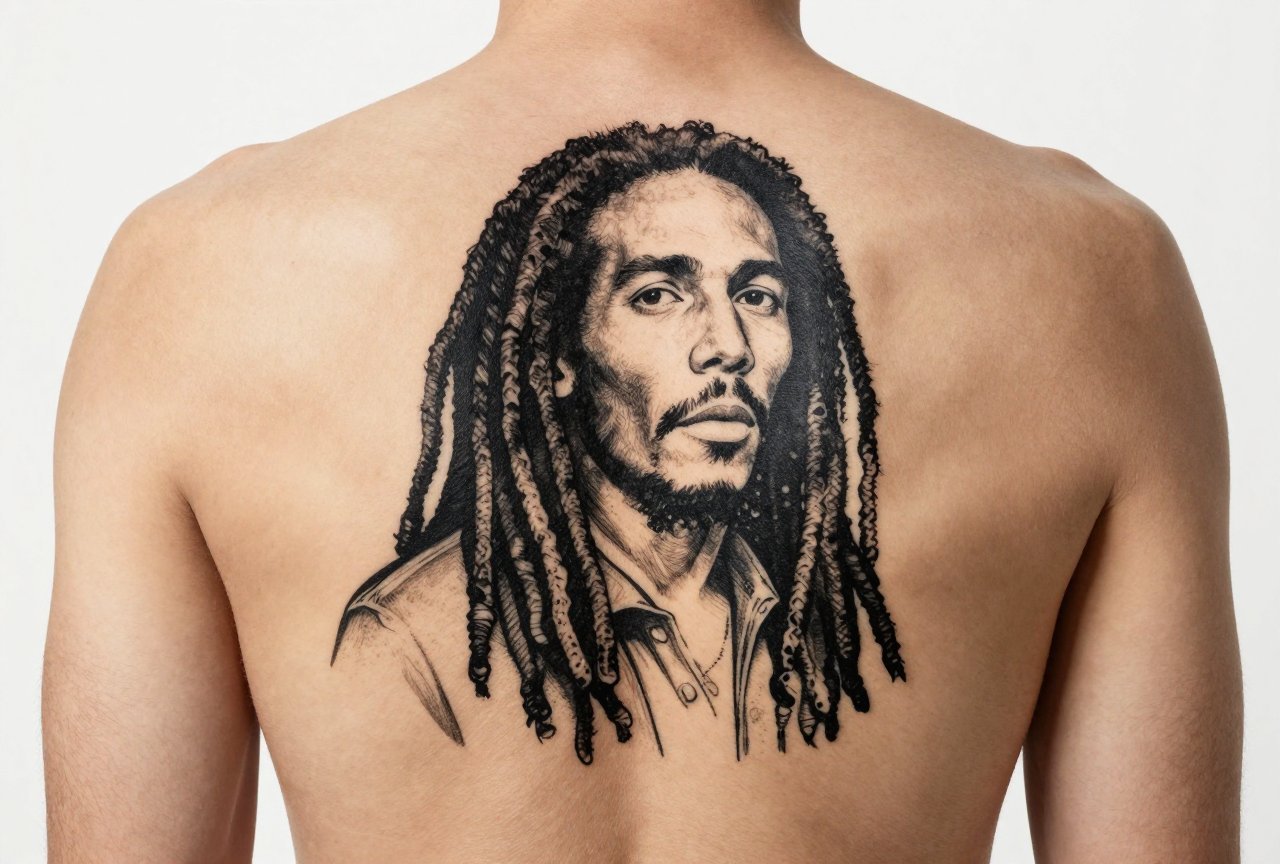
This is what most people ask for first. They bring in that iconic black-and-white photo from the “Catch a Fire” sessions, or the color shot with the smoke curling up. Realistic portraits demand space. I’m talking palm-sized minimum, ideally larger. The dreadlocks are the hardest part, those fine lines blur together over time if they’re too small. I did one on a guy’s upper arm last year, maybe six inches tall, and the hair texture still reads clean because we had room to build depth with stippling and soft shading. Go smaller than four inches and you’re gambling.
Stylized and Graphic Approaches
Not everyone wants to wear a face on their body. I’ve tattooed Marley’s silhouette with the lion mane merged in, done neo-traditional versions with bold outlines and limited color, and even a few blackwork pieces where his profile becomes negative space inside a larger Rasta-themed composition. These age better. The bold lines hold. The simplified forms don’t rely on subtle gradations that disappear as skin changes.
- Black and gray realism: Sophisticated, timeless, shows texture in hair and facial features
- Neo-traditional: Bold outlines, limited but saturated color palette, graphic impact
- Illustrative/linework: Sketchy or crosshatched, artistic and less literal
- Blackwork/negative space: High contrast, uses skin tone as part of the design
Design Ideas Worth Considering
Beyond the portrait, there’s a whole language of Marley-related imagery. Some clients come in knowing exactly what they want. Others need help translating their connection into something visual.
Iconic Imagery and Symbols
The lion. The cannabis leaf. The guitar. “One Love” in his handwriting. I’ve tattooed the Zimbabwe performance photo where he’s mid-jump, dreads flying. I’ve done the red, gold, and green stripes wrapping around forearms. One woman wanted the “No Woman, No Cry” lyrics circling her ribcage in a spiral, we used his actual handwriting from a signed album she owned. That kind of personal connection makes the tattoo matter more than any Pinterest find.
Smoke is a recurring request. It looks amazing fresh. Here’s the reality: soft gray smoke without solid structure fades fastest. If you want smoke in the design, anchor it with darker values or incorporate it into a larger composition so the fading doesn’t ruin the whole piece.
Combining Elements
My favorite Marley tattoos layer meaning. Portrait with hibiscus flowers for his Jamaican roots. The dreadlocks transforming into roots or tree branches. The Ethiopian flag behind his profile. One guy’s whole back piece shows Marley with the Three Little Birds perched on his guitar. These composite designs take planning, but they become tattoos people never regret because they’re singular, not copied from a Google image.
- Portrait with Rasta color accents (red, gold, green, black)
- Lyrics integrated with natural elements: roots, birds, ocean
- Album art reinterpretation (“Legend,” “Exodus,” “Kaya”)
- Spiritual imagery: lion of Judah, Ethiopian cross, Nyabinghi drums
Best Placements
Where you put it affects how it ages, how much it hurts, and how often you see it.
Upper arm and thigh are the sweet spots for portraits. Flat surfaces, good muscle padding, the ink stays put. Forearm Marleys look great but fade faster due to sun exposure and constant washing. Calves are underrated. Stable skin, easy to show or hide, and the cylindrical shape actually suits portrait orientation well.
Ribs and sternum hurt more. The skin stretches, breathes, moves. But some clients insist because they want it close to their heart. Fair enough. We just design with the movement in mind, flowing elements, not rigid geometric frames that’ll distort.
- Best for detail: Upper arm, thigh, calf
- Best for visibility: Forearm, upper chest
- Most personal/intimate: Ribs, over heart, shoulder blade
- Avoid for complex portraits: Hands, feet, inner bicep (too much movement and fading)
Color Choices
Color is where people get romantic and I have to be honest. Rasta colors, red, gold, green, black, are gorgeous. They also require commitment. Those bright greens and yellows don’t stay electric without care. I’ve seen gold turn mustard, green turn teal-ish, red hold decent but dull out.
Black and gray Marley tattoos age with dignity. The contrast stays readable. The dreadlock texture maintains its depth. If you want color, consider strategic placement: the background in Rasta tones, the portrait itself in black and gray. Or limited color accents, just the stripes, just the lion’s mane. One approach I love is doing the portrait in black and gray with one element in full color, a red rose, green leaves, gold halo. That selective saturation pops harder than everything competing.
On darker skin, I often recommend heavier black saturation and richer, deeper colors rather than pastels. A deep crimson, an emerald green, a burnt gold? Those sing. I’ve learned this by doing, by seeing what healed well, by adjusting my palette client to client.
What to Know Before You Book
The consultations that go smoothest happen when people have done some thinking but stay open.
Reference Quality Matters
Blurry screenshots from YouTube? We can work with them, but it’s not ideal. High-resolution photos with clear light and shadow give me information to build from. Multiple angles help. Skip the airbrushed t-shirt version. Those are already simplified in ways that don’t translate to tattoo. I want to see pores, hair texture, the way light catches his cheekbone.
Size and Time Realism
A detailed portrait takes hours. My average Marley piece runs 4 to 6 hours for something substantial. Some go to multiple sessions. The people who love their tattoos most are the ones who budgeted time and money properly, who didn’t rush me because they had dinner plans. Good tattoos aren’t fast.
- Bring multiple clear references, not one low-res image
- Budget for the time quality requires, don’t rush the artist
- Consider how the design flows with existing or planned tattoos
- Ask your artist about their experience with portraits specifically
- Plan for touch-ups, especially with color and fine detail
Make It Mean Something
Bob Marley tattoos carry weight. I’ve watched people cry in my chair getting them, grief, joy, gratitude, all of it. The best ones happen when the design matches the feeling, when the technical choices support the emotional intent. For anyone drawn to his face, his words, or the symbols that surrounded him, work with an artist who respects the subject. This isn’t just another celebrity portrait. For a lot of people, Marley represents something close to sacred. Take your time choosing. Sit with the design. And find someone who’ll put that reverence into every line.
Frequently Asked Questions
Will a Bob Marley portrait look good in small size?
Honestly, no. Small portraits lose the detail that makes them recognizable. I won’t do Marley faces smaller than four inches, below that, the features blur and the hair becomes a dark blob. Go bigger or choose a simpler symbolic design instead.
How do Rasta colors hold up over time?
Red stays decent but dulls, gold often shifts to mustard, and green can turn muddy without proper saturation. I usually recommend black and gray for the portrait with selective color accents, or deeper, richer tones rather than bright primaries.
Can I combine Marley imagery with other artists or themes?
Absolutely, and I see this often. The key is visual cohesion: similar style, consistent flow, unified color palette. I’ve done Marley paired with Hendrix, with Jamaican landscape elements, with spiritual iconography. Just don’t cram unrelated styles together.
How do I find an artist who can actually do a good portrait?
Look at their healed work, not just fresh photos. Ask specifically about portrait experience. Any artist worth your money will show you examples and be honest about their comfort level. Don’t be their experiment.
More Tattoo Ideas
- Realistic Sword Tattoos: A Working Artist s Guide
- Traditional Portrait Tattoos: A Working Artist s Guide
- Traditional Star Wars Tattoos: A Working Artist s Guide
- Explore more