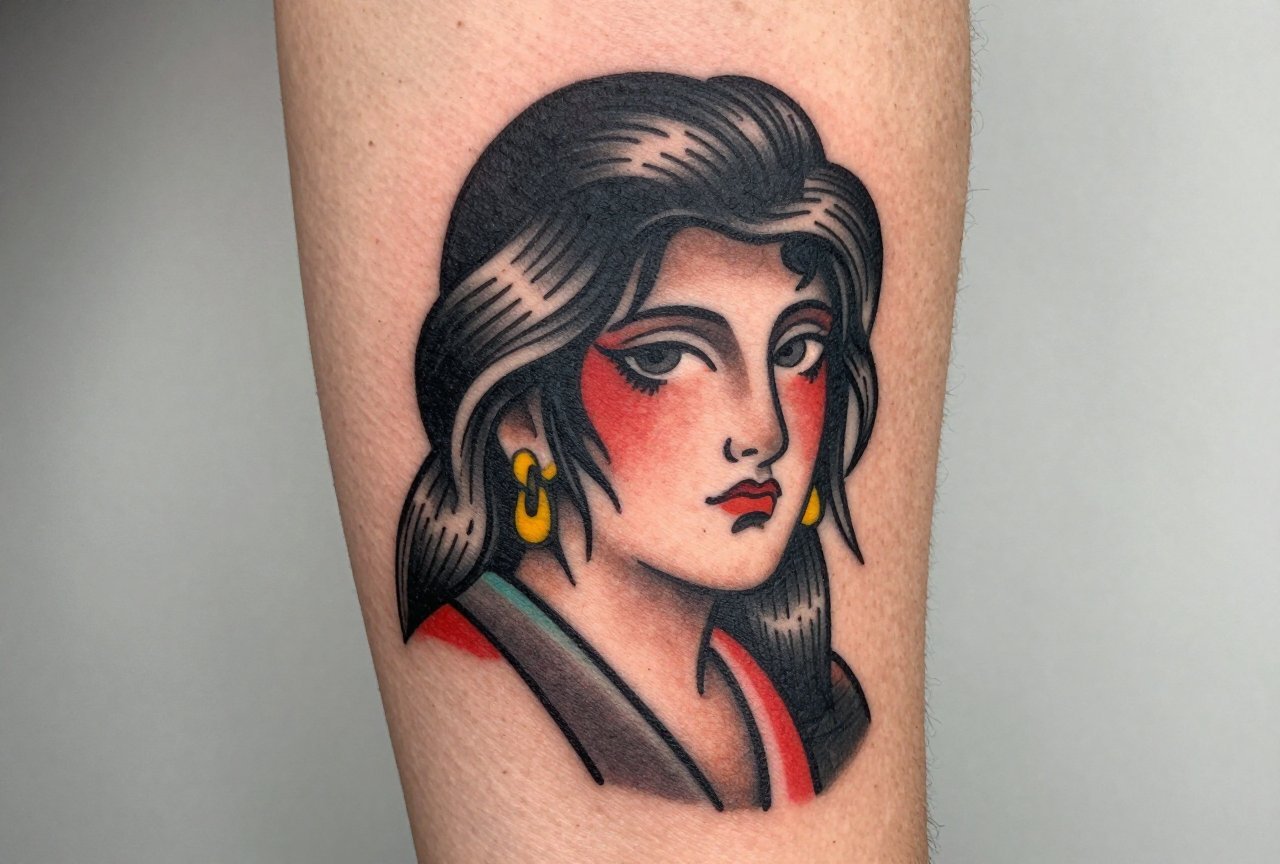
A traditional portrait tattoo isn’t a photorealistic face rendered with 20 hours of soft grey wash. It’s something older, more graphic, more deliberate. Think bold black outlines, a restrained palette of red, green, yellow, and black, and faces that feel iconic rather than documentary. Sailor Jerry. Ed Hardy. The faces of beautiful women, fierce warriors, dead presidents, and religious figures rendered with swagger and simplicity. I’ve tattooed these for fifteen years, and I still love how a good traditional portrait reads from across the room. It holds. It ages. It doesn’t need to whisper.
Origins & History
Traditional American tattooing coalesced in the early 1900s in port cities, Honolulu, San Francisco, New York, where sailors brought home skin art from Polynesia and Japan. The electric tattoo machine, patented by Samuel O’Reilly in 1891, made fast, bold work possible. By the 1930s and 40s, a visual language had hardened: thick black lines, solid color fields, minimal shading, imagery that could be completed quickly and read clearly on moving bodies.
Portraits entered this vocabulary early. Sailors wanted women’s faces to remember lovers left behind. Soldiers wanted pin-ups. The religious got Jesus, Mary, the Sacred Heart. The patriotic got Washington, Lincoln, eagles clutching banners. These weren’t likenesses in the photographic sense. They were types, symbols, emotional shorthand rendered with enough structure to survive decades of sun and salt.
The Sailor Jerry Legacy
Norman Collins, working in Honolulu from the 1940s until his death in 1973, codified much of what we call “traditional” today. His women’s faces had a particular geometry, heavy-lidded eyes, strong jawlines, hair that flowed in stylized waves. He used limited color but deployed it strategically: a red rose, a yellow banner, green leaves framing the face. I’ve studied his flash sheets until the edges frayed. The lesson is always restraint. Every element earns its place.
Shop Culture & Passing It Down
In my first shop, the old timers had a phrase: “Bold will hold.” They meant it as a warning against fine-line work that would blur into blue haze within five years. Traditional portraits were the standard against which other styles measured their durability. I watched apprentices earn their chairs by painting flash sheets of women’s faces, getting the eyes symmetrical, the proportions readable at postcard size. It’s a training ground that still matters.
Key Characteristics & Motifs
What separates a traditional portrait from other styles? I tell clients to look for these markers:
- Bold black outlines, typically 7-14RL needles, sometimes heavier on the outer contour than interior details
- Limited color palette, red, green, yellow, blue, black, with skin tone rendered as negative space or light brown wash
- Stylized features, eyes are larger than life, lips fuller, expressions archetypal rather than individual
- Graphic backgrounds, roses, banners, daggers, snakes, eagles framing the face rather than realistic environments
- Minimal grey wash, shading exists but reads as distinct blocks, not smooth gradients
Common subjects include pin-up women, Native American chiefs (a complicated motif I’ll address), Jesus and Mary, military figures, and anonymous beautiful faces meant to represent an ideal. The banner with lettering, “Mother,” “Death Before Dishonor,” a lover’s name, remains a classic pairing.
Line Weight & How It Heals
Here’s something I learned from watching thousands of tattoos settle: traditional lines are built to accommodate the body’s healing chaos. A 10RL line at proper depth, with consistent ink saturation, will heal as a readable dark band even if the client picks at it, gets sunburned, gains thirty pounds. I’ve seen thirty-year-old traditional portraits that still punch from across a pool deck. The same can’t be said for delicate single-needle work.
Color vs Black and Grey
The classic traditional portrait uses color. But black and grey traditional has its own lineage, especially in Chicano tattooing and certain East Coast shops where color was harder to come by. I do both, and the choice changes the feel dramatically.
Color traditional portraits feel celebratory, almost poster-like. The red of a rose jumps against green leaves; a woman’s lips pop against her skin. Black and grey reads more somber, more timeless, closer to the woodcut and engraving sources that influenced early tattoo flash.
Healing differs slightly. Color needs more careful sun protection long-term, red fades fastest, green can go muddy if overworked. Black and grey is more forgiving but can look flat if the artist doesn’t vary line weight and use solid blacks for contrast. I warn clients: a black and grey traditional portrait without enough black “anchor” will look like a pencil sketch left in the rain.
Best Placements
Traditional portraits work best where they can be seen and where the body’s curves complement the composition. In my chair, these placements succeed most often:
- Upper arm/shoulder, the classic “arm piece” placement, flat enough for facial symmetry, visible in a tank top
- Thigh, front or outer, plenty of room for banner and framing elements
- Chest, centered over the sternum, especially for religious figures; the pectoral curve frames faces naturally
- Forearm, smaller scale, but readable; I keep details bolder here, simplify the eyes
- Calf, less common but effective for vertical compositions, warrior faces with headdresses
I avoid ribs and stomach for traditional portraits. The stretching, the movement, the difficulty of healing, it’s not worth fighting the body. Traditional should sit like it belongs there.
Who It Suits
Not everyone wants a traditional portrait, and that’s fine. This style suits people who value longevity over trend, who want their tattoo to read clearly in any light, who connect to the historical weight of American tattooing. I’ve tattooed traditional portraits on punk kids, on grandfathers getting their first tattoo at 70, on military members, on artists who work in completely different mediums but respect the craft.
Skin tone matters less than people think. On darker skin, I adjust by using more solid black for contrast, choosing subjects where the graphic impact carries even if some colors read subtler. The bold lines remain. The composition remains. A good traditional portrait doesn’t depend on pale canvas.
Modern Variations
Contemporary artists have stretched traditional boundaries without breaking them. I see “neo-traditional” portraits that add more illustrative detail, more color blending, more naturalistic anatomy while keeping the bold outline and iconic feel. Japanese traditional influences appear in background waves or wind bars. Some artists incorporate dotwork textures or limited realism in eyes while keeping the overall graphic punch.
What I don’t do: call something “traditional” when it’s really photorealism with a thick outline. That’s a different genre. Clients sometimes bring reference photos wanting “traditional style” and don’t understand why I’ll simplify the features, flatten the lighting, add a banner they didn’t ask for. The conversation matters. I explain: traditional is a language with grammar. You can bend it, but break it and you’re speaking something else.
Choosing an Artist
Finding the right artist for a traditional portrait means looking at healed work, not just fresh photos. Anyone can make bold lines look black on day one. Ask to see pieces that are two years old, five years old. Do the eyes still hold? Has the red stayed red?
- Check their flash, do they paint traditional designs from imagination, or only copy reference?
- Look at line consistency, healed traditional should show uniform line weight, no blowouts, no patchy saturation
- Ask about their machines, coil or rotary, doesn’t matter, but they should know why they use what they use for bold lining
- Discuss their influences, do they know names beyond Sailor Jerry? Paul Rogers? Bob Shaw? Zeke Owen?
I always encourage consultation. Bring references, but be open to the artist’s interpretation. A traditional portrait is collaboration between your desire and a visual tradition that predates both of us. The best pieces happen when clients trust that heritage.
Final Thoughts
Traditional portrait tattooing isn’t nostalgic fetish. It’s a living craft with practical wisdom built in, how to make marks that last, how to simplify without losing soul, how to render a human face that feels universal rather than specific. I’ve watched trends come and go: photorealism, watercolor, minimalist line art. Traditional endures because it works. The faces in my portfolio from 2010 still look like themselves. The clients still stop me on the street to say so.
If you’re drawn to this style, sit with it. Study the old flash. Find an artist who bleeds it. And understand that your portrait won’t be a photograph. It’ll be something older: an icon, a symbol, a face that carries meaning beyond mere likeness. That’s the tradition. That’s the point.
Frequently Asked Questions
How is a traditional portrait different from a realistic portrait tattoo?
Traditional portraits use bold outlines, limited colors, and stylized features that read graphically. Realistic portraits aim for photographic accuracy with smooth shading and fine detail. Traditional sacrifices likeness for longevity and iconic impact.
Will a traditional portrait tattoo fade faster than black and grey?
Color can fade more with sun exposure, but traditional’s heavy black outlines hold structure for decades. The key is solid saturation during application and consistent sun protection afterward. I’ve seen color traditional pieces look crisp at twenty years.
Can any face be done in traditional style, or only certain subjects?
Any face can be adapted, but traditional works best when simplified to its essential character. Photorealistic subtlety gets lost. I often suggest clients choose subjects that already feel symbolic, loved ones work better when rendered as “types” rather than exact likenesses.
How much should I expect to pay for a quality traditional portrait?
Traditional portraits vary by size and artist experience, but expect a full session minimum. In most US cities, established artists charge $150-300 hourly. A palm-sized piece might take 3-4 hours; a full thigh piece could be 8-10. Good traditional isn’t fast, bold lines demand precision.
Related Style Guides
- Traditional Religious Tattoos: Complete Style Guide
- Traditional Tattoo Artwork: A Working Artist s Guide
- Traditional Gypsy Tattoos: Style Guide
- Explore more