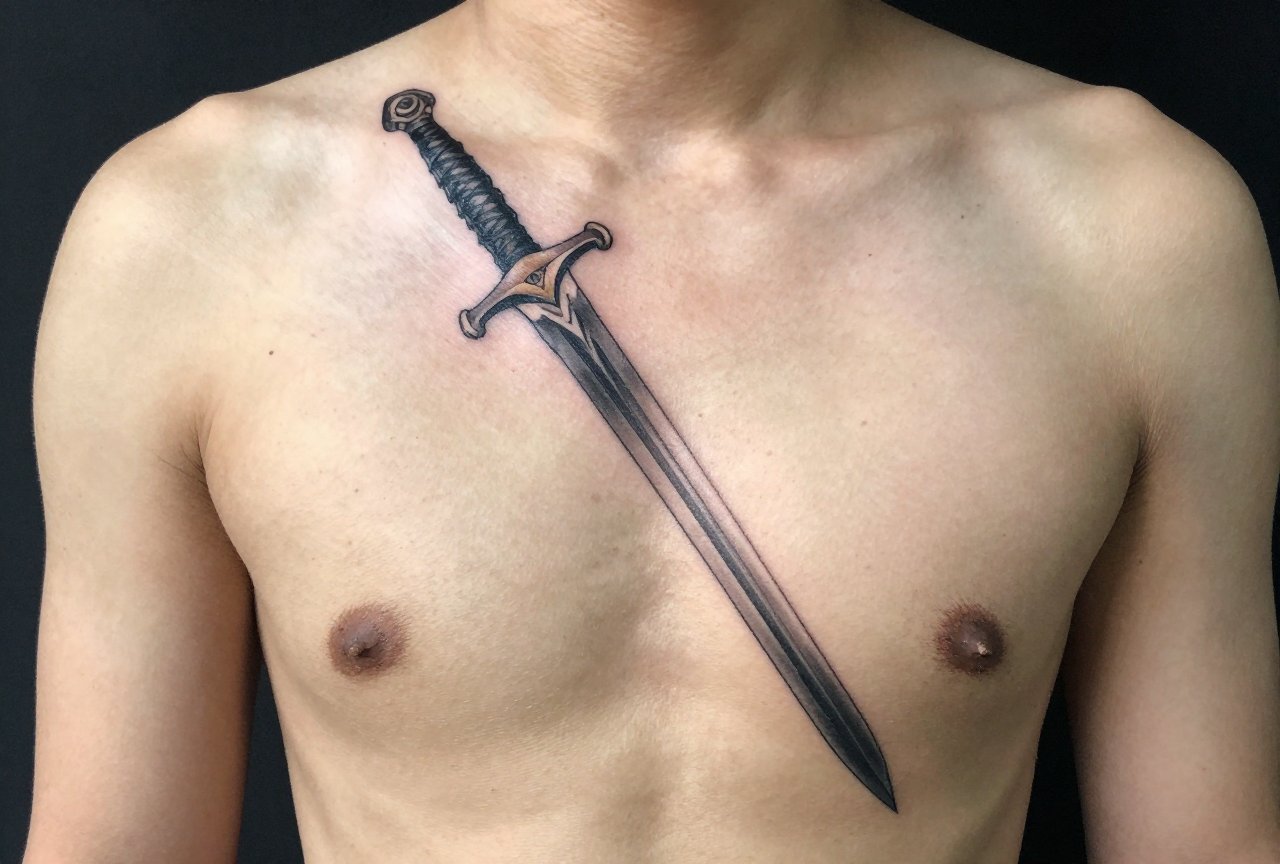
A realistic sword tattoo isn’t just a sharp object on skin, it’s a study in metal, shadow, and the illusion of weight. I’ve tattooed blades that look like you could pull them from someone’s arm, and I’ve seen others that read as flat cartoon cutlery. The difference comes down to understanding how steel catches light, how edges degrade over centuries, and how human skin accepts (or fights) that level of detail. This is the guide I wish every client read before sitting in my chair.
Origins & History
From Military Pride to Personal Symbol
Sword imagery has marked human skin for millennia, but the realistic approach is relatively young. Sailors in the 1800s got simple dagger tattoos, bold lines, minimal shading, more symbol than object. The photorealistic blade didn’t emerge until the 1990s, when artists like Paul Booth and Bob Tyrrell pushed black and grey into territory that mimicked actual photography. Suddenly a sword could look like a museum piece, not a stamp.
I tell clients who want historical pieces: the realistic style lets you honor a specific blade. Your grandfather’s WWII bayonet. A katana from a particular smith. A Viking sword based on an actual archaeological find. That specificity is what separates this from traditional tattooing’s generic “sword” symbol.
What Realism Demands of the Subject
Not every sword translates well. The realistic style needs reference material, photos, museum visits, sometimes 3D models. I once spent three hours with a client photographing his great-grandfather’s cavalry saber from every angle. The pommel wear, the leather grip staining, the nicks along the false edge. Those details became the tattoo’s soul. Without them, you’ve got a clipart sword with fancy shading.
Key Characteristics & Motifs
Realistic sword work lives or dies in the details. Here’s what distinguishes the style:
- Steel gradients: True metal isn’t one grey tone. It shifts from near-white highlights to deep charcoal, with subtle blue or brown undertones from tempering marks and age.
- Edge geometry: A proper blade has a primary edge, a secondary bevel, sometimes a fuller (that groove down the center). Each catches light differently. I build these with single-needle work and careful greywash layering.
- Handle materials: Wood grain, ray skin under wrapping, leather cracking, wire binding, these textures contrast with smooth steel and give the eye places to rest.
- Context elements: Blood grooves, maker’s marks, rust spots, sheath wear. These tell a story of use, not just possession.
The most common motif I see is the broken blade. Symbolically loaded, sacrifice, ended conflict, lost love. Visually tricky. A clean break shows crystalline steel structure inside; a jagged one needs irregular highlights that read as fresh fracture surfaces. I’ve done both, and the broken blade always takes longer than clients expect. Worth it, though. The texture variation keeps the piece alive for decades.
Color vs Black and Grey
When Steel Needs Color
Most realistic swords live in black and grey. That’s the safe choice, and often the right one. But certain blades demand color: a bronze-age sword with that distinctive green patina. A Japanese blade with a habaki (collar) in copper-gold shakudo. A fantasy piece with runic glow. I’ve done a Damascus steel blade where the pattern welding needed subtle brown and blue tones to read properly, that was color used surgically, not decoratively.
The Black and Grey Advantage
Black and grey ages cleaner on most skin types. Color in sword tattoos tends to concentrate in handle wraps, background elements, or that distinctive Japanese red lacquer saya (sheath). The steel itself? Keep it monochrome. I’ve watched too many blue-steel attempts shift to muddy green after five years of sun exposure. Greywash holds its value.
One exception: blood. A realistic sword with blood on the blade is a specific choice. Fresh blood is crimson with depth; dried blood goes brown-black. Most clients who request this want the fresh look, which means saturated reds that will fade to pink without proper care. I warn them every time.
Best Placements
Swords are linear. That sounds obvious, but it dictates placement more than most subjects. Here are the realities from my chair:
- Forearm (lengthwise): The classic. Follows the bone, uses available real estate efficiently. A 12-inch blade fits comfortably. Watch the wrist bend, too close to the joint and the perspective shifts weirdly when you rotate your hand.
- Outer thigh: Massive canvas. I’ve done full medieval longswords here, 24 inches of detail. The muscle stability preserves fine line work better than squishier areas. Pain is manageable. Healing is straightforward.
- Spine/vertebrae: Vertical placement, dramatic as hell. But the skin moves constantly with breathing and bending. Fine details blur over time. I keep spine swords bolder in contrast, simpler in micro-detail.
- Ribcage: Popular for diagonal placements, sword piercing through. Brutal to sit through. The floating ribs make the canvas unstable; I’ve had to adjust designs mid-session as the client breathes. Not for first-timers.
- Chest (crossed blades): Common military tribute. Two swords crossing over the sternum. The symmetry is satisfying but technically demanding, any imbalance reads immediately. I stencil twice, minimum.
One placement I actively discourage: the hand. Swords need length to read as swords. A two-inch finger blade becomes a grey smear within two years. I’ve seen it. Don’t do it.
Who It Suits
Not a personality assessment, this is about skin and lifestyle. Realistic sword work needs:
- Skin that holds fine detail: Darker skin tones can absolutely get realistic swords, but the contrast strategy changes. I use heavier blacks, more negative space, less mid-tone greywash that can muddy. It’s a different approach, not a lesser one.
- Commitment to aftercare: Those steel gradients? Built from layers of subtle tone. A sunburned or scratched healing process destroys them. I tell clients: treat this like a wound, not a decoration, for three weeks minimum.
- Patience for long sessions: A detailed forearm sword runs 6-8 hours. Thigh pieces can be 15+ over multiple sessions. The shading is slow, methodical. No rushing.
The clients who love these pieces most often have actual blade experience, military, martial arts, historical reenactment, collecting. They notice when the fuller is too wide or the crossguard is historically inaccurate. That scrutiny keeps me honest.
Modern Variations
Hyperrealism vs Stylized Realism
There’s a spectrum now. On one end, hyperrealism: tattoos that could be photographs, every rust particle rendered, sometimes incorporating photorealistic backgrounds of stone or fabric. These take 20+ hours and demand enormous technical skill. I’ve done three in my career. They’re exhausting and expensive.
More common is stylized realism: the sword reads as real, but the composition is designed for the body. Maybe the blade emerges from abstract shadow. Maybe the handle is photorealistic but the blade dissolves into geometric fragments. This is where most clients land, and where most artists prefer to work. The body flow matters more than photographic fidelity.
Mixed Media Approaches
Some of the best sword work I’ve seen lately combines realistic blade rendering with traditional tattoo elements, bold black outlines for decorative borders, ornamental filigree in American traditional style surrounding a photorealistic center. The contrast makes the realism pop harder. It’s not my personal style, but I respect the hell out of it when done well.
Choosing an Artist
This is where clients stumble. Every black and grey artist claims realism. Few deliver blades specifically. Here’s what I look for when friends ask me to recommend someone:
- Portfolio evidence: Not one sword. Multiple. Different types, different angles, different states of wear. Ask to see healed photos, fresh tattoos lie, healed ones tell truth.
- Reference handling: A good artist asks for your reference images immediately. Great ones ask about the story behind them. If they just nod and say “cool, I can do that,” keep looking.
- Technical specifics: Do they talk about needle groupings? Single needle for fine edges, mag shaders for broad steel planes? If they can’t explain their approach, they don’t have one.
- Shop culture: Realistic work requires time. Is the shop rushing bookings? Pushing you toward a smaller, faster design? Walk away. This isn’t a walk-in special.
I personally send sword inquiries to artists I’ve watched work. Nikko Hurtado for color-realistic blades. Carlos Torres for black and grey steel with atmospheric depth. Josh Duffy for military-specific pieces with authentic detail. These aren’t casual recommendations, they’re people whose healed work I’ve examined up close.
Final Thoughts
A realistic sword tattoo is a commitment to an illusion. The metal isn’t metal. The weight isn’t weight. But done right, the eye believes before the mind catches up. I’ve had clients flex their forearm and laugh at how the blade seems to shift with the muscle. That’s the payoff. Not Instagram likes. The moment of genuine visual surprise, years later, when you catch your reflection and forget it’s ink.
The best sword I’ve ever tattooed was a simple M1 bayonet on a Vietnam veteran’s calf. No ornamentation. Just worn steel, stained wood, and the specific nick where he’d used it as a pry bar in Hue. Took four hours. He cried when he saw it finished. That’s the standard. Everything else is just decoration.
Frequently Asked Questions
How long does a realistic sword tattoo take to heal before I can show it off?
Surface healing takes 2-3 weeks, but the fine greywash tones settle for 2-3 months. I tell clients to wait at least six weeks before judging the final look, fresh and healed are different tattoos.
Will a realistic sword tattoo stretch if I gain muscle?
Forearm and thigh pieces handle muscle growth well since swords follow the long axis. Chest blades over the pectorals can distort more noticeably. Placement matters more than most people think.
Can you tattoo a specific sword from a photo, or does it need to be simplified?
I can work from photos, but I usually simplify slightly for skin. Engravings get bolder, tiny details get merged. The goal is recognizable fidelity that lasts, not pixel-perfect reproduction that blurs in two years.
Do sword tattoos hurt more than other realistic designs?
The pain depends on placement, not the image. Long bones like the forearm and shin are sharp. Fleshy areas like the outer thigh are more manageable. The session length hurts more than the subject, swords are time-intensive.
Related Style Guides
- Virgin Mary Drawing Chicano Tattoos: Style Guide
- Common Tattoo Designs That Actually Work
- Christianity Tattoo Ideas for Believers
- Explore more