
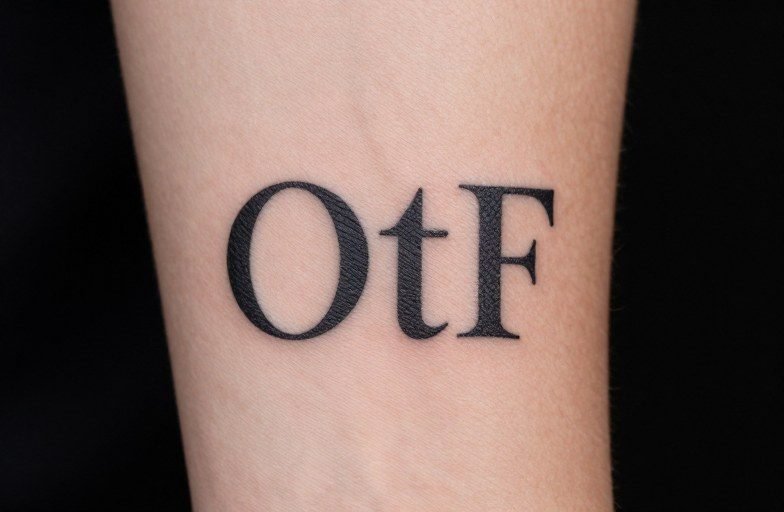
OTF stands for “Only The Family,” a phrase tied to loyalty, blood bonds, and inner-circle trust. In tattoo form, it functions as a pledge, sometimes to actual relatives, sometimes to chosen family, sometimes to a street crew or rap collective with shared values. The letters carry weight because they’re compact, instantly recognizable to those in the know, and adaptable across dozens of visual styles.
Symbolism & History
Where the Letters Come From
The acronym blew up through Chicago drill music, often linked to the rap collective founded by Lil Durk. That mainstream exposure pushed OTF from regional street slang into global tattoo vocabulary. Some trace it to older neighborhood codes where “family” meant who you ride with, not who you’re related to. The tattoo borrows that same energy: a public signal of private allegiance.
Beyond the rap connection, the letters get repurposed by people who’ve never heard a drill track. “Only The Family” translates cleanly across subcultures, motorcycle clubs, military units, childhood friend groups. The core symbolism stays consistent: us against them, no outsiders, loyalty tested and proven.
What the Letters Represent
- Loyalty over everything: The tattoo marks a permanent commitment to a specific group or set of values.
- Loss and remembrance: Some get OTF after losing someone who embodied that ride-or-die mentality.
- Rejection of fair-weather bonds: The phrase implies most people aren’t worth the trust.
- Self-accountability: A smaller segment uses it as a personal reminder to put family first in their own decisions.
Common Variations & Styles
Lettering Approaches
Script dominates. Cursive OTF flows across forearms, chests, or collarbones with connected letters that read as one continuous gesture. Old English or blackletter gives it a heavier, more territorial feel, common in chest pieces where the letters anchor a larger composition. Block letters, sometimes with a slight tilt or shadow, mimic sports jersey typography and read younger, more athletic.
Negative space lettering has picked up traction. The letters get carved out of a solid black shape, so you see skin-tone OTF against heavy fill. That approach ages better than thin-line script because the surrounding black holds contrast even as the inner lines soften slightly.
Added Imagery
- Crowns: Usually placed above the letters, signaling leadership or self-respect within the group.
- Roses or money bands: Tied to the “get it for the family” hustle mentality.
- Doves or halos: Memorial versions for lost members.
- Crosses or praying hands: Blends street loyalty with religious devotion, particularly in Southern U.S. interpretations.
- Neighborhood numbers: Area codes or block digits tucked beside or below the letters.
Color vs. Black and Grey
Black and grey rules this tattoo. Color creeps in occasionally, red drops for blood ties, green for money motivation, but most wearers stick to solid black. The reasoning is practical: black holds up under any lighting, any age, any social context. A forearm OTF in clean black script works at a job interview (long sleeves) and at a backyard cookout (sleeves up).
Best Placements
Forearms win for visibility. The letters sit where you can see them, others can read them, and the flat surface lets script flow without distortion. Inner forearm protects slightly from sun fading; outer forearm gets more exposure but also more admiration.
Chest pieces center the letters over the heart, literal and not subtle. This placement usually means larger scale, sometimes with the letters inside a banner or scroll. The pectoral muscle movement makes straight lines tricky; experienced artists map the design with the client flexing and relaxing.
Hands and fingers carry the most risk. OTF finger tattoos blur fast, blow out easily, and hurt intensely. The reward is maximum visibility, the cost is likely touch-ups every few years. Neck placements split the difference: visible, serious, but easier to cover than face ink.
Behind the ear and along the jawline have emerged as quieter options. Small, single-needle OTF in these spots reads almost like a whispered secret rather than a shouted claim.
Who Chooses This Tattoo / Personal Meanings
The Core Demographics
Young men in urban environments get this tattoo most frequently, though the gender gap has narrowed. Women often choose more delicate script or pair OTF with floral elements, recontextualizing the phrase away from pure street hardness. Age ranges cluster heavily in the late teens to early thirties, old enough to understand permanence, young enough to still define identity through group belonging.
Individual Motivations
- Actual siblings: Matching OTF tattoos between brothers or sisters, sometimes with birth dates or shared last initials.
- Survivors of group trauma: Friends who made it through violence, addiction, or incarceration together.
- Artists and musicians: Fans of the rap collective who feel the music articulated something about their own lived experience.
- Reformed individuals: Former gang members who keep OTF but redefine “family” as legitimate loved ones they’re now providing for.
The tattoo functions as a boundary marker too. Wearing OTF signals who you don’t need to explain yourself to. That can be protective in hostile environments and isolating in unfamiliar ones.
Similar Symbols
OTF overlaps with several loyalty tattoos that carry comparable weight. “Ride or Die” script covers similar emotional territory but reads more romantic, often couple-oriented. “Family First” is the cleaner, more mainstream version, less street, more universal. Roman numerals of significant dates achieve the same memorial function without the cultural baggage.
Crown of thorns or barbed wire sometimes accompanies OTF in the same visual language of protective suffering. Praying hands with a rosary, particularly in Chicano black and grey tradition, shares the devotional intensity. The difference is specificity: OTF names the group, while these other symbols gesture toward the feeling.
Street codes from other regions offer direct parallels. “MOB” (Money Over Bitches, Members Only Business, or simply the mob) operates similarly. “GD” or “BD” references carry actual gang affiliation, which OTF sometimes avoids and sometimes blurs into depending on the wearer’s actual ties.
Final Thoughts
OTF tattoos work because they’re legible across multiple worlds, street, music, family, personal code, without fully belonging to any single one. The letters compress complex loyalty into three characters that fit almost anywhere on the body. That flexibility is the real design strength.
If you’re considering one, the question isn’t whether the letters look good. It’s whether you’ll still mean them in fifteen years when the script softens, the context shifts, and the people who defined “family” have come and gone. The best OTF tattoos outlast their original reference points because the wearer redefines the letters as life changes. The worst ones become trapped in a specific moment that no longer fits.
Placement and lettering style matter more than added imagery. Clean, readable, well-spaced letters in a spot you control the visibility of, that’s the foundation. Everything else is decoration on a promise you’re making to yourself and whoever you count as yours.
Frequently Asked Questions
Does getting an OTF tattoo mean I’m joining a gang?
Not automatically. Many people use OTF for literal family loyalty or personal codes completely separate from gang culture. Context matters, pairing it with specific neighborhood numbers or gang symbols changes the reading significantly.
How much should an OTF script tattoo cost?
Simple three-letter script runs $80, $200 depending on the artist’s rate and your city’s market. Intricate custom lettering with ornamental details can push $400, $600. Hand or neck placement often adds a premium due to difficulty.
Will OTF finger tattoos fade quickly?
Yes, finger tattoos fade faster than almost anywhere else. The skin regenerates constantly, ink doesn’t settle deep, and daily friction wears letters down. Plan on touch-ups every 1, 3 years, or choose a bolder, simpler font to maximize longevity.
Can I cover up an OTF tattoo if I change my mind?
Three compact letters are coverable, but placement limits options. Forearm OTF can become part of a larger sleeve. Finger or hand OTF is harder to hide or transform, laser removal is often the more practical path for highly visible regrets.
Related Tattoo Meanings
- Fenrir Tattoo Meaning: Norse Wolf Symbolism Style Guide
- Peach Tattoo Meaning: Symbolism, Styles Placement
- Pelican Tattoo Meaning: Sacrifice, Renewal Coastal Devotion
- Explore more









