
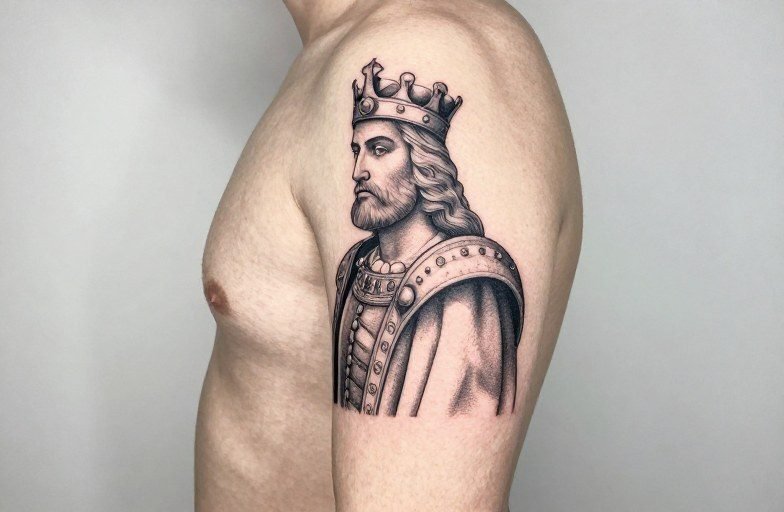
The King Baldwin tattoo most commonly depicts Baldwin IV, the 13th-century leper king of Jerusalem who led Crusader forces despite debilitating illness. For most wearers, it represents unyielding leadership through physical suffering, faith under duress, and the refusal to surrender authority when the body fails. The image carries particular weight in Orthodox Christian, Eastern European, and military-veteran communities, though its appeal has broadened through recent film and gaming depictions.
Symbolism & History
The Historical Figure
Baldwin IV ruled Jerusalem from 1174 to 1185, ascending as a teenager and battling leprosy throughout his reign. He defeated Saladin at the Battle of Montgisard in 1177 despite being unable to close his right hand or feel his limbs. The mask he reportedly wore to hide facial disfigurement has become the dominant visual reference, more recognizable than his actual portrait.
This historical reality shapes the tattoo’s core symbolism:
- Leadership despite physical limitation
- Religious duty maintained through suffering
- Military competence separated from bodily wholeness
- The mask as both concealment and public performance
Religious & Cultural Layers
The Crusader context matters. Baldwin’s story is often linked to Christian martyrdom narratives, particularly in Eastern Orthodox traditions where suffering for faith holds raised status. Some trace the tattoo’s popularity in Balkan and Russian tattoo culture to this religious framing, though the image also circulates in secular nationalist contexts where “Crusader” becomes shorthand for European or Christian identity.
Separating these threads matters for anyone considering this design. The same image reads differently in a Serbian Orthodox church basement versus a Florida tattoo shop where the wearer discovered it through a video game.
Common Variations & Styles
The Masked Portrait
The most frequent depiction shows Baldwin in profile or three-quarter view, silver or iron mask covering the lower face. Line work dominates here, fine black lines defining the mask’s planes, the visible eye, and chainmail or crown details. Shading, when present, stays minimal: dotwork for texture, perhaps a single gray wash for depth behind the figure. This restraint suits the subject; ornate color would undermine the austerity.
Some versions show the mask lifted or broken, revealing diseased skin beneath. This variation intensifies the vulnerability theme but risks graphic shock value. The decision between masked and unmasked usually reveals what aspect the wearer wants to emphasize, public duty versus private suffering.
Battlefield & Equestrian Scenes
Full compositions place Baldwin on horseback at Montgisard, sometimes with Saracen forces in retreat. These require substantial skin real estate: full back, thigh, or chest panels. The horse’s anatomy demands an artist comfortable with animal proportions; a poorly rendered horse collapses the entire composition. Color here tends toward earth tones, ochre, rust, dried blood, rather than bright Crusader heraldry.
Stylized & Abstract Approaches
Neo-traditional versions flatten the mask into geometric planes, sometimes incorporating stained-glass patterns or Gothic architectural elements. Single-needle realism attempts historical accuracy, often referencing the few contemporary descriptions rather than the anachronistic silver mask from later depictions. Blackwork and woodcut styles strip away detail for maximum graphic impact, suitable for smaller placements.
Best Placements
The masked portrait works strongest where a viewer encounters it frontally: chest center, outer forearm, or calf front. The mask’s flat planes and single visible eye create immediate visual recognition; hiding this on a ribcage or inner bicep wastes the design’s confrontational quality.
For the equestrian scene, the back’s full vertical canvas allows the horse’s rearing posture and descending lance. Thigh placements suit seated poses but compress the vertical composition; the horse ends up looking compressed, legs splayed awkwardly.
Smaller mask-only designs, two inches or less, migrate to hands, throats, or behind ears in street and subculture contexts. These carry different connotations: gang identifiers in some European prisons, nationalist markers in others. Research local context before choosing these placements.
Healing realities affect placement too. The mask’s fine lines around eye holes and nose vents blur easily on high-movement areas like wrists or elbows. Touch-ups within a year are common for these placements. Chest and thigh skin holds sharper detail longer.
Who Chooses This Tattoo / Personal Meanings
Military & Service Communities
Veterans and active service members sometimes select Baldwin to mark continued service despite injury, amputations, chronic pain, PTSD. The parallel is explicit: the king fought while his body disintegrated. These wearers often pair the image with unit insignia, deployment dates, or religious text in banner scrolls.
Medical & Disability Experience
People managing visible or progressive conditions, autoimmune disorders, degenerative diseases, disfigurement from accident, use Baldwin to reclaim public visibility on their own terms. The mask becomes paradoxical: it hides, but the tattoo reveals. Several online communities document this specific adoption, though no formal study tracks prevalence.
Faith & Heritage Contexts
Eastern European and Middle Eastern Christian communities sometimes use Baldwin within broader Crusader-saint iconography, particularly where historical Christian minority status persists. The image connects present-day religious endurance to medieval precedent. This usage often appears alongside crosses, specific saint portraits, or Church Slavonic text.
Pop Culture Discovery
Film and game depictions have introduced Baldwin to audiences with no prior historical attachment. These wearers may emphasize aesthetic or narrative drama over specific symbolism, drawn to the masked figure’s visual power without Crusader ideological commitment. The meaning here is more diffuse: struggle generally, mystery, medieval atmosphere.
Similar Symbols
Several tattoos occupy adjacent symbolic territory and appear in similar placements:
- The Wounded King / Fisher King (Arthurian): Also depicts leadership through bodily failure, but without historical specificity or Crusader baggage. More explicitly mythological, less politically charged.
- St. Lazarus (raised from death): Christian resurrection imagery, sometimes used for recovery from illness. The leprosy connection overlaps with Baldwin’s historical condition.
- Masked plague doctor: Shared visual vocabulary of medical concealment, but from different historical moment. Less military, more collective catastrophe.
- Spartan or Roman helmet portraits: Similar martial endurance symbolism, stripped of medieval religious context. Less specific physical suffering, more generalized warrior ethos.
- Orthodox iconographic saints with visible wounds (St. Panteleimon, St. Dymphna): Direct religious healing intercession rather than active leadership despite affliction.
The Baldwin image’s particular concentration, single historical figure, documented military achievement, progressive physical collapse, creates narrower specificity than these alternatives. Wearers seeking exact narrative alignment find it here; those wanting broader symbolism often drift toward the Arthurian or classical alternatives.
Final Thoughts
The King Baldwin tattoo carries genuine historical weight that simpler warrior imagery lacks. That weight can serve as anchor or burden depending on the wearer’s knowledge and intent. The masked face, borrowed from later romantic depictions rather than contemporary sources, has become the recognized symbol, historical accuracy less relevant than accumulated cultural recognition.
Line work quality determines whether this tattoo succeeds aesthetically. The mask’s planes must read as metal, not skin; the visible eye must convey intelligence despite concealment. Poor execution produces a generic armored figure indistinguishable from countless fantasy illustrations. Seek artists with demonstrated portrait and historical subject portfolios, not merely general realism skill.
Social context matters for placement and visibility. The Crusader reference carries loaded associations in pluralistic or Muslim-majority environments. Understanding this before committing respects both the image’s history and the wearer’s future interactions. The tattoo’s meaning is not fixed, it accumulates through who sees it, where, and what they already know.
Frequently Asked Questions
Did the real King Baldwin actually wear a metal mask?
Contemporary accounts describe facial disfigurement from leprosy, but the silver mask originates in later romantic and cinematic depictions. The tattoo image draws from these artistic traditions rather than documented historical practice.
Is this tattoo considered offensive or controversial?
The Crusader context can carry negative associations in Muslim communities or among people who view Crusader imagery as colonial or anti-Islamic. Context of placement, accompanying imagery, and wearer intent all shape how it’s received.
How well does fine line detail hold up in this design over time?
The mask’s vents, eye openings, and chainmail details commonly blur within 5-10 years, especially on high-movement or sun-exposed areas. Bold line versions age more predictably than delicate single-needle work.
What’s the typical cost range for a quality Baldwin portrait?
A palm-sized masked portrait in black and gray typically runs $400-800 at established shops, with equestrian full-back pieces reaching $2,000-4,000 depending on artist reputation and geographic location. Complex color or extensive background adds substantially.
Related Tattoo Meanings
- Kiss Tattoo Meaning: Romance, Rebellion, and Rock History
- Kokopelli Tattoo Meaning: Fertility, Music Southwest Spirit
- Lamb Tattoo Meaning: Innocence, Faith, and Quiet Strength
- Explore more









