
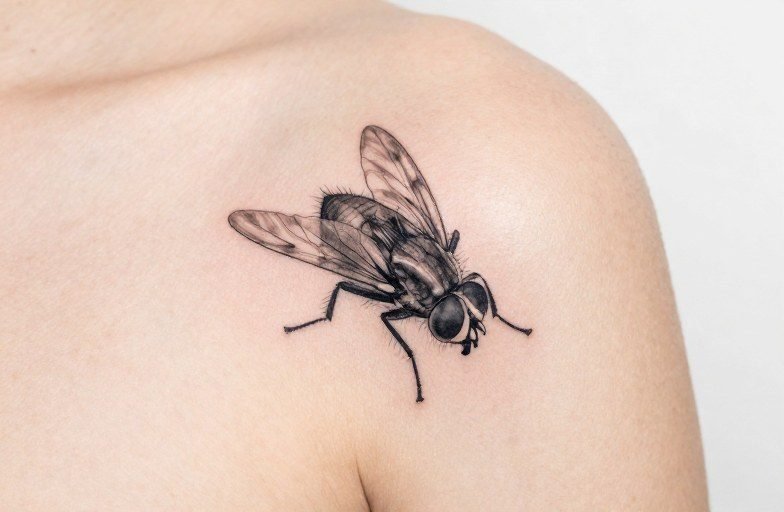
Fly tattoos most commonly symbolize mortality, decay, and the unstoppable cycle of life feeding on death, but they also carry threads of persistence, adaptability, and unflinching honesty about what actually happens to bodies and matter. Unlike butterflies or bees, which soften nature into something palatable, the fly refuses to be sanitized. That refusal is exactly why people choose it.
Symbolism & History
The fly’s symbolic weight runs deep and uncomfortable. In European traditions, the fly often linked to Beelzebub, the “Lord of the Flies,” a name that stuck through centuries of biblical translation. That association with corruption and sin still lingers in the symbol, though plenty of people today reclaim it as an acknowledgment of darkness rather than a submission to it.
Some trace the fly’s meaning to ancient Egyptian culture, where the gold fly was a military honor, awarded for persistence in battle, not beauty. The insect’s relentless return, its refusal to be swatted away permanently, became a virtue. That duality matters: the same creature that buzzes around waste also survives where more delicate things perish.
Decay and Mortality
Forensic entomology made the fly’s role in death visually familiar to everyone. Blowflies arrive within minutes. Their lifecycle on a body is so predictable that investigators use it to establish time of death. A fly tattoo can function as a memento mori without the skull’s theatricality, quieter, more biological, less romantic. The message: this happens, this will happen, the body is temporary substrate.
Persistence and Adaptability
Flies survive radiation, extreme temperatures, and most poisons. They colonize every continent including Antarctica. That resilience translates to personal symbolism for people who’ve persisted through illness, addiction, poverty, or systemic obstacles. The fly doesn’t triumph; it endures. The tattoo becomes a refusal of prettier metaphors for survival.
Common Variations & Styles
Style choices dramatically shift how a fly tattoo reads. The same insect rendered in different techniques communicates entirely different relationships to the symbol.
- Scientific illustration: Fine linework, labeled segments, anatomical accuracy. Reads as intellectual curiosity, naturalist identity, or clinical detachment. Works best at medium size (3-5 inches) where detail holds.
- Traditional/Americana: Bold black outlines, limited color palette, heavy saturation. The fly becomes a tough, almost humorous emblem, less about death, more about not giving a damn. Often paired with banners or dagger motifs.
- Blackwork/dotwork: Dense stippling creates texture and shadow. Excellent for capturing the fly’s iridescent body without color. Ages well because the technique already accounts for ink spread.
- Realism: Hyper-detailed compound eyes, transparent wing membranes, hairy thorax. Demands significant space and a specialist artist. The visceral reaction is the point, uncomfortable, unavoidable, alive.
- Minimalist/line: Single continuous line or extreme reduction. Surprisingly versatile; the fly’s silhouette is distinctive enough to read instantly even abstracted. Fades faster on high-movement areas but holds clean on forearms, ribs, upper back.
Color choices matter too. Metallic greens and blues reference the blowfly’s actual carapace. All black emphasizes shadow and death. Red eyes create a specific horror-movie association. Some people choose gold ink to reference the Egyptian military honor, though gold pigment is notoriously unpredictable, some brands heal to a mustard yellow, others disappear entirely.
Best Placements
Fly tattoos work almost anywhere, but placement affects both practical longevity and symbolic reading.
High-Visibility Areas
Hands, fingers, and neck make the fly impossible to ignore. The symbolism intensifies, you’re not hiding your relationship with decay or persistence. Finger flies, usually small and simple, have become a recognizable subgenre in certain punk and hardcore scenes. They fade fast due to constant use and sun exposure, requiring touch-ups every few years.
Medium and Concealed Placements
The ribcage and inner bicep offer space for detail while staying personal. The ribcage’s movement during breathing adds an unsettling quality to a realistic fly, subtle motion. Upper back and shoulder blades suit larger compositions, especially multiple flies or a fly with surrounding organic matter. The calf and thigh provide stable skin that ages predictably, good for fine linework that might blur on thinner, more mobile skin.
One practical consideration: fly wings are thin, detailed structures. In small tattoos, wing veins often bleed together during healing, becoming muddy lines. Artists compensate by simplifying vein patterns or using negative space rather than fine lines. Ask to see healed photos of small insect work before committing.
Who Chooses This Tattoo / Personal Meanings
There’s no single demographic. The fly attracts people who reject symbolic shortcuts.
Healthcare workers, particularly in palliative care and pathology, sometimes choose the fly as an unsentimental acknowledgment of what their work involves. Morticians and funeral directors occasionally use it similarly, professional identity inked into skin. People in recovery have described the fly as representing the bottom they crawled out from, not prettified, not heroic.
The fly also appears in artistic and literary communities with specific reference points: the cover of William Golding’s Lord of the Flies, the David Cronenberg film and its body-horror lineage, certain strains of industrial and death metal iconography. These aren’t universal meanings, they’re reference tattoos that require the right viewer to read correctly.
Some choose flies to commemorate specific deaths without the usual memorial language. The insect’s biological role in decomposition becomes a strange, honest tribute: this person became part of the cycle, returned to matter, fed what feeds what feeds us.
Similar Symbols
People considering flies often look at related imagery. Understanding the distinctions helps clarify whether the fly is actually the right choice.
- Moths: Also drawn to decay, but carry more romantic associations, attraction to flame, vulnerability, the moon. Softer, more tragic. The fly is less sentimental.
- Crows and ravens: Carrion birds with similar death-symbolism, but larger, more mythologically loaded, more visually dramatic. The fly is smaller, more ignorable, more pervasive.
- Beetles (especially scarabs): Ancient Egyptian overlap, but the scarab specifically symbolizes rebirth and solar cycles. The fly, even in Egyptian context, meant persistence and military honor, not transformation.
- Cicadas: Periodical emergence, resurrection symbolism, noise. The fly’s cycle is continuous, not cyclical, always present, not periodically reborn.
- Skulls: The standardized memento mori. The fly accomplishes similar work with less cliché, more specificity, and a living (not dead) symbol.
Final Thoughts
The fly tattoo works because it refuses to make things easy. It doesn’t offer redemption arcs or natural beauty. It sits with what actually happens to organic matter, to human bodies, to ambitions and plans. That sitting-with is the point. Whether rendered as a tiny finger stamp or a detailed ribcage piece, the fly asks the viewer to look at something they’d normally swat away. The people who choose it have already done that looking.
If you’re considering this tattoo, spend time with the specific species. A housefly, a blowfly, a crane fly, a horsefly, each carries different visual weight and biological reality. Bring reference photos from actual entomology, not tattoo flash. The best fly tattoos come from artists who’ve studied the insect’s actual anatomy, not symbolic shorthand. The discomfort of that specificity is what makes the tattoo last.
Frequently Asked Questions
Do fly tattoos always mean something dark or negative?
Not necessarily. While decay and mortality are common associations, the fly also symbolizes persistence, survival, and the Egyptian military honor of relentless determination. The meaning depends on which symbolic thread you emphasize and how you frame it in conversation.
How well do detailed fly tattoos age over time?
Fine wing veins and tiny leg segments tend to blur within five to ten years, especially on high-movement skin. Simplified designs with bolder lines and strategic negative space hold definition much longer. Discuss aging specifically with your artist before finalizing the design.
What’s the difference between a fly tattoo and a moth tattoo symbolically?
Moths carry romantic, tragic associations, drawn to flame, lunar, vulnerable. Flies are more biological and unsentimental, tied to decomposition and relentless persistence rather than transformation or doomed attraction. The moth mourns; the fly persists.
Is a fly tattoo appropriate for a memorial piece?
It can be, but it requires careful communication. The fly’s direct connection to decomposition reads as brutally honest rather than comforting. Some find that honesty meaningful; others prefer more traditional memorial imagery. Consider how the person being memorialized would have responded to the symbol.
Related Tattoo Meanings
- Johnny Silverhand Tattoo Meaning: Cyberpunk Rebellion Inked
- Pirate Tattoo Meaning: Symbolism, Styles What It Actually Says
- Poisonous Tree Tattoo Meaning: Danger, Growth Protection
- Explore more









