
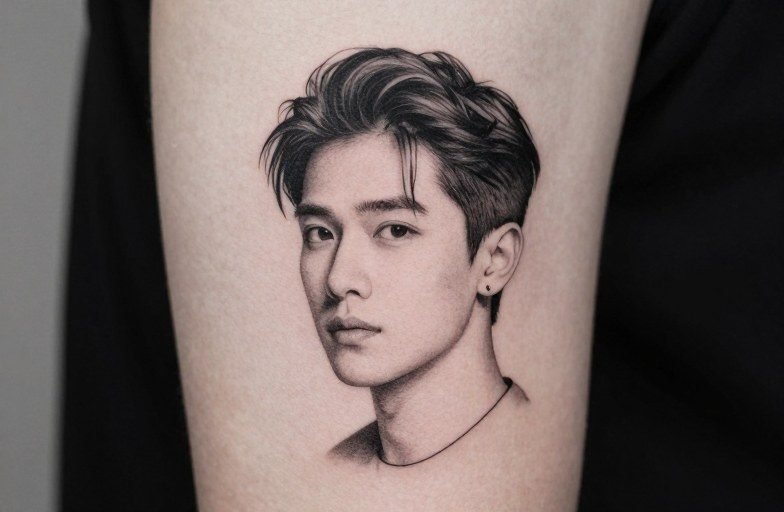
The Dear Hongrang tattoo originates from the 2024 Korean drama Dear Hongrang (홍랑에게), where the title character’s distinctive ink became a visual shorthand for hidden identity, fated love, and the tension between who you are and who the world believes you to be. For viewers and tattoo collectors alike, it represents the idea that markings, both physical and emotional, can be both concealment and revelation.
Symbolism & History
Drama Origins & Narrative Weight
In the series, Hongrang’s tattoo functions as a plot-critical device: a mark that connects past to present, servant to master, truth to deception. The design draws from Joseon-era aesthetics while speaking to contemporary Korean tattoo culture, which has historically operated under legal and social pressure. The drama uses the tattoo as a loaded object, beautiful, dangerous, and impossible to ignore.
The symbolism resonates beyond the screen:
- Concealed identity: The tattoo hides in plain sight, visible yet unreadable to those without context
- Fated connection: Marks that bind characters across time and social class
- Agency under constraint: A body marked by choice within systems that deny choice
- Transformation: The moment of becoming someone new, marked permanently
Cultural Context
Korean drama tattoos occupy a specific symbolic register. Unlike Western media’s biker-gang or military-rite associations, K-drama ink often signals romantic destiny, tragic backstory, or supernatural burden. The Dear Hongrang tattoo continues this tradition while reflecting real shifts in South Korean tattoo culture, particularly the ongoing legal ambiguity around who can legally tattoo (currently restricted to medical professionals, though widely practiced underground).
Common Variations & Styles
Screen-Accurate Reproductions
Some collectors pursue precise replication of the drama’s prop design, which features delicate linework with traditional Korean decorative elements, cloud motifs, floral borders, or hanja characters integrated into the composition. These typically render at 3-5 inches, requiring a steady hand for the fine lines that blur faster than bold traditional work.
Interpretive Adaptations
More common are personalized versions that preserve the emotional DNA while altering visual specifics:
- Minimalist line: Single-needle Korean characters or abstracted forms, often placed on inner wrist or collarbone
- Illustrative: Expanded scenes incorporating drama imagery, costume details, specific episode moments, paired character marks
- Blackwork integration: The design as one element within larger Korean-inspired sleeves or back pieces
- Color additions: Subtle red or gold accents referencing Joseon royal palette, though most stay strictly black
Line weight matters enormously here. The drama’s aesthetic leans fine and wispy, but tattoo aging demands consideration. Single-needle work at small sizes can blow out or fade to gray mush within five years. A skilled artist will thicken strategic lines slightly, maintaining visual delicacy while ensuring the piece holds.
Best Placements
The original drama placement, visible when costumes permit, hidden when strategy requires, suggests locations with similar theatrical potential.
- Inner forearm: Most popular. Visible in short sleeves, concealable with a long sleeve or strategic positioning. Offers flat skin for clean line execution.
- Upper arm/shoulder: Traditional Korean tattoo territory. Good canvas for expanded designs with surrounding decorative elements.
- Side ribcage: Intimate, painful, genuinely hidden. Suits the drama’s themes of secret-keeping.
- Upper back, between shoulder blades: Classic placement for marks of identity or destiny in East Asian visual storytelling.
- Behind the ear or nape: Small-character versions only. High fade risk from sun and friction.
Healing reality: fine-line work on mobile areas (wrists, inner arm near elbow) faces more movement during healing, which can affect line crispness. Plan for two weeks of genuine restriction, no gym, no swimming, no picking at flakes that take pigment with them.
Who Chooses This Tattoo / Personal Meanings
The Drama Devoted
Primary audience: viewers who experienced the series as emotional event rather than casual entertainment. These collectors often pair the tattoo with specific episode references, quotes, or companion marks referencing the drama’s central relationship. The tattoo functions as membership badge in a fan community that spans languages and continents.
Broader Resonance
Beyond fandom, the design attracts people drawn to its thematic content without direct drama attachment:
- Those navigating identity transitions, name changes, gender journeys, career pivots, who connect to the “hidden self becoming visible” arc
- Collectors of Korean cultural imagery seeking contemporary reference points beyond traditional motifs
- People marked by formative relationships they cannot publicly acknowledge
- Romantic realists who understand love as something that scars
Age distribution skews young, twenties and thirties, matching K-drama’s global demographic. However, the tattoo’s literary quality (the title itself reads like correspondence, like intimacy addressed) attracts older collectors with patience for narrative depth.
Similar Symbols
For those drawn to the Dear Hongrang concept but seeking alternatives, several related visual traditions exist:
- Korean magpie tattoos: Often linked to joy and good news, but dramatically deployed in period pieces as omens or messengers
- Hanja calligraphy: Single meaningful characters rendered in various script styles, more abstract but similarly text-rooted
- Thai sak yant: Sacred geometry with comparable narrative weight in their native dramatic tradition, though culturally distinct
- Chinese drama-inspired marks: From series like The Untamed or Nirvana in Fire, where tattoos or spiritual marks carry plot-significant meaning
- Western literary tattoos: Dickensian character marks, Poe imagery, similar function, different visual language
The Dear Hongrang tattoo occupies a specific niche: contemporary enough to feel current, traditional enough in visual language to age well, emotionally specific enough to reward the devoted, thematically open enough to include the casually connected.
Final Thoughts
The Dear Hongrang tattoo succeeds because it does what the best drama-inspired ink accomplishes, translates a specific fictional moment into a durable personal symbol without requiring footnotes. Someone who has never heard of the series can still read the design as beautiful, mysterious, and emotionally weighted. Someone who has watched every episode twice finds layers invisible to outsiders.
Technical execution demands honesty about the tension between screen aesthetics and skin reality. The drama’s lighting, makeup, and post-production created a tattoo that never needs to heal, never faces sun damage, never blurs with age. Your version will. Choose an artist who understands Korean line traditions, who won’t default to generic Asian-fusion styling, and who will tell you when your desired size compromises longevity.
The mark Hongrang carried was both burden and proof. Yours can be whatever you need it to be, remembrance, aspiration, secret kept in skin.
Frequently Asked Questions
Do I need to watch the drama to get this tattoo?
Not at all. Many collectors connect with the visual style or thematic elements, hidden identity, fated love, transformation, without knowing the source material. The design carries weight independent of its origin.
How much should I expect to pay for a quality Dear Hongrang tattoo?
Fine-line work with Korean traditional elements typically runs $150-$400 for smaller pieces, $400-$800 for larger or more detailed versions. Rates vary significantly by artist location and experience. Prioritize technical skill over bargain pricing with this style.
Will Korean characters in the tattoo be readable to native speakers?
Depends entirely on your artist’s familiarity with Korean script. Many tattooists can copy characters accurately but lack understanding of stroke order, spacing, or cultural nuance. Request an artist with demonstrated Korean-language work, or verify your design with a native speaker before needling.
How do I make sure the fine lines don’t blur over time?
Start slightly larger than the drama’s screen version, minimum 3 inches for complex designs. Follow aftercare precisely: keep moist, avoid sun during healing, and plan for touch-ups every 5-8 years. Black ink on lighter skin holds crispness longest; darker skin tones may need bolder line weights for equivalent longevity.
Related Tattoo Meanings
- Squirrel Tattoo Meaning: Resourcefulness, Play Preparedness
- Doberman Tattoo Meaning: Loyalty, Protection Power
- Don Lorenzo Tattoo Meaning: Symbolism, Styles Placement
- Explore more









