
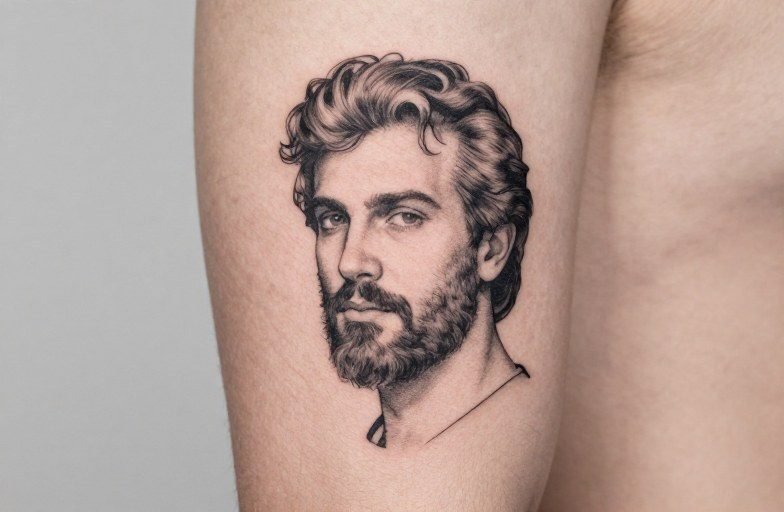
The Don Lorenzo tattoo centers on a folk saint figure rooted in Mexican and Chicano culture, typically depicted as a skeletal or robed male figure holding scales, a scythe, or coins. Most commonly, this imagery connects to San Lorenzo (Saint Lawrence), the Christian martyr, but filtered through folk traditions that emphasize his role as a protector of the poor and a judge of moral balance. In tattoo culture, particularly within Chicano and Latino street art traditions, Don Lorenzo has evolved into a symbol of divine justice, loyalty to one’s community, and the weighing of life’s choices.
Symbolism & History
Religious Roots and Folk Adaptation
San Lorenzo, martyred in 258 AD on a gridiron, traditionally carries the palm of martyrdom and his instrument of death. Mexican folk devotion often softens this brutality, focusing instead on his generosity in distributing church treasures to the poor. The “Don” honorific, signifying respected elder status, reflects how communities raised him beyond standard saint veneration into a paternal protector figure. Some trace this specific iconographic blend to mid-20th century barrio devotional art, though the exact timeline remains diffuse across regional practices.
Scales, Scythe, and Coins
The objects Don Lorenzo holds carry layered significance. Scales represent judgment and moral reckoning, whether divine or internal. The scythe, often linked to Santa Muerte imagery nearby in folk practice, suggests the inevitability of death and the harvesting of souls. Coins specifically reference San Lorenzo’s distribution of wealth, but in tattoo contexts frequently symbolize the tension between material survival and spiritual integrity. Black and grey rendering dominates these elements, allowing subtle gradation that makes metallic surfaces read as genuine.
- Scales: moral balance, choices weighed, karmic justice
- Scythe: mortality, finality, the reaping of consequences
- Coins: poverty and generosity, the ethics of money, street economics
- Robe or cloak: dignity maintained despite material circumstances
Common Variations & Styles
Chicano Black and Grey Realism
The dominant style for Don Lorenzo tattoos remains fine-line black and grey with smooth shading transitions. Faces require particular technical precision, too heavy on the black and the figure becomes a skull; too light and the saintly quality dissolves. Experienced artists build depth through multiple grey washes rather than solid blacks, preserving the human warmth beneath the skeletal suggestion. This approach demands healthy skin that holds detail; sun-damaged or heavily calloused areas will blur the subtle gradations within two to three years.
Color Variations and Fusion Styles
Some collectors incorporate muted earth tones, deep burgundy robes, oxidized gold coins, tobacco-stained backgrounds, to distinguish their piece from standard monochrome Chicano work. Newer adaptations blend the figure with geometric framing or letterform banners carrying names or dates. Watercolor backgrounds behind traditional figuration create tension between old and new approaches, though this pairing ages unevenly; the loose color bleeds while the tight figure holds, creating visual dissonance that may or may not be intentional.
- Full figure with architectural background (gates, church facades, prison walls)
- Portrait crop focusing on face and scales alone
- Don Lorenzo integrated into larger religious sleeve or chest piece
- Minimalist line-work version for smaller placements
Best Placements
The chest and upper back provide the broad, flat planes that let Don Lorenzo’s robes and implements read at proper scale. A full figure needs roughly eight to ten inches of vertical space to avoid compressing the scales into unreadable blobs. The outer upper arm works for single-figure compositions, though the cylindrical surface distorts the symmetry of balanced scales slightly. Forearms suit smaller portrait versions but risk faster fading from constant sun exposure and washing.
Hand and neck placement, while popular in some street culture contexts, presents specific problems for this imagery. The fine lines defining facial structure and scale chains blur rapidly on hands; neck skin’s constant movement accelerates grey wash degradation. Ribs and stomach offer large areas but stretch and compress with breathing, distorting the figure’s solemn stillness. For longevity, the upper chest centered over the sternum or the flat between shoulder blades remains the most reliable choice.
Who Chooses This Tattoo / Personal Meanings
Community and Cultural Connection
Collectors with Mexican or Chicano heritage often select Don Lorenzo to maintain visible connection to family devotional practices, particularly when separated from those communities by distance or circumstance. The tattoo functions as portable altar, saint imagery that travels across state lines or prison walls. This isn’t performative ethnicity; it’s practical continuity for people whose religious life has always blended official and folk practice.
Justice and Personal Reckoning
Others gravitate toward the scales specifically, having faced situations where moral choices carried heavy consequences. Former prisoners, recovering addicts, people who’ve survived violent environments, Don Lorenzo’s judgment imagery resonates with those who’ve weighed their own actions and seek external symbolization of internal accounting. The figure doesn’t celebrate past behavior; it acknowledges the weighing process itself as honorable.
- Protection during dangerous work or living situations
- Memorial for deceased family members who held similar devotion
- Marker of personal transformation or “reckoning” with past self
- Affiliation with specific neighborhoods or crews without explicit naming
Similar Symbols
Santa Muerte tattoos share the skeletal figuration and object-holding composition, but shift focus from judgment to mercy and direct intervention. San Judas Tadeo (Saint Jude) offers another Mexican folk saint popular in tattoo culture, though his imagery emphasizes impossible causes rather than moral balance. The Grim Reaper, stripped of religious context, carries similar scythe symbolism but loses the protective, community-rooted dimension entirely.
La Mano Poderosa and various Virgen de Guadalupe adaptations occupy adjacent cultural territory but serve different functions, familial blessing rather than individual moral scrutiny. For collectors considering Don Lorenzo, the key distinction is whether they want a figure that judges alongside them or one that intercedes on their behalf. Don Lorenzo does both, but leans toward the former.
Final Thoughts
The Don Lorenzo tattoo rewards careful artistic selection and honest self-assessment about why the imagery matters. Its strength lies in specificity, this particular saint, these particular objects, this particular cultural lineage, rather than generic “spiritual” appropriation. Work with artists who understand Chicano black and grey technique, not merely blackwork generally. Budget for the time proper shading requires; rushed Don Lorenzo pieces flatten into indistinguishable grey smears within months. Most importantly, carry the symbol with the same gravity the figure’s expression suggests: judgment as responsibility, not threat.
Frequently Asked Questions
Is Don Lorenzo the same as Santa Muerte?
No. While both appear as skeletal figures in Mexican folk art, Don Lorenzo derives from San Lorenzo and emphasizes judgment and moral balance. Santa Muerte functions as a death saint offering protection and miracles without moral conditions.
Can non-Latino people get this tattoo respectfully?
The imagery carries specific cultural weight. If the symbolism genuinely connects to your life experience, approach it with research and humility. Avoid mixing it with unrelated cultural elements or treating it as purely aesthetic.
How much does a quality Don Lorenzo tattoo typically cost?
Black and grey realism at this detail level requires multiple sessions. Expect significant investment proportional to the artist’s skill level and your local market rates. Prioritize technical ability over bargain pricing.
Does the scythe mean the same thing as in Grim Reaper tattoos?
Within Don Lorenzo context, the scythe connects to harvesting souls and final judgment rather than pure death personification. The scales beside it shift the meaning toward measured reckoning rather than inevitable termination.
Related Tattoo Meanings
- Eye of the Storm Tattoo Meaning: Calm, Chaos, and Control
- Filled Tear Drop Tattoo Meaning: Symbolism, Styles Placement
- Fly Tattoo Meaning: Decay, Resilience, and Unflinching Honesty
- Explore more









