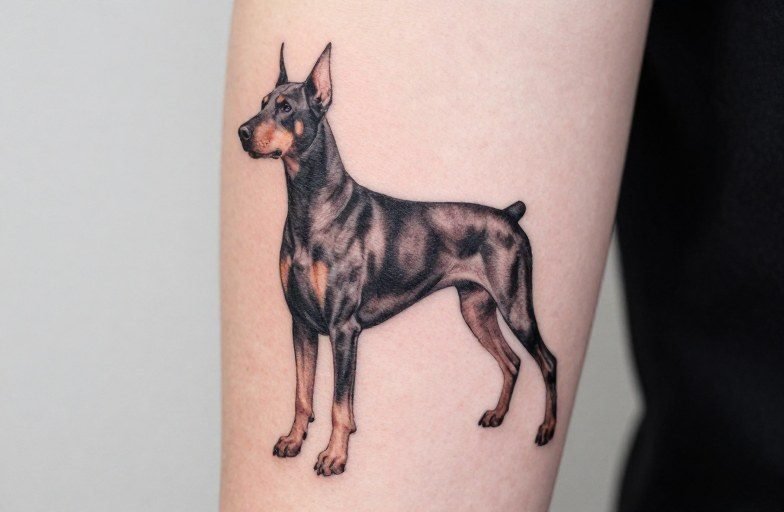
A Doberman tattoo carries weight. this design stands for loyalty, protection, and controlled aggression, the dog bred to guard, not to attack without cause. Most people who choose this image aren’t showing off toughness; they’re marking something they protect fiercely or someone who protects them.
Symbolism & History
The Breed’s Built-In Meaning
The Doberman Pinscher emerged in late 19th-century Germany, bred specifically as a personal protection dog. That origin gives the tattoo its backbone: alertness, discipline, and readiness. Unlike the wolf (wild, untamed) or the pit bull (often reclaimed from negative stereotypes), the Doberman occupies a specific space, domesticated but dangerous, elegant but functional. The breed’s cropped ears and docked tail, controversial in animal welfare circles, also factor into tattoo imagery. Many designs emphasize those sharp, alert ears, which visually signal vigilance.
Military & Service Connections
Dobermans served extensively in both World Wars as messenger dogs, sentries, and mine detectors. The U.S. Marine Corps famously used them in the Pacific theater. This history often links the tattoo to veterans, active service members, or families with military ties. Some designs incorporate unit insignia, dog tags, or American flag elements. The connection isn’t automatic, plenty of civilians choose the breed, but it’s a recognized thread in the tattoo’s symbolism.
- Protection of family, property, or personal boundaries
- Loyalty to a specific person, group, or code
- Discipline and self-control (the “attack dog” that doesn’t attack without command)
- Vigilance, staying watchful against threats
- Remembrance of a specific Doberman companion
Common Variations & Styles
Realistic Portraits
These demand a skilled artist. Doberman coats show subtle color shifts, black, red, blue, or fawn, with distinct rust markings above the eyes, on the muzzle, chest, and legs. A good portrait captures the breed’s wedge-shaped head, almond eyes, and athletic build. Photo references matter enormously here. Line weight variation helps distinguish the short, sleek coat from background elements. Without proper contrast, a realistic Doberman can flatten into a dark blob as it ages.
Traditional & Neo-Traditional
Traditional American style suits the Doberman surprisingly well. Bold black outlines, limited color palettes, and graphic simplicity translate the dog’s sharp angles into readable, long-lasting tattoos. Expect heavy black fills, maybe a red collar or tongue for pop. Neo-traditional allows more detail, ornamental backgrounds, jewel tones, decorative elements, while keeping the graphic punch. These styles age better than hyper-realism because the bold lines hold up against skin changes and sun exposure.
Geometric & Abstract
Some designs break the Doberman into polygonal shapes or negative-space silhouettes. These read more modern, less literal. The geometric approach works well for smaller pieces where fine detail would blur. A clean side-profile silhouette, ears erect, can communicate the breed instantly without shading or color. Abstract versions might focus on the ear shape alone, or the distinctive chest and foreleg stance.
- Portrait style: high detail, needs large scale, fades faster without strong black contrast
- Traditional/neo-trad: bold, readable, ages well, limited color range
- Geometric/abstract: scalable, modern aesthetic, less breed-specific recognition at small sizes
- Black and grey: classic, relies on smooth shading gradients
- Full color: rare for this breed; most stay monochromatic with rust accents
Best Placements
The Doberman’s long, athletic body shape influences placement choices. A side-profile portrait follows the natural lines of a forearm, calf, or ribcage flow. The dog’s raised ears and alert posture suit vertical placements, thighs, upper arms, sides of the torso, where the design can stand tall.
Forearm and calf: Excellent for medium-sized portraits. The cylindrical shape wraps slightly, so a forward-facing or three-quarter view works better than strict profile. These spots show easily, which matters if the tattoo marks public-facing identity.
Chest and back: Large canvases for detailed realism or compositions with additional elements, floral backgrounds, military insignia, names or dates. The broad, flat planes suit the Doberman’s stance when depicted head-on or in a guarding posture.
Ribcage and hip: Painful, but the elongated space suits a running or leaping pose. These placements stay private, which fits if the tattoo represents personal loss or intimate loyalty.
Hands and neck: High visibility, high commitment. A small Doberman head works here in traditional or simplified styles. Fine detail won’t hold; bold lines and solid blacks are essential.
Consider how the tattoo will sit with others. A Doberman among floral pieces reads differently than one surrounded by military or motorcycle imagery. The same design shifts context by placement and neighbors.
Who Chooses This Tattoo / Personal Meanings
Breed Owners & Animal Memorials
The most straightforward group: people who lived with a Doberman and want permanent memorial. These tattoos often include names, dates of birth and death, or specific physical traits, a scar, a white chest patch, a particular ear crop style. The meaning is concrete, not abstract. Artists should ask for multiple photos and note what made that individual dog recognizable.
Protection & Boundary-Setting
People who’ve survived violation or threat sometimes choose guardian imagery. The Doberman fits this need precisely, bred to deter, not to seek conflict. It’s the dog that makes intruders think twice. This meaning stays private usually; the wearer knows why it’s there without explaining.
Discipline & Self-Mastery
The breed’s trainability and work drive attract people marking personal transformation. Recovery from addiction, military training completion, athletic commitment, the Doberman represents the will to follow through. Unlike the wolf (instinct) or lion (pride), this symbol emphasizes learned control over raw capability.
- Former Doberman owners and handlers
- Veterans and active military with K9 unit connections
- People marking protective roles, parents, partners, caregivers
- Individuals who value discipline and structured strength
- Those drawn to the breed’s aesthetic: sleek, dark, architectural
Similar Symbols
If the Doberman doesn’t quite fit, related imagery might. Understanding the distinctions helps clarify why someone chooses this breed specifically.
Rottweiler: Similar guardian role, heavier build, more associated with police and Schutzhund sport. The Rottweiler reads more grounded, less elegant; the Doberman more agile and alert.
German Shepherd: Versatile working dog, strongly associated with police and military service. Less specifically “personal protection,” more “public service.” The German Shepherd also carries different regional and cultural associations.
Wolf: Wild, pack-oriented, often chosen for independence or spiritual connection. The Doberman is domesticated purpose, human-directed, trained, controlled. These are fundamentally different energies.
Pit Bull: Heavily loaded with rescue-reclamation narratives, breed-specific legislation controversy, and American urban identity. The Doberman lacks that particular political weight, though both face breed stigma.
Lion or tiger: Traditional power symbols, less specific, more universal. The Doberman offers particularity, modern, breed-specific, less mythological.
Guardian figures: Angels, saints, ancestral warriors. The Doberman replaces supernatural protection with trained, earthly vigilance. Some combine both: a saint’s image with a Doberman at their feet.
Final Thoughts
A Doberman tattoo works when the image matches the intent. The breed’s visual language, sharp angles, dark coat, alert stance, communicates before anyone asks meaning. Choose style and placement to support that communication: bold traditional for readability, careful realism for specific memorial, geometric for modern restraint. The tattoo lasts decades; the dog’s working history gives it substance beyond trend. Whether marking a companion, a role, or a personal code, this design carries its weight without needing explanation.
Frequently Asked Questions
Does a Doberman tattoo always mean someone is aggressive or dangerous?
Not at all. The breed symbolizes controlled protection, discipline over unchecked aggression. Most people choose it for loyalty, guardianship of loved ones, or memorializing a specific dog. The meaning centers on what you protect, not who you threaten.
How much detail can a small Doberman tattoo hold?
Less than you’d hope. Under three inches, the distinctive facial structure blurs. Go bold and simplified, silhouette, traditional style, or geometric breakdown. Save fine fur texture and realistic eyes for larger pieces where line weight can vary properly.
Why do some Doberman tattoos show cropped ears and docked tails while others don’t?
The cropped, erect ear is visually iconic and signals alertness, which is why many designs include it. However, ear cropping and tail docking are increasingly restricted or banned in many countries, and some owners prefer natural-eared representations. Both versions exist; the choice often reflects personal preference or regional norms.
Can a Doberman tattoo work well in color, or should it stay black and grey?
Black and grey dominates because the breed’s coat is naturally dark. The rust markings do offer color opportunity, subtle red-brown accents on muzzle, chest, and legs. Full-color backgrounds (floral, military emblems) can frame a monochromatic dog effectively without fighting the natural palette.
Related Tattoo Meanings
- Don Lorenzo Tattoo Meaning: Symbolism, Styles Placement
- Eye of the Storm Tattoo Meaning: Calm, Chaos, and Control
- Filled Tear Drop Tattoo Meaning: Symbolism, Styles Placement
- Explore more