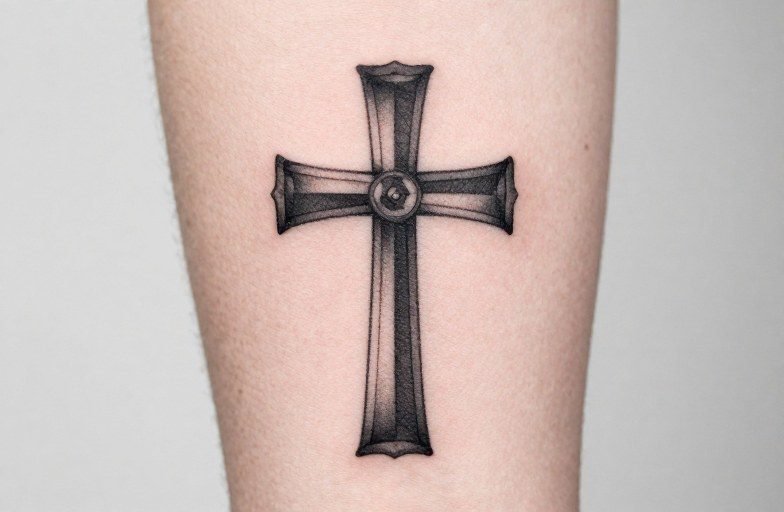
The crusader cross tattoo carries layered meaning rooted in medieval military history, Christian faith, and personal conviction. Most commonly, it signals strength of belief, warrior spirit, or a willingness to stand firm for one’s principles. Today, wearers range from devout Christians to history enthusiasts to people who simply connect with its visual weight of resolve and sacrifice.
Symbolism & History
Origins and Historical Context
The cross pattée or “cross formée” appeared on the tunics and shields of knights during the medieval Crusades, military campaigns often linked to Christian efforts to reclaim holy sites. The design’s flared, armored arms gave it a distinctive profile that distinguished crusader forces from other European military units. Some trace it to earlier Byzantine or heraldic traditions, but its strongest association remains with the Knights Templar, Knights Hospitaller, and Teutonic Knights.
Unlike the simple Latin cross, the crusader version carries martial energy. The widening arms suggest stability, a base that grounds and expands simultaneously. For modern wearers, this geometric solidity translates into personal symbolism: foundational faith, unshakable commitment, or the idea of being “armed” with conviction.
Modern Interpretations
Contemporary meaning splits along several paths. Some wearers emphasize the Christian devotional aspect, treating the cross as a mark of faith tested through struggle. Others focus on the historical warrior archetype: discipline, protection, service to a cause larger than oneself. A third thread involves heritage connection, family lineage traced to European military orders or specific regions where crusader history remains culturally present.
Importantly, the symbol has also been adopted by some extremist groups, which creates a tension thoughtful wearers navigate. Many counter this by pairing the cross with specific contextual elements, dates of personal significance, names, or complementary imagery that steers interpretation toward individual meaning rather than political statement.
Common Variations & Styles
The core design adapts remarkably across tattoo styles, each carrying different visual impact and aging characteristics.
- Classic heraldic: Bold black outline, minimal interior detail, sometimes with a ring or circle where arms intersect. Ages cleanly; the heavy line weight resists the softening that blurs fine work over decades.
- Templar-specific: Two knights on a single horse, the Beauceant banner, or the red cross on white background. More complex, requires larger scale to maintain readability as ink spreads slightly in skin.
- Stylized/modern: Geometric simplification, negative space techniques, or integration with compass roses, swords, or armor elements. Popular in blackwork and neo-traditional approaches.
- Text-integrated: Scripture references, unit mottos, or personal phrases wrapped around or through the cross arms. Demands careful font choice, overly ornate lettering blurs faster than clean sans-serif or traditional serif faces.
- Color vs. black and grey: Historical accuracy favors muted tones (crimson, iron grey, weathered gold). Contemporary pieces sometimes use high-contrast color for visibility, though black and grey typically ages more gracefully on most skin tones.
Line weight matters significantly with this design. The cross’s defining feature, those widening arms, depends on crisp edges. Too thin, and the geometry collapses as skin ages; too heavy, and the symbol becomes a blob. Experienced artists adjust proportion based on placement size and anticipated sun exposure.
Best Placements
Visibility and Professional Considerations
The crusader cross functions as a statement piece. Its historical weight and size requirements push most wearers toward placements that accommodate detail while matching their visibility comfort level.
- Upper arm/shoulder: Classic canvas for medium-sized heraldic versions. Muscle movement adds living dimension; the cross appears to shift slightly as the arm moves. Easy to cover with short sleeves if needed.
- Forearm: High visibility, suits elongated vertical or horizontal compositions. Sun exposure here is significant, expect more frequent touch-ups if you don’t use SPF consistently.
- Chest/pectoral: Symmetrical placement over the heart carries obvious symbolic resonance. Larger scale allows for Templar-specific additions or integrated text. Heals straightforwardly on this relatively flat, low-friction area.
- Calf or thigh: Accommodates substantial detail, less professionally risky than forearm or hand. The cylindrical shape requires the artist to design with curvature in mind, not simply transfer a flat image.
- Back, between shoulder blades: Central, altar-like positioning. Suits larger compositions with surrounding elements, banners, clouds, architectural framing.
Hand, neck, and face placements are rare with this specific design, not because of any rule but because the cross’s historical gravity clashes with the impulsive connotation of highly visible “job-stopper” spots. When seen there, it typically signals deep commitment rather than spontaneous choice.
Who Chooses This Tattoo / Personal Meanings
Demographic patterns exist but shouldn’t be overstated. Military personnel and veterans form a significant group, drawn to the warrior-service resonance and the cross’s use in some unit insignia. Law enforcement and fire service members occasionally select it, though less commonly than St. Florian’s cross or Maltese variants.
Christian believers seeking something more visually substantial than a simple Latin cross represent another cluster. The crusader version carries narrative weight, the idea of faith under pressure, tested, defended. Some connect this to personal recovery narratives: addiction, loss, or trauma survived through spiritual anchoring.
History enthusiasts and medieval reenactors choose historically accurate versions, sometimes researching specific order details to ensure period correctness. This group tends toward larger, more detailed pieces with documented reference material.
Finally, some wearers simply respond to the form itself. The geometry satisfies visually; the flared arms create natural balance and directional energy. Their “meaning” may be aesthetic preference combined with general attraction to the qualities the symbol suggests, strength, steadiness, clarity of purpose.
Similar Symbols
Confusion with related crosses is common, and each carries distinct connotation worth understanding before committing.
- Maltese cross: Eight triangular points, associated with the Knights Hospitaller and modern fire service. More ornate, less geometrically stable than the crusader pattée.
- Iron Cross: German military symbol with 19th-20th century associations. Visually similar but historically loaded differently; wearing it without understanding the distinction invites misinterpretation.
- Celtic cross: Ringed intersection with knotwork. Irish/Scottish heritage focus, generally less martial in connotation.
- Cross pattée (general): The broader category, crusader crosses are a subset. Other pattée variants appear in heraldry, scouting, and various national symbols.
Artists working in this space should verify which specific cross a client references. The visual differences are subtle to outsiders but meaningful to informed viewers. A Templar cross with added elements differs from a generic “crusader” design in ways that matter to wearers invested in accuracy.
Final Thoughts
The crusader cross tattoo endures because it compresses multiple potent ideas into a clean, recognizable form: faith tested, service rendered, identity defended. Its historical weight demands respect, this isn’t a design to choose lightly or wear without understanding its cultural resonance. But for those who connect with its specific gravity, the cross offers a visual anchor that ages well and communicates clearly across decades.
Work with an artist who understands heraldic geometry and can adapt proportion to your chosen placement. Prioritize line weight and spacing over excessive detail; the power lives in the shape’s clarity, not ornamentation. And consider context: surrounding elements, text, or stylistic choices that steer the symbol toward your personal meaning rather than leaving interpretation entirely to observers. The best crusader cross tattoos feel earned, not borrowed.
Frequently Asked Questions
Does a crusader cross tattoo always mean someone is religious?
Not necessarily. While many wearers connect it to Christian faith, others value the historical warrior symbolism, personal resilience, or simply the geometric form. Context matters, accompanying imagery and placement often clarify individual intent.
How well does a crusader cross tattoo age over time?
The bold, geometric structure ages better than fine-detail work, but sun exposure on visible placements like forearms will soften edges over a decade. Black ink holds longer than color; expect touch-ups eventually, especially if you don’t use sunscreen consistently.
What’s the difference between a Templar cross and a general crusader cross?
The Knights Templar used a specific red cross pattée on white background, sometimes with additional symbols like two knights on one horse. “Crusader cross” is a broader category that includes Templar, Hospitaller, and Teutonic variants, each with distinct historical details.
Can a crusader cross tattoo be considered offensive?
The symbol has been adopted by some extremist groups, which creates potential for misinterpretation. Many wearers counter this by adding personal contextual elements, names, dates, scripture, or complementary imagery that anchors meaning to individual belief rather than political ideology.
Related Tattoo Meanings
- King Baldwin Tattoo Meaning: Crusader King Symbolism
- Pete Hegseth Deus Vult Tattoo Meaning: Symbolism Explained
- Knights Templar Tattoo Meaning: Symbolism Style Guide
- Explore more