Black cat tattoos most commonly symbolize protection, independence, and the crossing of boundaries between seen and unseen worlds. Depending on the design and cultural context, they can represent good fortune, feminine mystery, or a deliberate reclamation of symbols once feared. The meaning shifts noticeably with artistic choices, an arched-back silhouette reads differently than a sleeping cat curled into a crescent moon.
Symbolism & History
These designs carry weight across multiple traditions, though their significance has transformed dramatically over centuries.
European Folklore and the Witch’s Familiar
Black cats became tangled with witchcraft accusations during medieval Europe, often linked to supposed demonic companionship. This wasn’t universal, Sailors in particular kept black ship cats for luck, believing they could predict storms. The “unlucky” association solidified later, particularly in Puritan-influenced regions. Today, many wearers deliberately invert this history, choosing the black cat as an emblem of misunderstood power or reclaimed outsider identity.
Egyptian and Maritime Protectors
Some trace the black cat’s protective role to Egyptian reverence for cats generally, though specific black cat veneration is harder to document. Maritime traditions offer clearer precedent: fishermen’s wives kept black cats at home believing they’d safeguard husbands at sea. A black cat boarding ship was considered fortuitous; one leaving was ominous. This duality, simultaneously lucky and threatening, persists in tattoo symbolism.
Contemporary Reclamation
Modern black cat tattoos frequently signal affiliation with witchcraft, pagan practice, or feminist spirituality. The imagery connects to goddess traditions, seasonal cycles, and resistance against patriarchal frameworks that historically condemned both women and cats. For others, it’s simply an aesthetic choice drawn to the visual drama of black fur against skin.
Common Variations & Styles
Design choices dramatically alter how these tattoos read. Line work versus solid black, presence of additional elements, and the cat’s depicted posture all shift interpretation.
Silhouette and Minimalist Designs
Clean black outlines or filled silhouettes emphasize mystery and universality. Without facial detail, the cat becomes archetype rather than portrait. These age well, solid black holds its saturation longer than fine lines, though blowout risk increases with heavy saturation on thin skin. Minimalist placements behind the ear or on the wrist read as subtle personal talismans rather than declarations.
Traditional and Neo-Traditional
American traditional black cats typically feature bold outlines, limited color palettes, and accompanying elements like moons, stars, or number 13s. The “lucky” framing dominates here. Neo-traditional work allows more illustrative detail, jewel tones in eyes or collars, and complex backgrounds. These suit larger placements where the cat can anchor a broader composition.
Realistic and Portrait Styles
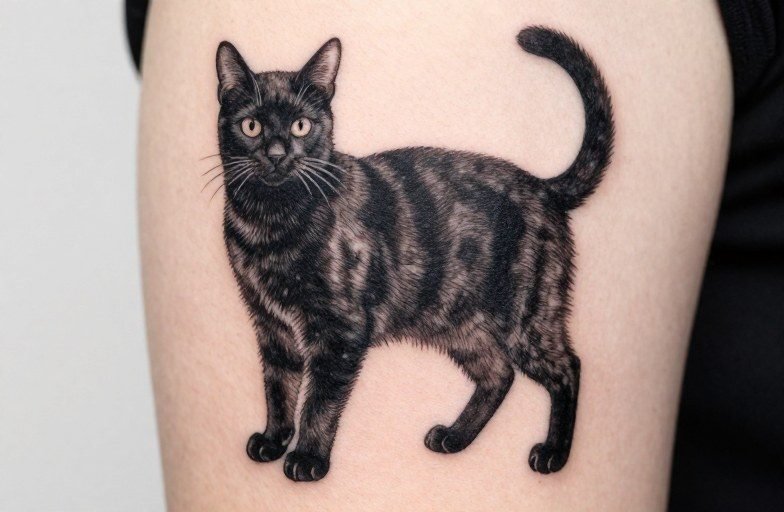
Photorealistic black cat tattoos commemorate specific pets, requiring reference photos and skilled shading to capture fur texture. These demand larger skin real estate, at least palm-sized, to render detail that won’t muddy as ink settles. White ink highlights for eye gleam or whiskers often fade faster than surrounding black, creating a “ghosting” effect some artists anticipate by over-saturating initially.
Occult and Gothic Variations
Black cats framed by coffins, candles, ouija planchettes, or alchemical symbols lean into darker associations. Pentagram collars, moon-phase backgrounds, or skull-morphing features amplify witchy aesthetics. These designs tend toward larger scales and more complex compositions, often extending from thigh to hip or across the upper back.
Best Placements
Black cat tattoos adapt to most body areas, though certain placements enhance specific meanings.
- Shoulder blade/upper back: Accommodates detailed compositions with moon or star backgrounds. The flat surface preserves line integrity. Easily concealed or displayed depending on clothing.
- Forearm: Popular for medium-sized silhouettes or walking cat poses. Visible enough for personal significance, socially acceptable in most environments. Expect some fading from sun exposure over years.
- Ankle/calf: Walking or prowling poses work naturally with limb shape. Lower leg tattoos generally heal straightforwardly, though calf muscle movement can slightly distort designs during healing.
- Behind the ear: Tiny silhouettes here read as secretive, almost whispered. The area heals tenderly and requires touch-ups more frequently than less mobile skin.
- Chest/sternum: Centered placements suit symmetrical designs, cat flanked by matching elements. This area hurts significantly and experiences more fading from skin movement and sun.
- Thigh: Offers substantial canvas for detailed or larger pieces. The muscle padding makes longer sessions tolerable. Hip-to-thigh extensions allow dynamic posing, leaping, stretching, or curled sleeping forms.
Black ink on lighter skin tones offers maximum contrast; on darker skin, artists may recommend slightly raised line weight or strategic negative space to maintain legibility as the tattoo ages. Solid black areas can develop a blue-gray cast over decades as ink particles disperse, this is normal, not poor quality.
Who Chooses This Tattoo / Personal Meanings
Certain patterns emerge among people selecting black cat designs, though individual motivation varies considerably.
Pet Memorial and Connection
Owners of black cats specifically choose these tattoos to honor living companions or memorialize deceased ones. The specificity matters, generic cat tattoos exist, but selecting a black cat usually indicates actual relationship rather than abstract cat appreciation. Portrait styles dominate this category, often incorporating dates, names, or paw prints.
Subcultural Affiliation
Witches, pagans, and those in goth or alternative communities frequently adopt black cat imagery as cultural shorthand. It signals belonging without explicit text. The tattoo functions as identifier within communities where such symbols carry mutual recognition. This overlaps with feminist reclamation, given the historical parallel between cat persecution and witch-burning.
Superstition and Luck
Some wearers genuinely embrace the lucky associations, particularly those from maritime backgrounds or cultures where black cats remain auspicious. Number 13 combinations, horseshoe pairings, or explicitly “lucky” framing (four-leaf clovers, dice) reinforce this interpretation. These designs often feature brighter, more decorative elements than occult-leaning versions.
Individualist Identification
Cat behavior, self-directed, boundary-setting, nocturnal, selectively affectionate, resonates with people identifying as independent, introverted, or socially unconventional. The black cat specifically amplifies this through its historical association with outcasts and the misunderstood. These tattoos often feature solitary cats in self-contained poses, not interacting with human figures or narrative scenes.
Similar Symbols
Black cat tattoos frequently appear alongside or substitute for related imagery. Understanding these connections helps clarify personal preference.
- Ravens/crows: Share death and mystery associations, but with more masculine cultural coding. Black cats retain stronger domestic and feminine connections.
- Owls: Wisdom and nocturnal sight, less superstition-laden. Owls carry academic or knowledge-seeker connotations cats lack.
- Wolves: Pack-oriented where cats are solitary; more explicitly “wild” rather than liminal-between-worlds.
- Moons (various phases): Nearly universal pairing with black cats, amplifying cyclical, feminine, and nocturnal themes. Crescent moons specifically connect to Artemis/Diana traditions.
- Broomsticks: Direct witchcraft association, more explicit than cat alone. Combined, they leave little ambiguity about intended symbolism.
- Skulls: Mortality and memento mori, transforming cat from living companion to psychopomp or death’s companion.
Choosing between these often comes down to desired specificity, black cats offer more interpretive flexibility than ravens, more personality than moons alone, more contemporary relevance than purely historical symbols.
Final Thoughts
Black cat tattoos endure because they operate on multiple registers simultaneously: pet tribute, protective talisman, subcultural badge, aesthetic choice. The best designs acknowledge this layered history rather than treating the image as merely cute or spooky. Work with an artist who understands how line weight, negative space, and companion elements shift the tattoo’s register from one meaning to another. Consider how the piece will age, solid black holds but can blur; fine detail demands larger scale and eventual refreshing. Most importantly, know if you’re choosing the black cat for what it has meant to others, or for what it specifically means to you; the strongest tattoos usually manage both.
Frequently Asked Questions
Does a black cat tattoo always mean bad luck?
Not at all. Many cultures consider black cats lucky, and most contemporary wearers choose them for protection, pet memorial, or witchy aesthetics. The “bad luck” association is largely a Western, post-medieval construction that many deliberately reject.
How well do solid black cat tattoos age over time?
Solid black generally holds saturation longer than color work, though it can develop a blue-gray cast as ink disperses beneath skin. Fine fur detail tends to blur faster than bold silhouettes. Expect touch-ups after 5-10 years depending on placement and sun exposure.
What’s the best style for a small black cat tattoo?
Minimalist silhouettes or clean line work suit small scales best. Avoid realistic detail under two inches, whiskers and eye highlights blur into indistinguishable blobs. Simple shapes behind the ear or on the wrist remain legible for years.
Can black cat tattoos work on darker skin tones?
Absolutely, though approach matters. Artists may use slightly thicker lines, strategic negative space, or deep black saturation rather than graywash to ensure contrast. Consult specifically with artists experienced in your skin tone, as techniques vary from lighter-skin approaches.
Related Tattoo Meanings
- Broken Mirror Tattoo Meaning: Symbolism, Styles Placement
- Broome Loser Tattoo Meaning: Origins, Symbolism Design
- Caduceus Tattoo Meaning: Symbolism, Styles What to Know
- Explore more