
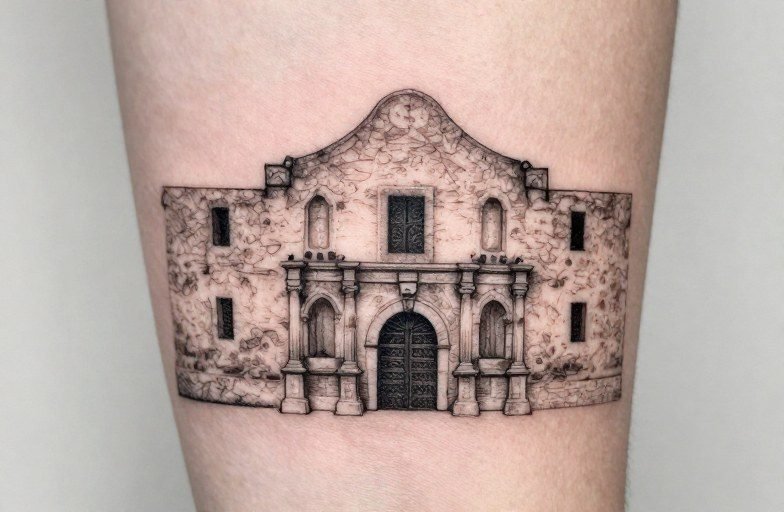
An Alamo tattoo carries the weight of a specific moment in history: the thirteen-day siege of 1836 where a small group of Texan defenders held out against the Mexican army. For most wearers, it signals Texas identity, stubborn resilience, or a personal connection to the state. The image can also carry darker undertones, military defeat, sacrifice, or the complicated politics of rebellion, depending on how the wearer frames it.
Symbolism & History
The Alamo mission itself, with its curved facade and distinctive roofline, is one of the most recognizable architectural silhouettes in North America. As tattoo imagery, it functions as shorthand for several overlapping ideas.
Remember the Alamo
The phrase itself became a rallying cry during the Texas Revolution and has never fully faded from cultural memory. A tattoo quoting or alluding to this slogan usually emphasizes defiance against odds, standing ground when surrounded, or refusing to surrender even when the outcome looks grim. Some wearers connect it to military service, law enforcement, or firefighting, professions where holding position matters. Others use it more loosely, as a personal mantra about perseverance through divorce, illness, or career collapse.
The Complicated Legacy
The Alamo story is not clean heroism. The defenders included slaveholders fighting for an independent republic that would protect slavery. Mexican forces were defending national sovereignty against separatists. Modern Texans themselves argue about how to interpret the site. A tattoo of the Alamo can mean unexamined patriotic nostalgia, or it can mean conscious engagement with that messiness. Placement and surrounding imagery usually clarify which: a battle scene with Davy Crockett’s coonskin cap reads differently from the mission facade standing alone in negative space.
Common Variations & Styles
The Alamo translates to skin through several visual approaches, each carrying different emotional temperatures.
- Architectural silhouette: The mission facade rendered in clean black lines or soft gray wash. Often paired with a Texas outline, a lone star, or the date 1836. This style ages well because the simple geometry holds up as lines spread slightly over years.
- Battle scene: More complex, with figures, cannon fire, smoke, and motion. Requires a skilled artist comfortable with historical detail. These pieces demand larger scale, thigh, back, or outer arm, to avoid muddling into brown blur as the fine lines age.
- Texas flag integration: The Alamo framed within or overlapping the state flag’s bold blocks of red, white, and blue. High color saturation helps, but the blue especially can fade toward gray within five to seven years without touch-ups.
- Minimalist line work: Just the arched doorway and roofline, sometimes reduced to a single continuous line. Popular on wrists, ribs, or behind the ear. The risk here is that the image becomes so abstract that viewers read it as a generic church or building.
- Lettering-focused: “Remember the Alamo” in script or bold serif, with or without the building itself. Script ages poorly on high-movement areas like inner forearms or collarbones; the thin upstrokes can disappear into skin texture over time.
Color vs. Black and Gray
Black and gray dominates Alamo tattoos for good reason. The actual mission is limestone and weathered wood, naturally muted tones. Color pieces tend toward sunset backgrounds or stylized flag elements rather than attempting realistic hues of the building itself. Bright color can work but reads less historically grounded, more graphic or illustrative.
Best Placements
The Alamo’s vertical proportions, taller than it is wide, suit certain body areas better than others.
- Outer upper arm: Classic placement for medium-sized architectural pieces. The cylindrical shape of the arm frames the building naturally. Easy to show or cover with a short sleeve.
- Thigh or calf: Offers enough real estate for detailed battle scenes or the mission with surrounding landscape. Calf placement means the image sits upright when standing, sideways when seated, something to consider if the composition has a strong directional flow.
- Ribcage: Popular for vertical silhouettes with lettering above or below. Painful placement, and the skin’s constant movement with breathing can affect how fine lines settle during healing.
- Back, upper center: Ideal for large-scale compositions with multiple elements, flag, mission, figures, dates. The flat surface lets the artist work without wrapping around muscle contours.
- Forearm: High visibility, which suits people who want the tattoo to function as conversation starter or identity marker. Sun exposure here is constant; expect faster fading without SPF protection.
Small Alamo tattoos on fingers, hands, or necks are rare and usually don’t read well, the detail collapses at that scale, and the building loses its recognizable proportions.
Who Chooses This Tattoo / Personal Meanings
The obvious demographic is Texas-born or Texas-raised people who left the state and want permanent connection. But the wearer pool runs wider.
Military and First Responders
The siege narrative, outnumbered, surrounded, holding until the end, resonates with military culture. Some veterans get Alamo pieces alongside unit insignia or deployment dates. The meaning here is less about Texas specifically and more about the archetype of the last stand.
Genealogical Connection
People with documented ancestors among the defenders or the Mexican army sometimes use the tattoo as family memorial. These pieces often include names, birth and death dates, or specific company designations. The emotional register shifts from regional pride to personal ancestry.
Transplants and Converts
People who moved to Texas as adults and embraced the state’s cultural mythology sometimes get Alamo tattoos as initiation ritual, proof of belonging, or at least of sincere effort to belong. These can feel slightly performative to native Texans, but the wearers themselves usually mean it genuinely.
Similar Symbols
The Alamo sits within a broader family of regional and historical tattoos that carry comparable weight.
- Texas outline with lone star: Simpler, more common, less historically specific. The Alamo tattoo usually signals deeper engagement with Texas history than the generic state shape.
- Goliad or San Jacinto imagery: Other Texas Revolution sites, far less common in tattoo form. Someone with Goliad specifically is usually making a deliberate counterpoint to Alamo-centric narratives, Goliad was a massacre of surrendered prisoners, not a battle.
- Other last-stand imagery: The 300 Spartans at Thermopylae, the defenders of Rorke’s Drift, the Alamo’s own cultural descendants. These share the structural appeal of outnumbered heroes, though the political contexts diverge wildly.
- Mission architecture generally: California mission chains, Arizona Spanish colonial sites. Similar visual language but different regional identities and histories attached.
Final Thoughts
An Alamo tattoo works best when the wearer understands what specifically draws them to the image, the architecture, the narrative, the state identity, or some personal overlap of all three. The design fails when treated as generic Texas branding without that specificity. Line-based architectural pieces hold up longest; complex battle scenes require committed aftercare and future touch-up budgeting. Like any historical tattoo, it will prompt questions, and having a genuine answer ready matters more than the ink itself.
Frequently Asked Questions
Does an Alamo tattoo always mean the person is from Texas?
Not necessarily. Military veterans, history enthusiasts, and people with ancestral connections to the siege often choose it without strong Texas ties. The meaning depends on what the wearer emphasizes, state pride, military solidarity, or personal resilience.
How detailed can an Alamo battle scene be before it starts aging badly?
Fine details like individual faces, small weapons, or thin smoke wisps tend to blur within five to eight years. For longevity, prioritize bold silhouettes, strong contrast between light and dark areas, and larger scale, thigh, back, or outer arm at minimum.
Is it disrespectful to get an Alamo tattoo if I’m not Mexican or Texan?
The Alamo’s history involves both Texan and Mexican narratives, and neither group holds exclusive claim to its memory. What matters more is whether you’ve engaged with the history rather than treating it as shallow iconography. Avoid it if you’re just chasing a ‘tough’ aesthetic without understanding the events.
What’s the most common mistake people make with Alamo tattoo designs?
Overcrowding the composition, trying to fit the mission, flag, dates, lettering, and figures into too small a space. The building’s proportions already challenge small-scale work; adding elements compounds the problem. Start with the facade alone, then build outward if the artist confirms the canvas can handle it.
Related Tattoo Meanings
- Anbu Tattoo Meaning: Hidden Leaf s Shadow Symbolism
- Ant Tattoo Meaning: Hard Work, Teamwork Quiet Strength
- Antler Tattoo Meaning: Nature, Strength Renewal
- Explore more









