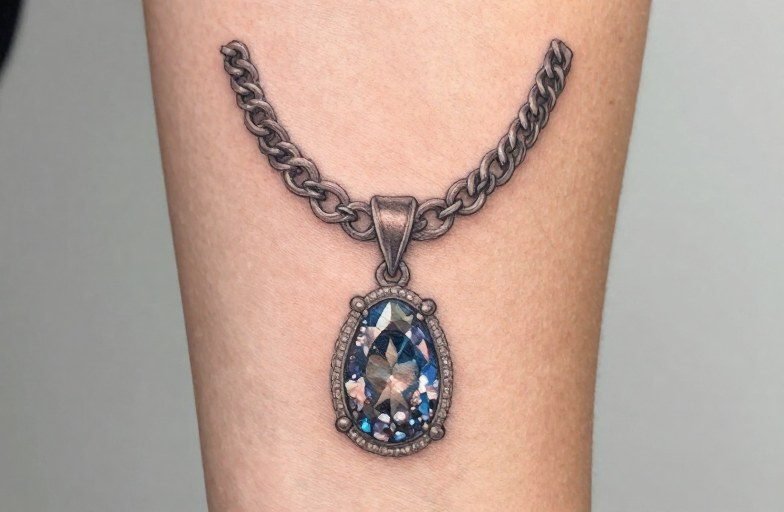
Realistic jewelry tattoos replicate the weight, shine, and material texture of actual adornments, chains draping over collarbone, rings wrapping fingers, gemstones catching phantom light. Unlike ornamental line work or traditional decorative motifs, this style pursues trompe-l’oeil deception: the eye should momentarily register metal, stone, or pearl before recognizing skin and ink. The technique demands mastery of reflective surfaces, cast shadows, and the way precious materials distort and mirror their surroundings.
Origins & History
From Portrait Realism to Adornment
The style emerged from the broader photorealism movement in tattooing, which gained momentum during the 1990s and early 2000s as artists refined single-needle techniques and studied how ink behaves at microscopic scales. Realistic jewelry specifically borrowed from portrait artists’ approaches to rendering eyes, catchlights, refraction, the soft bloom of highlight. Some trace the jewelry subgenre to European realism specialists who began experimenting with metallic surfaces on small scales, treating a pendant or chain link with the same obsessive detail previously reserved for faces.
Cultural Threads
Jewelry imagery carries loaded associations across cultures. Gold chains reference status, memory, and sometimes grief, permanent renderings of heirlooms that were lost, stolen, or never owned. Religious pendants, lockets with portrait inserts, and rosary beads wrapped around wrists or ankles all appear frequently in this style. The tattoo functions as both aesthetic choice and symbolic weight, though the symbolism remains personal rather than universal.
Key Characteristics & Motifs
Several visual elements distinguish realistic jewelry from stylized ornamental tattooing:
- Reflective highlights: Sharp white caps (often negative space or very light ink) where light would strike metal or facet; softer gradients where reflection diffuses
- Cast shadows: The jewelry must appear to sit on or through the skin, requiring consistent light source and believable contact shadows where chain meets flesh
- Material specificity: Distinct approaches for yellow gold (warm, soft gradients), white gold or platinum (cooler, crisper), oxidized silver (darker, more contrast), pearls (subsurface glow, no hard highlights)
- Dimensional wrapping: Chains and bands must follow body contours convincingly; flat rendering breaks the illusion immediately
Common motifs include Cuban link chains, tennis bracelets, signet rings on fingers or over knuckles, cross pendants, diamond solitaires with visible crown and pavilion facets, and antique lockets with cracked portrait inserts. Less common but technically impressive: hinged bracelets that appear to open, pocket watch chains with visible wear patterns, or stacked rings showing compression where they contact each other.
Color vs Black and Grey
Black and Grey Dominance
Most realistic jewelry tattoos execute in black and grey, which naturally suits silver, platinum, and white gold while allowing warm tones to be suggested through skin undertones showing through. The technique relies heavily on smooth grey wash transitions, harsh jumps between values read as cartoonish rather than metallic. Achieving pearl or opal effects in pure black and grey requires exceptional control of dotwork and extremely subtle value shifts.
Color Applications
Color realism opens yellow and rose gold, emeralds, rubies, sapphires, and the play-of-color in opals. The challenge: colored inks fade and shift differently than black. Reds tend to spread slightly; blues can granulate or heal patchy. Gemstone tattoos often use limited color palettes, one dominant stone with surrounding metal in grey, to reduce long-term unevenness. Some artists use white ink strategically for bright facets, though white heals to a translucent yellowish tone on most skin and requires touch-ups.
Best Placements
Placement determines both the illusion’s success and the tattoo’s longevity.
- Neck and collarbone: Chains and pendants read naturally here; the clavicle provides structural logic for where jewelry would rest. Moderate sun exposure means fading over years but not extreme wear
- Hands and fingers: Ring tattoos thrive here, but hands shed ink rapidly, fine detail blurs within 2-5 years. Bold, simplified ring designs last better than micro-detail; consider this a high-maintenance placement
- Wrist and forearm: Bracelets and watch chains wrap convincingly. The inner wrist sees friction from desks, keyboards, and sleeves; outer forearm preserves detail longer
- Chest and sternum: Large pendants or layered chains work well; the flat plane allows consistent light source rendering. Stretching and weight fluctuation affect this area significantly
- Behind the ear and hairline: Delicate chain strands or single pearls; limited space forces restraint, which often improves the result
Areas to avoid for fine jewelry realism: palms and soles (ink rejection is high), ribs and stomach (movement distorts rigid geometric forms), and anywhere with frequent abrasion from clothing or equipment.
Who It Suits
This style favors specific skin conditions and personal circumstances. The reflective highlights require negative space or near-white ink, which disappears or muddies on very dark skin, though skilled artists adapt by using high-contrast dark values and strategic skin-tone highlights rather than relying on white. Medium to deep skin tones can achieve excellent results in black and grey with warm undertones suggested through red or brown wash mixed sparingly.
Jewelry tattoos also suit people who want the appearance of adornment without theft risk, workplace restrictions, or the physical sensation of wearing metal. The permanence cuts both ways: unlike actual jewelry, you cannot remove it for job interviews, MRI machines, or changing taste. The commitment exceeds that of most decorative tattoos because the subject matter is so specifically material and status-coded.
Modern Variations
Mixed Media Approaches
Contemporary artists increasingly blend realistic jewelry with adjacent styles. A photorealistic chain might terminate in a traditionally rendered heart or dagger. Some pieces incorporate actual three-dimensional elements, raised white ink for pearl texture, or subtle scarification beneath to create genuine shadow depth. Others juxtapose hyperreal metal against flat graphic backgrounds, creating tension between illusion and acknowledged artifice.
Biomechanical and Organic Fusion
A growing subset merges jewelry realism with organic forms: chains growing into or out of skin, gemstones set directly into flesh without metal surround, pearls that appear to be secreted by the body rather than mounted. These retain the technical demands of jewelry realism while loosening the literal representation requirement.
Choosing an Artist
Not every realism specialist handles jewelry well. The skills transfer partially, skin tone rendering, hair texture, fabric folds all differ from metallic reflection. When evaluating portfolios, look for:
- Consistent light source across the entire piece, not arbitrary highlights placed for drama
- Contact shadows that prove the artist understands how objects sit on surfaces rather than float above them
- Healed photos, ideally 6+ months old, showing how metallic gradients settle, fresh tattoos always look more contrasted
- Variety in material types, not just one repeated chain style
- Evidence of wrapping around body contours, not just flat presentation on easy surfaces
Expect longer sessions than simpler styles. A single realistic ring with proper shadow and reflection might take 3-4 hours where a traditional ornamental band takes 45 minutes. The premium reflects both time and the specialized skill set.
Final Thoughts
Realistic jewelry tattooing sits at the intersection of technical ambition and personal symbolism. The best pieces function as convincing optical illusions while carrying whatever private significance the wearer attaches to the specific item rendered, a grandmother’s ring, a chain that couldn’t be afforded, a religious commitment made visible. The style demands patience in selection, execution, and healing, with particular attention to how the chosen placement will age. Done well, it offers something actual jewelry cannot: permanence without vulnerability, weight without gravity, shine that never tarnishes.
Frequently Asked Questions
How long do realistic jewelry tattoos typically take to heal?
Surface healing runs 2-3 weeks, but the fine gradients and subtle highlights continue settling for 2-3 months. During this period, the metallic contrast may appear slightly muted before the final values emerge.
Do realistic ring tattoos on fingers blur quickly?
Yes, finger skin regenerates rapidly and sees constant friction. Fine detail in ring tattoos often requires touch-ups every 2-4 years. Simpler, bolder designs with less micro-detail hold substantially better.
Can realistic jewelry tattoos cover scars or stretch marks?
They can incorporate some texture irregularities into the design, chain links can break pattern, aged metal shows wear, but highly raised or discolored scar tissue disrupts the smooth gradients essential for metallic illusion. Consultation with the specific artist is necessary.
Why do some realistic jewelry tattoos look flat or fake after healing?
Usually inconsistent light source, missing contact shadows, or highlights placed without structural logic. The eye recognizes these errors subconsciously. Proper technique accounts for body curvature and how actual metal interacts with surrounding skin.
Related Style Guides
- Realistic Raccoon Tattoos: Complete Style Guide
- Traditional Name Tattoo Ideas: Style Guide
- Traditional Ship Flash Tattoos: Style Guide
- Explore more