Elvis Presley tattoos occupy a strange, enduring space in American ink culture. Done well, they capture a specific moment in music history, youth, rebellion, or the Vegas-era spectacle. Done poorly, they become unrecognizable mush within five years. The difference usually comes down to style choice, placement realism, and understanding how certain imagery translates to skin.
Popular Styles
Not every approach to Elvis imagery works equally well. Some styles demand specific technical skills from your artist; others age better under certain conditions.
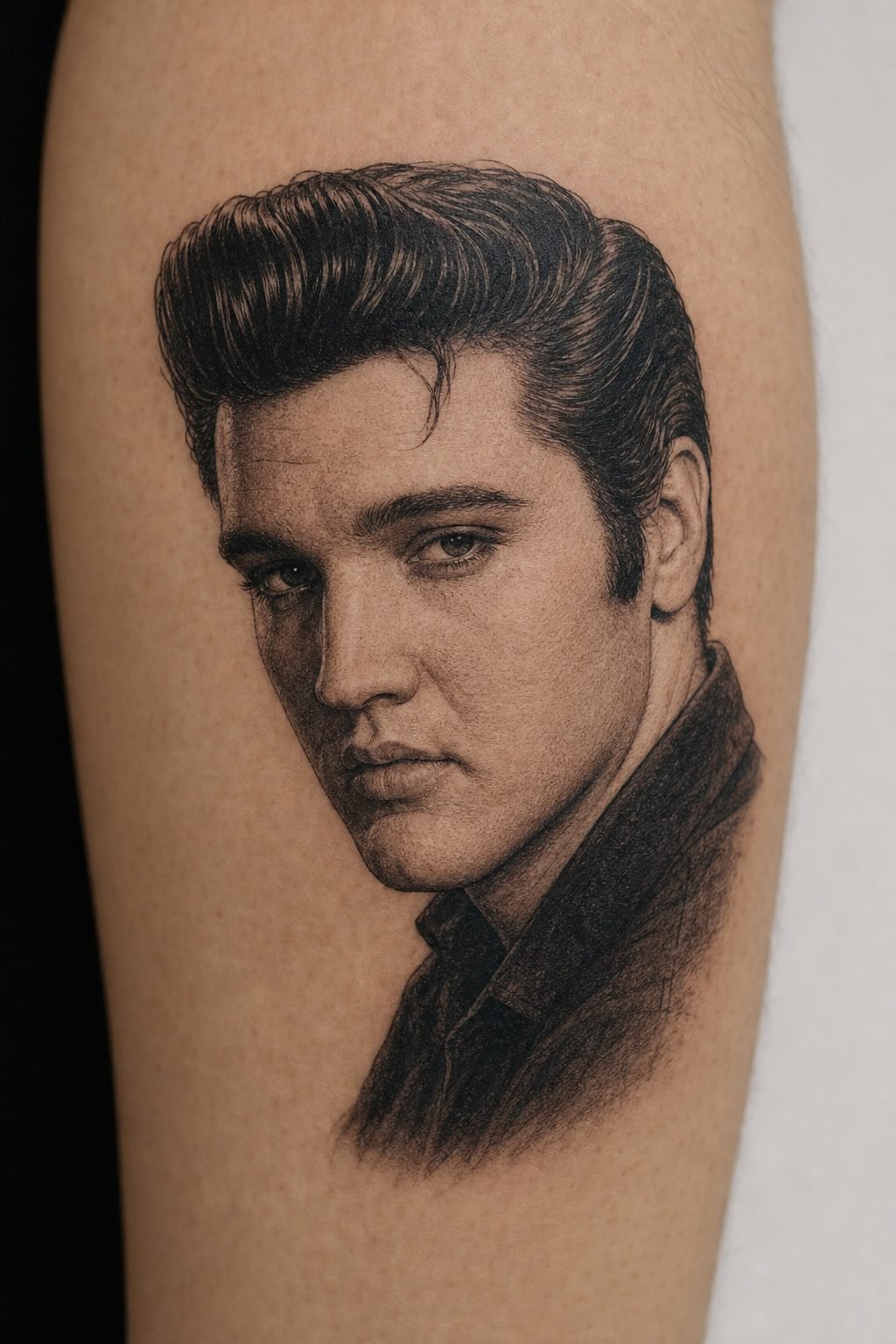
Photorealistic Portraits
The 1950s face, full lip curl, pompadour, that particular snarl, offers the most recognizable reference material. Photorealism requires an artist who specializes in black-and-gray portraiture, not just someone who “can do faces.” The pompadour’s height and shadow density create natural contrast that helps the image hold. Young Elvis portraits generally age better than later-era versions because the cleaner jawline and sharper features give the artist more structural information to work with. Jumpsuit-era Elvis introduces fabric texture, sequin suggestion, and softer facial features that blur faster as ink settles.
Neo-Traditional and American Traditional
These stylized approaches solve the aging problem by design. Bold outlines, limited color palettes, and simplified features don’t depend on micro-detail. American traditional Elvis typically renders him in profile or three-quarter view, hair as a solid black shape with highlight dots, maybe a microphone or guitar integrated into the composition. Neo-traditional allows more color variation, pink for the iconic jacket, teal for background elements, while keeping readable line weight. Both styles travel better across body placements and heal more forgivingly.
Minimalist and Line Work
Single-needle or fine-line silhouettes of that hair silhouette, the sunglasses, or just the lip curl work for smaller placements. The risk here is blowout; thin lines spread over time, especially on high-movement areas. A minimalist approach demands either extremely confident placement (low-friction skin zones) or acceptance that you’ll need refresh work. Some artists solve this by starting slightly bolder than the final desired look, planning for natural spread.
Design Ideas Beyond the Face
Portrait tattoos aren’t the only move. The Elvis visual vocabulary runs deeper and often produces more interesting tattoos.
- Signature elements: The TCB lightning bolt, the Taking Care of Business logo, or the crown from his jewelry collection translate immediately to fans without requiring likeness accuracy. These work well as standalone pieces, filler elements, or integrated into larger music-themed sleeves.
- Graceland architecture: The gates, the staircase, the jungle room, architectural elements offer composition opportunities that don’t depend on portraiture skill. The gates specifically provide natural symmetry and vertical flow that suits forearms, calves, or rib panels.
- Record and microphone imagery: A Sun Records 78 with Elvis’s name, or a vintage microphone with a banner, connects to the music without the pressure of facial recognition. These pair naturally with other American music imagery, blues, country, early rock.
- Text-based pieces: Song titles in period-appropriate lettering, or that specific “Elvis” script from early posters. Typography ages well when line weight stays consistent and the artist understands letter spacing at skin scale.
Best Placements
Where you put Elvis on your body affects both the design constraints and how the image holds over decades.
Upper Arm and Shoulder
The classic canvas for portraiture. Deltoid and outer bicep skin stays relatively stable, minimal stretching, moderate sun exposure if you’re sleeve-conscious, enough flat area for detail work. A young Elvis face fits naturally here, oriented vertically with the hair flowing toward the shoulder. The inner bicep works for smaller pieces but experiences more friction and moisture; save that for bolder designs, not fine detail.
Forearm
Highly visible, which suits Elvis’s public persona but also means constant sun exposure. If you’re committed to forearm placement, plan for sunscreen discipline or accept faster fading. The elongated shape favors vertical compositions, microphone stands, full-figure poses, the Graceland gates. Inner forearm skin is thinner and shows ink differently than the outer surface; experienced artists adjust value ranges accordingly.
Chest and Back
Larger-scale work. A back piece allows full-figure Elvis in jumpsuit, or a composite scene with stage elements. Chest placement over the heart carries obvious symbolic weight but presents technical challenges, pectoral movement, hair density variation, the sternum’s central ridge. Portraits here often look slightly different when the muscle flexes; good artists design for the relaxed state.
Thigh and Calf
Lower placements offer large, relatively flat areas with less sun exposure than arms. The calf’s natural curve suits profile compositions. Thighs accommodate bigger pieces but experience more weight fluctuation; significant muscle gain or loss distorts imagery more here than on upper body placements.
Color Choices
Elvis imagery offers specific color opportunities that other subjects don’t.
The pink jacket from the 1950s NBC appearance, the gold lamé suit, the white jumpsuit with red and blue eagle detailing, these are culturally fixed colors that read immediately. However, bright reds and pinks fade fastest in tattoo ink. Gold and yellow hold better but can look muddy if the artist uses low-quality pigment. Black-and-gray with selective color accents, maybe just the jacket in pink, everything else monochrome, often outlasts full-color approaches while keeping the reference clear.
Skin tone matters significantly for color choices. The pink jacket reads differently on very dark skin than on very light; experienced artists adjust saturation and value rather than just transferring a reference image directly. White ink as highlight on dark skin requires particular technical knowledge, many artists avoid it entirely in favor of negative space or skin-tone values.
Tips for Choosing
Specific decisions that improve your outcome:
- Reference quality matters enormously. Bring your artist high-resolution, well-lit source images. The 1950s photography you’re working from often has limited tonal range; good artists know how to interpret and expand that for tattoo readability.
- Consider which Elvis era actually resonates. The 1950s rebel, the 1968 comeback special, the Vegas years, these represent different aesthetics and different technical demands. Don’t default to the most common image if another period means more to you.
- Account for your lifestyle. Visible Elvis tattoos in professional settings depend heavily on your field. Forearm and hand placements are harder to conceal than upper arm or torso work.
- Research your artist’s actual portfolio. Look specifically for black-and-gray portraiture if you’re going realistic, or bold traditional work if you’re choosing that route. Elvis-specific experience matters less than technical alignment with your chosen style.
- Plan for the long fade. All tattoos soften. Ask your artist how the design will read at ten years, not just ten days. Slightly bolder choices in initial work usually age more gracefully than maximum detail.
Final Thoughts
Elvis tattoos carry cultural weight beyond personal fandom, they connect to American music history, visual identity, and a specific period of youth culture that keeps resonating. The best ones acknowledge that weight without overreaching. A solid traditional piece with clean lines and smart placement outlasts a hyper-detailed portrait from an artist who doesn’t specialize in realism. Know what you’re asking for, match the technical approach to the placement, and choose an era that means something specific to you. The King’s been gone decades, but good ink keeps him recognizable.
Frequently Asked Questions
How much detail can a small Elvis portrait actually hold?
Less than most people expect. Under two inches, facial features merge into undefined shapes within a few years. For small placements, choose a single recognizable element, sunglasses, hair silhouette, TCB logo, rather than attempting a full face. Your artist can advise on minimum viable size for your specific skin and chosen style.
Will a black-and-gray Elvis tattoo look too dark on my skin tone?
Not necessarily, but value adjustment matters. On darker skin, artists often open up shadow areas and use fewer true blacks to prevent muddiness. The contrast between Elvis’s pale 1950s complexion and dark hair actually helps readability across skin tones when the artist understands value translation.
How do I keep a color Elvis tattoo from fading fast?
The pink jacket and gold lamé suit colors are notorious for fading. Limit bright colors to small accent areas, use the highest quality pigments your artist recommends, and commit to sun protection. Even with perfect aftercare, plan on refresh sessions every 5-8 years for color-dominant pieces.
Can an Elvis portrait be covered up if I change my mind?
Covering detailed portraiture is difficult, the face has too much dark, saturated ink in concentrated areas. Black-and-gray work is harder to cover than bold traditional pieces with open skin space. If you’re uncertain, start with a smaller, simpler design or placement that allows for future modification rather than full concealment.
More Tattoo Ideas
- Realistic Portrait Tattoos: A Working Artist s Guide
- Abdominal Tattoo Ideas for Every Body
- Fast and Furious Tattoo Ideas for Speed Lovers
- Explore more