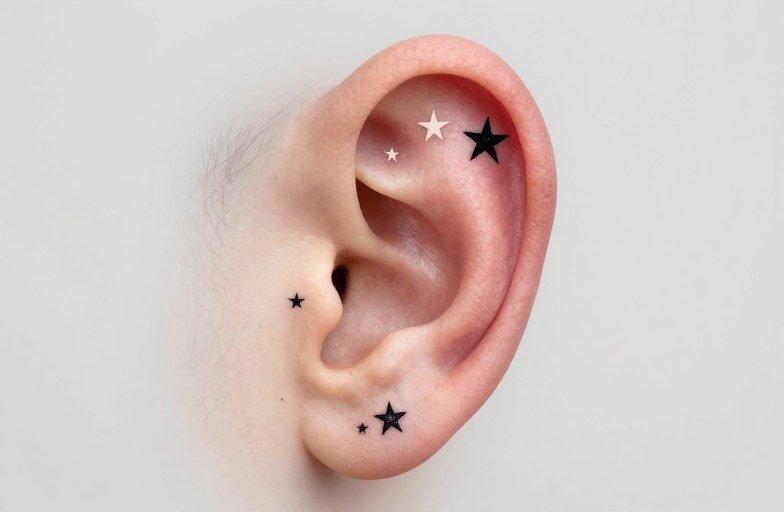
Stars behind the ear most commonly symbolize guidance, ambition, and moments of personal transformation. The placement itself, hidden yet easily revealed, adds a layer of intimacy to the symbol, suggesting something meant for the wearer first and the viewer second. Depending on the number of stars, their style, and accompanying elements, the meaning can shift from celestial navigation to memorial, from wanderlust to a private milestone marked in ink.
Common Variations & Styles
Behind the ear, space is tight. That constraint shapes every design choice, and skilled artists treat the area as a micro-canvas where precision matters more than complexity.
Single Star vs. Constellation Clusters
A solitary star reads as singular focus, one guiding principle, one person, one pivotal moment. Constellations, whether accurate astronomical patterns or stylized dot-connects, suggest relationships: family groupings, friend circles, or a specific date mapped to the night sky. The dots-between-stars technique ages better than thin lines here; hairline connectors tend to blur into solid shapes within five to seven years.
Outline, Solid Fill, and Dotwork
Outline stars keep the design light and adaptable to changing style preferences. Solid fill, especially black, creates a bold silhouette that holds contrast even as the tattoo softens with age. Dotwork and stippled gradients offer texture without the hard edges that can bleed in this high-friction zone. Behind the ear, the skin moves constantly with jaw motion and gets regular contact from hair, glasses arms, and pillow pressure. Designs with too many fine details often settle into indistinct grey blobs within a decade.
- Five-point nautical stars: traditional, crisp, readable at small sizes
- Seven-point or nine-point stars: more decorative, common in Russian prison iconography, know the visual lineage
- Shooting stars with trail: requires more horizontal space; often placed curving toward the hairline
- Star with moon or planetary pairing: adds narrative weight but demands slightly larger scale
Symbolism & Core Meaning
The star’s symbolism runs deep across cultures, but behind the ear, specific meanings tend to dominate.
Navigation and Direction
Historically, stars were literal guides for travelers. Transferred to skin, this meaning persists as personal direction, finding one’s way through difficulty, or maintaining course toward a goal. The behind-the-ear placement reinforces this: the star sits where you might press fingertips in thought, a private reminder visible only when you choose to tuck hair back or tilt your head.
Achievement and Aspiration
“Reach for the stars” may be cliché in speech, but as a tattoo motive, it carries genuine weight for people marking educational milestones, career shifts, or recovery from significant hardship. Multiple stars sometimes represent completed goals, one added per achievement, though this requires planning the initial spacing to accommodate future work.
Loss and Memorial
A single star behind the ear often memorializes someone who has died, particularly if that person was associated with a specific celestial reference, a nickname, a shared stargazing memory, or simply the idea of someone now “among the stars.” This meaning is common enough that the placement alone sometimes signals memorial intent to those familiar with tattoo culture.
Who Chooses This Tattoo
Demographics here are broader than stereotype suggests. Behind-the-ear stars appear across age groups, though they cluster in two noticeable patterns: younger clients getting first or second tattoos who want something concealable for professional contexts, and older clients returning to tattooing after years away, often with specific symbolic intent.
The concealability factor matters. Unlike forearm or collarbone placements, behind the ear hides under most professional hairstyles and reveals easily with a hair tuck or updo. This makes it popular among people in client-facing fields, conservative family environments, or simply those who prefer their body art to be opt-in rather than broadcast.
Gender distribution is fairly even, though stylistic choices sometimes diverge: men more often choose solid black nautical stars or geometric patterns, while women more frequently request delicate outlines, clusters with negative space, or star-and-moon combinations. These are trends, not rules, good artists see consistent exceptions.
Best Placements
“Behind the ear” actually encompasses several distinct zones, each with different visibility, pain profiles, and aging characteristics.
The Mastoid Flat
The flattest area directly behind the earlobe offers the most stable canvas. Ink here experiences less distortion from skin movement and maintains detail longest. However, it’s also the most visible when hair is up or short, and the most likely to rub against pillowcases and headphone bands.
The Hairline Curve
Following the ear’s upper curve toward the temple creates a natural flow that complements the body’s architecture. Designs here read as integrated rather than placed-on, but the skin texture changes near the hairline, slightly rougher, more follicle density, and can affect how fine lines settle. Artists often recommend slightly bolder line weight in this zone.
Extending Below the Lobe
Some designs drop a small star or trail of stars below the earlobe onto the upper neck. This increases visibility but also exposes the tattoo to more sun and friction. The skin here is thinner and more vascular; healing tends to produce more plasma buildup, requiring more diligent afterthought during the first two weeks.
Color vs Black and Grey
Color theory behind the ear deserves honest discussion. This area sees less direct sun than, say, a forearm, but it’s not immune to fading. Yellow and light orange stars, popular for a “gold” effect, tend to fade fastest, often shifting to a pale peach or skin-tone within five years. Red maintains saturation better. Blue and purple occupy the middle ground.
Black and grey offers longevity and versatility. A solid black star remains readable even after significant softening. Greywash shading can create dimension without the commitment of color, though behind the ear, heavy shading sometimes heals patchy due to the area’s thin skin and movement during sleep.
White ink deserves specific warning: marketed as “subtle” or “glow” effect, white pigment behind the ear frequently disappears entirely or yellows within two to three years, leaving a faint scar-like texture rather than visible design. Most experienced artists discourage pure white tattoos in this placement.
Similar & Related Symbols
Clients considering stars behind the ear often arrive with reference images that blend related iconography. Understanding the distinctions helps clarify intent.
Moons and Celestial Pairings
Crescent moons behind the ear carry distinct associations, feminine cycles, change and renewal, or witchcraft-adjacent symbolism depending on context. A star paired with moon suggests balance of opposites, day and night, aspiration and reflection. The combination requires more space than a single star; artists typically need at least an inch of vertical room to prevent the elements from blurring together.
Compass Stars and Nautical Imagery
The nautical star, five points filled alternately black and red or black and white, emerged from sailor tradition, often linked to finding one’s way home. Its adoption into mainstream tattooing has diluted some specific meaning, but the visual remains instantly recognizable. Behind the ear, the bold geometry of nautical stars holds up better than delicate alternatives.
Religious and Cultural Variants
The Star of David, pentagram, and hexagram each carry specific cultural and religious weight that shouldn’t be adopted casually. The six-pointed star of Judaism, the five-point pentagram’s varied occult associations, and the hexagram’s use in several Eastern traditions all require genuine personal connection rather than aesthetic appreciation alone. Artists should, and increasingly do, ask about intent when these appear in reference images.
The Takeaway
Stars behind the ear work because the symbol and the placement reinforce each other: something meant to guide, privately, through whatever darkness or distance the wearer faces. The meaning isn’t inherent to the image, it’s constructed by the choice of style, number, pairing, and the personal context the wearer brings. What matters for longevity is matching that meaning to a design that will still read clearly when the initial crispness softens. Go too delicate, and the star becomes a smudge. Go too bold without intent, and the symbol feels borrowed rather than owned. The best pieces in this placement balance personal significance with the technical realities of a small, mobile, frequently touched patch of skin.
Frequently Asked Questions
Does a star behind the ear always mean someone has died?
No. While single stars sometimes memorialize someone, the meaning varies widely, guidance, personal achievement, and aesthetic preference are equally common. The placement alone doesn’t indicate memorial intent.
How painful is getting a tattoo behind the ear?
The skin here is thin with little muscle padding, so most people rate it moderate to high on the pain scale. The vibration from the machine against the skull bone adds a distinct sensation that some find more uncomfortable than needle pain itself.
Can I cover a star behind the ear if I change my mind?
Small black stars are among the easier tattoos to laser remove due to their size and dark pigment. Cover-ups are more challenging in this tight space, options usually involve expanding the design rather than truly hiding it.
Will hair growing over the tattoo damage it long-term?
Hair itself doesn’t damage healed tattoos, but the friction from frequent hair tucking, tight ponytails, and hair product contact can accelerate fading. Let the tattoo fully heal, typically three to four weeks, before regularly covering it with styled hair.
Related Tattoo Meanings
- Steph Curry Tattoo Meaning: Faith, Family Basketball
- Veni Vidi Vici Tattoo Meaning: Conquest in Ink
- Whale Tail Tattoo Meaning: Symbolism, Styles Placement
- Explore more