
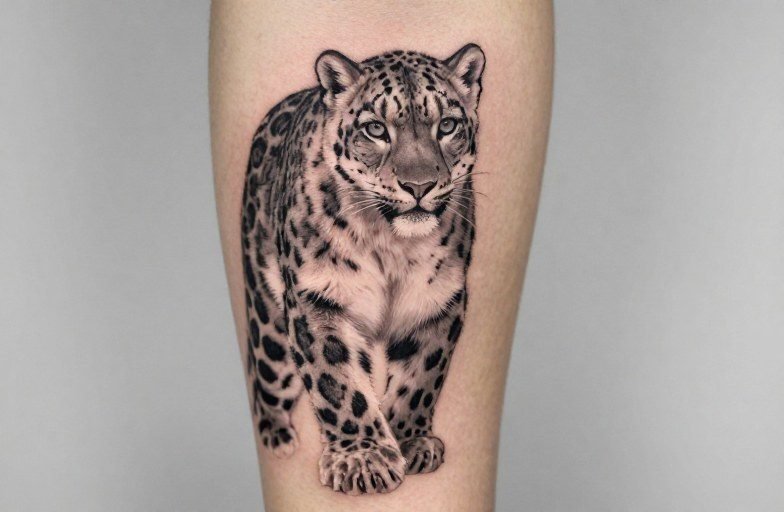
A snow leopard tattoo most commonly represents solitude without loneliness, the ability to thrive in isolation, and power that doesn’t need to announce itself. Unlike the standard leopard’s association with overt ferocity, the snow leopard carries a more specific symbolism tied to its extreme environment: camouflage, patience, and survival where few others could endure. The meaning shifts noticeably depending on whether the design emphasizes the animal’s eyes, its full body in motion, or its characteristic rosette pattern.
Design Tips & Pairings
Placement changes how this tattoo reads. A snow leopard’s face, eyes forward, works powerfully on the chest or upper arm, locations where direct gaze meets the viewer. Full-body designs stretched along the ribs, thigh, or down the forearm capture the animal’s elongated, low-slung movement. The tail alone, curling around an ankle or wrist, references the snow leopard’s legendary balance without requiring a large commitment.
Complementary Imagery
Mountain ranges ground the design in its natural habitat and reinforce themes of altitude, isolation, and endurance. Moon phases pair well with the snow leopard’s nocturnal nature. Geometric elements, particularly hexagons or crystalline shapes, echo the angular rock faces where these animals hunt. Avoid overcrowding; the snow leopard’s power lies partly in negative space, in how it disappears against snow and stone. Too much surrounding detail dilutes this effect.
- Single large eye with mountain reflection in the pupil: intense, personal, works at smaller sizes
- Full body mid-pounce across shoulder blade: dynamic, requires skilled foreshortening
- Paw and tail emerging from abstract snow/stone texture: subtle, rewards close inspection
- Rosette pattern as standalone geometric sleeve element: abstract, carries the association without literal depiction
Religious & Spiritual Angles
In Tibetan Buddhist contexts, the snow leopard often linked to certain mountain deities and protector spirits. Some trace it to local practices where the animal’s ability to move unseen made it a symbol of spiritual accomplishment that doesn’t seek display, the idea that genuine power or insight needs no advertisement. This differs sharply from traditions where sacred status demands visibility and ceremony.
Contemporary Spiritual Use
Modern wearers sometimes adopt the snow leopard as a personal emblem of silent practice: meditation, prayer, or ethical commitment kept private rather than performed. The tattoo functions as a self-directed reminder, not a signal to others. This meaning holds particularly for people leaving high-visibility spiritual communities who want to maintain practice without public identification. The animal’s literal invisibility in its environment becomes a metaphor for internal life that doesn’t require external validation.
Mythology & Folklore
Central Asian traditions vary widely by region and ethnic group. Some Kazakh and Kyrgyz stories cast the snow leopard as a trickster figure, outsmarting hunters through patience rather than speed. In certain Pamir Mountain tales, the animal guides lost travelers to shelter, not through benevolence, but because the follower’s survival serves the leopard’s territory. The relationship is mutual, not charitable.
Modern Symbolic Adaptation
Conservation efforts since the late 20th century have layered additional meaning onto the snow leopard. As an endangered species with an estimated population in the low thousands, the animal now carries associations with rarity under threat, with causes that resist easy solutions. A tattoo referencing this aspect might include broken chain links, fragmented habitat, or simply the species’ scientific name, Panthera uncia, as a quiet nod to biological specificity over generic symbolism.
How It Ages on Skin
The snow leopard’s visual identity depends heavily on fine detail: the soft gradation between white and grey fur, the dark spots’ precise edges, the green-gold eye color. This creates specific aging challenges. Fine dotwork representing fur texture tends to blur within 5-8 years, becoming muddy rather than soft. Heavy black outlining of spots can hold but often spreads slightly, making the rosettes look stamped rather than organic.
Technical Recommendations for Longevity
Designs that age best emphasize value contrast over color subtlety. A snow leopard rendered in solid black and negative space, with no grey wash, maintains legibility far longer. If you want the animal’s actual coloration, limit subtle gradients to small areas, the face, perhaps, while keeping the body in bolder values. The eyes, so central to the design’s impact, need particular attention: solid black pupil with minimal grey transition, surrounded by a clean, saturated color if you choose to include it. Faded green-gold becomes sickly yellow; plan for this by selecting a slightly deeper initial hue than looks natural fresh.
- Avoid fine stipple shading on the belly/chest area where skin stretches most
- Expect spot edges to soften; design with slightly larger negative space between elements than looks ideal fresh
- Consider touch-up scheduling at 7-10 years for color pieces, less critical for bold black-and-grey
Color vs Black and Grey
Color snow leopard tattoos face the reality that the animal’s actual palette, pale grey, cream, faint rosy nose leather, translates poorly to skin without strong artistic interpretation. Successful color pieces typically push the blue-grey toward slate, the cream toward warm tan, creating enough saturation to survive healing and aging. The eyes almost always carry more color than the rest of the design, functioning as the focal point that justifies the color choice.
Black and grey offers different advantages. The snow leopard’s natural form reads immediately in value alone; you don’t need color to identify the species. A skilled artist can suggest the pale coat through careful use of negative space, letting untattooed skin carry the light values while concentrated black creates the rosettes and facial markings. This approach ages more predictably and often costs less due to reduced session time. The trade-off is emotional temperature: color reads more immediate and alive, black and grey more timeless and monumental.
Common Variations & Styles
Japanese-influenced designs treat the snow leopard similarly to the tiger in traditional irezumi, often with wind bars, maple leaves, or water elements that aren’t ecologically accurate but carry established visual vocabulary. The snow leopard substitutes for tiger when the wearer wants the compositional language without the tiger’s specific cultural or personal associations.
Contemporary Interpretations
Neo-traditional work favors the snow leopard’s face in a decorative frame, emphasizing the animal’s almost domestic-looking features, the rounded face, the small ears, while keeping the predator’s gaze. Photorealism attempts capture the fur’s actual texture, demanding significant size (typically hand-size or larger) and a highly experienced artist. Abstract and geometric treatments reduce the animal to essential lines: the low slung body silhouette, the spotted pattern as tessellation, the tail’s distinctive curve. These last work well at smaller sizes and in locations where detailed rendering would be impractical.
- Neo-traditional: bold lines, limited palette, decorative elements, strong readability at medium size
- Photorealistic: maximum detail, requires large scale, high artist skill, significant aging risk
- Geometric/abstraction: pattern-based, scalable, modern aesthetic, sacrifices literal recognition for symbolic density
- Blackwork/ornamental: rosettes as repeating motif, no literal animal form, relies on viewer’s cultural knowledge
Key Takeaways
The snow leopard tattoo’s core meanings, solitary strength, hidden power, survival in extreme conditions, remain consistent across variations, but the specific emphasis changes with design choices. A staring face demands different interpretation than a disappearing body. Color choices affect both immediate impact and long-term legibility. The animal’s conservation status adds a contemporary layer that didn’t exist for earlier generations of tattoo wearers. Most importantly, the snow leopard offers something the standard leopard or tiger cannot: the specific symbolism of power that does not need to be seen to be real. Whether that resonates with your own experience of competence, spirituality, or simply preference for understatement determines whether this particular cat belongs on your skin.
Frequently Asked Questions
Does a snow leopard tattoo always mean the same thing as a regular leopard?
No. Standard leopard tattoos typically emphasize speed, ferocity, and overt power. The snow leopard specifically carries associations with isolation, altitude, and hidden strength, survival in conditions that would kill most predators. The environmental context matters symbolically.
How big does a snow leopard tattoo need to be to show detail?
For a recognizable face with eye detail, plan on at least palm-sized. Full body designs need significantly more space, thigh, back, or ribs, to avoid the spots merging into indistinct grey wash. Abstract or pattern-only versions can work much smaller.
Is the snow leopard culturally appropriative to tattoo?
The animal itself appears across multiple Central and South Asian cultures with varied significance. Specific sacred imagery, particular deities, ritual objects, or text, requires research and respect. A naturalistic animal portrait, absent specific religious iconography, generally raises fewer concerns than borrowed spiritual symbols.
Why do some snow leopard tattoos look muddy after healing?
The animal’s pale fur requires subtle grey washes that sit close to skin tone. If the artist uses too light a grey, it heals to invisibility; too dark, and the subtlety becomes heaviness. The narrow margin for error makes artist selection particularly important for this subject.
Related Tattoo Meanings
- Apple Tattoo Meaning: Symbolism, Styles Placement
- Barn Owl Tattoo Meaning: Mystery, Wisdom Silent Flight
- Japanese Temple Tattoo Meaning: Symbolism, Styles Placement
- Explore more









