
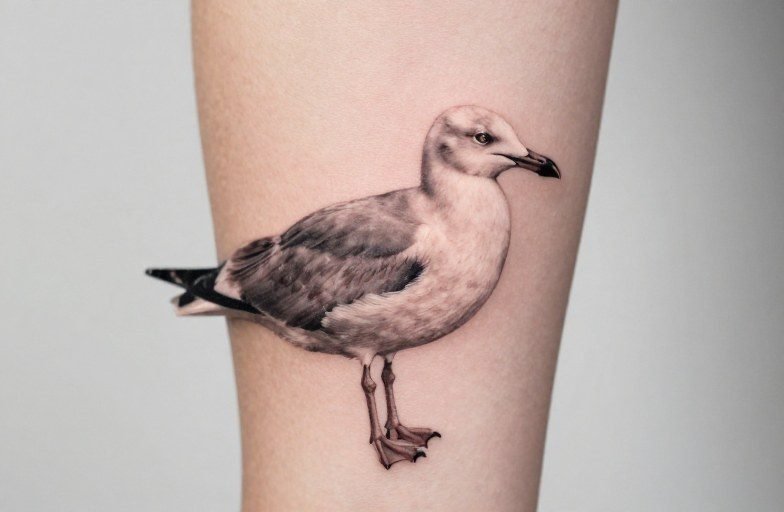
A seagull tattoo most commonly signals freedom, travel, and the ability to thrive in harsh conditions. For sailors, it meant land was near; for others, it represents adaptability and the refusal to be caged. The meaning tightens or loosens depending on style, placement, and what you pair it with.
Common Variations & Styles
Not every seagull tattoo reads the same way. The style you choose steers the symbolism as much as the bird itself.
Traditional American
Bold black outlines, limited color palette, simplified shapes. A traditional seagull usually flies in profile, wings curved upward, sometimes with a banner or rope frame. This style anchors the nautical meaning strongest, sailor heritage, miles logged, safe return. The heavy line weight ages well, and the design stays readable from a distance.
Realistic or Neo-Traditional
Feather detail, accurate anatomy, dynamic poses like diving or hovering. Realistic seagulls lean into the bird’s actual behavior: scavenging, enduring storms, living at the edge of land and sea. Neo-traditional adds decorative elements, geometric backgrounds, ornamental florals, that shift the tone toward personal symbolism rather than maritime tradition.
- Minimalist line work: Single-needle or fine lines, often small. Reads as quiet freedom, a private symbol rather than a declaration.
- Geometric or abstract: Broken into triangles or negative space. Modern, less tied to sailor history, more about the idea of flight itself.
- Pairings: Anchors, lighthouses, ships, compasses, or storm waves. Each addition rewires the meaning, anchor grounds the freedom, storm waves test it.
History & Cultural Roots
The seagull’s tattoo history is inseparable from maritime life, though the symbol has drifted inland over decades.
Sailor Origins
Among seafaring communities, spotting seagulls meant proximity to shore. A sailor might get one after a specific voyage, or after surviving a particular hardship at sea. The bird became shorthand for navigation, endurance, and the reward of arrival. Some trace the specific tattoo tradition to British and American naval culture of the early-to-mid 20th century, though documentation is spotty and often oral.
Literary and Pop Culture Threads
Richard Bach’s Jonathan Livingston Seagull (1970) reframed the bird as a seeker of personal perfection, not mere survival. That book spawned a wave of seagull tattoos among people who’d never tied a knot, readers drawn to the idea of transcending flock mentality. The literary association persists, especially among older collectors who came to the symbol through that lens.
Coastal towns worldwide have their own relationships with gulls. In some fishing communities, they’re respected as fellow scavengers who know where the food is; in tourist towns, they’re pests. That duality, resourceful survivor versus noisy opportunist, gives the tattoo an edge of ambiguity some collectors deliberately embrace.
Color vs Black and Grey
The choice between color and black and grey changes how the tattoo ages and what it communicates.
Color seagulls, white bodies, grey wings, yellow beaks, maybe a blue sky behind, read brighter, more literal, more tied to actual coastal scenery. The downside: white ink fades fast, yellow shifts or drops out, and the contrast that makes the bird pop when fresh can muddy within five to ten years. Touch-ups are almost guaranteed.
Black and grey seagulls, especially with heavy whip shading or smooth gradients, carry a more timeless, somber weight. They reference the traditional sailor aesthetic without needing to copy it exactly. Grey tones in the wings can suggest weather, distance, or memory. This approach ages more predictably; the value structure holds even as lines soften slightly.
- Small tattoos: Black and grey almost always wins. Color needs space to breathe, and tiny color seagulls can become indistinct blobs.
- Large back or thigh pieces: Color can work if the design includes enough dark anchor points to prevent the whole thing from washing out.
How It Ages on Skin
Seagulls present specific aging challenges because of their typical coloration and the thin lines often used in their wings.
Line Weight and Feather Detail
Fine lines in wing feathers blur together over time, especially on high-movement areas like wrists or collarbones. A well-designed seagull tattoo builds in enough solid black or grey packing between feather groups so that even as lines spread, the shapes remain distinct. Ask your artist to show you healed photos of similar work, not just fresh tattoos.
White Ink Reality
Seagulls are white birds, so many designs try to use white ink for the body. On most skin tones, white heals to a faint scar-like tone, not bright white. It often needs reinforcement with surrounding dark values to read as “light.” Some artists use negative space, skin left untouched, instead of white ink, which ages more honestly but requires tighter design planning.
Expect some yellowing in the beak and feet if you go color. Sunscreen matters for any tattoo, but color seagulls on exposed areas like forearms or calves fade noticeably faster than black and grey counterparts.
Best Placements
Where you put a seagull tattoo shapes how the bird “moves” and how long the detail holds.
Forearm or calf: Classic placement, enough flat surface for the wingspan to read clearly. The forearm’s visibility suits a symbol of freedom, you see it, others see it. Calves handle larger designs well and age better than areas with constant flexing.
Shoulder or upper arm: Lets the bird arc with the muscle, wings following the deltoid curve. Traditional sailor placement, historically common, still effective.
Ribcage or side: Painful, but the elongated space suits a diving or soaring pose. Less sun exposure means slower fading, though stretching from weight fluctuation can distort the shape over years.
Behind the ear or on the wrist: Popular for small minimalist designs. The tradeoff is fast aging, fine lines in these spots often need refreshing within five years. The meaning shifts to something more intimate, almost whispered.
Hand or fingers: Bold statement, poor longevity. Seagulls here are usually stripped to essential shape, losing feather detail. The nautical connection feels strongest, since hands are tools of work.
Religious & Spiritual Angles
The seagull carries looser spiritual baggage than some tattoo subjects, but it’s not empty.
In Christian symbolism, birds generally represent the soul, the Holy Spirit, or divine care (the “birds of the air” passage in Matthew). Seagulls specifically, as birds that cross between water and sky, have been used to suggest baptism, rebirth, or the liminal space between earthly struggle and spiritual peace. Some coastal churches use seagull imagery in this context, though it’s far less codified than the dove.
More commonly, the spiritual reading is secular: the seagull as emblem of personal transcendence, of refusing limits. Jonathan Livingston Seagull’s influence here again, self-improvement, breaking from the group, finding individual purpose. That resonates with people who’ve left restrictive backgrounds, literal or figurative.
For those drawn to nature spirituality, the seagull represents adaptation without domestication. It lives among humans, eats our waste, rides our boats, but never submits to breeding or control. That particular tension, coexistence without surrender, attracts people who value independence but not isolation.
Before You Decide
A seagull tattoo works best when the specific meaning is yours, not borrowed from a list. The sailor tradition, the literary reference, the spiritual reading, the simple love of coastlines, all valid, but mixing them without clarity produces a muddled design.
Think about pose: hovering suggests watchfulness, diving suggests pursuit, soaring suggests release. Pairings matter. A seagull with an anchor is different from one with a compass, different again from one alone with storm clouds. Be honest about how much detail your chosen placement can sustain over ten years, not just how it looks fresh on Instagram.
Talk to your artist about line weight for your specific skin type and placement. Bring reference of real seagulls in the pose you want, not just other tattoos. The best seagull tattoos look like birds that happen to be inked, not symbols that happen to resemble birds.
Frequently Asked Questions
Does a seagull tattoo always mean someone was in the Navy?
No. While the design has strong sailor roots, plenty of people choose it for travel, freedom, or coastal identity without any military connection. The meaning depends on your personal context and what you pair it with.
Will a small seagull tattoo on my wrist look good in ten years?
Small fine-line seagulls blur faster than bold traditional designs. If you want longevity, opt for thicker lines and less feather detail, or choose a placement with less movement and sun exposure.
What’s the difference between a seagull and an albatross tattoo?
Albatross tattoos carry more superstition and burden from Coleridge’s poem, guilt, curse, heavy weight. Seagulls are lighter symbols: survival, proximity to safety, adaptability. The birds look different too, with albatrosses having much longer wingspans.
Can a seagull tattoo work if I’ve never lived near the ocean?
Yes, but be intentional about why you’re choosing it. The symbol of freedom or resilience doesn’t require coastal residence. Just avoid pairing it with nautical elements that don’t connect to your actual life, as that can read as costume rather than meaning.
Related Tattoo Meanings
- Seraph Tattoo Meaning: Fire, Devotion, and Spiritual Intensity
- Silver Surfer Tattoo Meaning: Cosmic Wanderer Ink
- Simi Collins Tattoo Meaning: Symbolism and Design Guide
- Explore more









