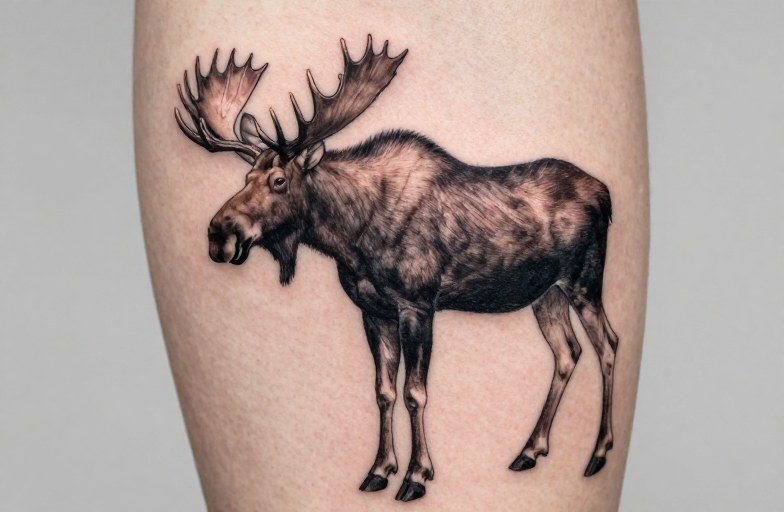
A moose tattoo typically signals self-reliance, quiet confidence, and an affinity for rugged, untamed landscapes. Unlike more aggressive animal imagery, the moose carries a slower, more deliberate energy, survival through patience, size, and adaptability rather than speed or ferocity. For many, it marks a personal connection to northern climates, hunting traditions, or a period of life where standing firm mattered more than charging forward.
Religious & Spiritual Angles
Spiritual interpretations of moose symbolism vary widely across traditions, though certain threads recur.
Indigenous North American Perspectives
Among several Algonquian-speaking peoples, the moose holds significance as a provider and a being deserving of respect. Some traditions trace ceremonial importance to moose hunts, where the animal’s sacrifice is acknowledged rather than taken for granted. Tattooing moose imagery in this context often carries responsibility, the wearer signals awareness of that relationship, not mere aesthetic borrowing. If you’re drawn to this symbolism without ancestral connection, approaching it with research and humility matters more than most online sources suggest.
Broader Spiritual Readings
Outside specific tribal contexts, moose frequently represent the “gentle giant” archetype in spiritual circles: power held in reserve, wisdom over aggression. Their solitary nature, bulls rarely travel in groups, lends itself to interpretations of healthy independence and boundary-setting. Some contemporary spiritual practitioners associate moose with earth-element energy, grounding, and the crown chakra’s quieter, less flashy side.
Best Placements
Moose anatomy in tattoo form demands space. The antlers alone spread wide; compressing them onto a wrist or ankle usually produces a muddy blob within five years.
Where the Details Survive
The upper back, across the shoulder blades, or a full thigh piece offer the real estate for antler spread and facial structure to read clearly. A side profile moose head fits well on a calf or outer upper arm. Chest placements work for frontal compositions, though the sternum’s movement can distort fine antler points over time. Forearms and ribs suit smaller, single-antler designs or abstracted silhouettes rather than full realism.
Scale and Aging Considerations
Linework in antlers, those thin, branching points, spreads. Plan for touch-ups, or design with slightly heavier outer contours than a reference photo suggests. Moose fur texture holds up better than hyper-detailed antler webbing; prioritize what you want visible at ten feet versus ten inches.
Mythology & Folklore
European settlers in North America initially found the moose bewildering, sometimes calling it a “monster” in early accounts, before it settled into regional folklore.
Scandinavian and Northern European Threads
The European elk (often conflated with moose in older translations) appears in Sami and broader Nordic traditions, sometimes linked to forest spirits or as a creature of the liminal space between settled land and deep wilderness. Some trace moose-antlered figures to shamanic imagery predating organized Viking-era religion, though scholarly consensus remains cautious. Modern Norse-pagan tattoo seekers sometimes choose moose as a regional alternative to more common stag imagery, particularly for those with actual northern European heritage.
North American Folk Traditions
Logging camps, hunting lodges, and northern town culture built their own moose mythology: the ghost moose (an albino or piebald animal), the impossible shot, the moose that wandered through town. These stories carry less formal spiritual weight but plenty of regional identity. A tattoo referencing this layer often pairs with specific landscapes, pine, lake, snow, rather than isolated animal portraiture.
Personal & Modern Meanings
Contemporary moose tattoos rarely hew to single interpretations. The most successful designs emerge from specific personal anchors.
Regional Identity and Outdoor Culture
For people from Maine, Minnesota, Alaska, or across Canada, moose can function as a permanent location marker without being literal coordinates. It signals belonging to a place where winter dominates, where vehicles hit moose more often than deer, where seeing one constitutes an event rather than a nuisance. The tattoo becomes shorthand for a whole climate and pace of life.
Recovery and Resilience Narratives
The moose’s ability to traverse deep snow, swim miles, and survive on coarse vegetation makes it a fitting emblem for endurance. Some choose it after significant health challenges, career rebuilding, or personal reinvention, not because the moose “represents” recovery in any traditional sense, but because its physical capabilities mirror desired inner qualities. The animal’s unhurried movement also appeals to those rejecting hustle-culture values.
Design Tips & Pairings
Moose imagery risks becoming generic outdoor-tattoo filler without deliberate choices.
Complementary Elements
Pine or birch framing grounds the composition in specific northern ecology. Mountain silhouettes behind antlers create depth. Water elements, lakes, rivers, reference actual moose habitat and break up the vertical emphasis of a standing animal. Avoid pairing with wolves or bears unless you want a crowded wilderness diorama; moose work better as solitary focal points.
Style Approaches
- American traditional: Bold outlines, limited palette, antlers simplified to readable shapes. Holds up decades.
- Blackwork/Nordic: Heavy black, knotwork or runic elements if appropriate to your background. Moose antlers lend themselves to geometric treatment.
- Realism: Requires skilled artist; reference photos of actual moose, not illustrations. Pay attention to the dewlap (bell) and facial fur direction.
- Negative space/silhouette: Effective for smaller pieces; the antler silhouette is instantly recognizable even in pure black.
Color vs Black and Grey
Moose offer limited natural color, dark brown, occasional lighter patches, black hooves and nose, so the choice carries less visual drama than, say, a macaw or koi.
When Color Works
Autumn settings justify oranges, reds, and muted golds. Northern lights backdrops introduce greens and purples. A few artists work in “color realism” with subtle brown layering, but this demands exceptional skill; flat color on moose fur often reads as painted-on rather than integrated. Watercolor-style splashes behind a black moose silhouette can work but trend toward dated quickly.
The Case for Black and Grey
Most enduring moose tattoos stay monochromatic. The animal’s value range, deep shadows in the neck, highlight on the antler palm, gives black and grey artists plenty to work with. Texture in the fur reads through whip shading and stippling without color’s added complexity. For longevity, black and grey wins: brown inks fade fastest to muddy orange, and moose brown specifically is hard to mix consistently across sessions.
The Bottom Line
A moose tattoo works when it connects to something concrete, place, experience, temperament, not when it genericizes “strength” or “nature.” The animal’s visual distinctiveness helps; even a mediocre moose tattoo is usually identifiable as a moose, which is more than can be said for many wolf or lion attempts. Prioritize antler clarity, give it enough skin, and choose an artist comfortable with animal portraiture rather than one who specializes in unrelated styles. The meaning, whatever yours is, will hold better if the technical execution does too.
Frequently Asked Questions
Does a moose tattoo always mean I’m into hunting?
Not at all. While hunters certainly choose moose imagery, plenty of people select it for regional identity, spiritual symbolism, or simple aesthetic preference. The meaning depends on your surrounding design elements and personal context.
How big does a moose tattoo need to be to look good?
For a recognizable head with antlers, plan on at least palm-sized, though larger is significantly better. Full-body moose compositions need serious real estate, thigh, back, or rib panel, to avoid cramming and future blurring.
Are moose antlers hard to tattoo well?
The webbing between antler points requires steady linework and will spread slightly over time. Experienced artists build in slightly heavier outer contours and avoid hair-thin interior details that won’t survive five years of aging and sun exposure.
Can I get a moose tattoo if I have no connection to northern regions?
Yes, but consider whether your personal meaning is specific enough to justify the imagery. Generic “wilderness” symbolism often reads as vague; pairing it with elements meaningful to your actual life creates a more grounded piece.
Related Tattoo Meanings
- Antler Tattoo Meaning: Nature, Strength Renewal
- Buck Tattoo Meaning: Strength, Renewal Masculine Energy
- Ollin Tattoo Meaning: Movement, Change, and Aztec Cosmic Power
- Explore more