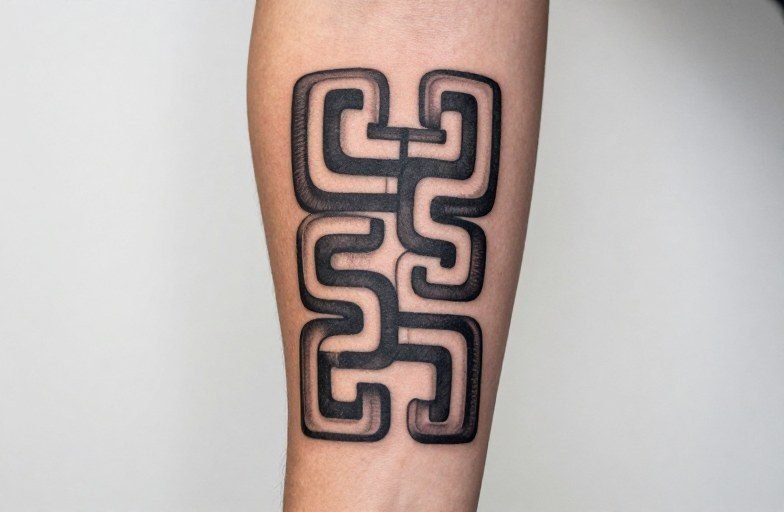
Ollin (pronounced OH-leen) is the Nahuatl word for “movement” or “earthquake,” and as a tattoo, it carries weight that goes far beyond its visual punch. The symbol itself, four interlocking rectangular shapes radiating from a central point, often with a face or eye at the center, represents seismic force, the trembling of the earth, and by extension, the constant motion of the cosmos. For someone wearing this on their skin, it typically signals a personal upheaval survived, a transformation in progress, or a commitment to staying adaptable through life’s shifts.
Personal & Modern Meanings
People gravitate toward ollin for reasons that sit close to the bone. The symbol’s geometry feels ancient and futuristic at once, which lets it bridge personal narrative without needing to explain yourself to strangers.
Marking Transitions
A common thread among those choosing ollin is major life restructuring, recovery, relocation, career abandonment, identity shifts. The earthquake metaphor works literally here: the ground you stood on disappeared, and you rebuilt anyway. The tattoo becomes a private marker of that instability survived, not a billboard demanding conversation. Placement tends toward areas the wearer sees daily: inner forearm, rib cage, upper thigh. These spots keep the meaning present without performative display.
Adaptability as Identity
Some wearers interpret ollin less as past trauma and more as ongoing philosophy. The symbol’s four directional arms suggest responsiveness to change from any quarter. This reading appeals particularly to people in volatile fields, freelancers, performers, activists, where rigidity equals obsolescence. The tattoo functions as a kind of physical mantra: stay loose, stay ready.
Common Variations & Styles
The core ollin glyph allows surprising stylistic range without losing recognizability. How you render it changes the emotional temperature considerably.
Traditional Glyph vs. Stylized Renderings
Purist versions hew close to surviving codex images: the four-part shape with squared corners, the central eye or face, the surrounding day-sign border. These read as scholarly, respectful, deliberate. Stylized versions might round the corners, elongate the arms into flame or feather shapes, or integrate the glyph into larger biomechanical or geometric compositions. The risk with heavy stylization is dilution, if the four-directional structure becomes unrecognizable, you’ve lost the symbol’s specific gravity and landed in generic tribal territory.
- Line weight: Thick, uniform lines age cleaner than hairline details around the central eye
- Shading approach: Dotwork or stipple in the negative space softens the glyph’s harsh geometry
- Border treatment: Some include the full day-sign square; others isolate the ollin proper
- Scale: At under 3 inches, the central details blur within 5-7 years; 4+ inches preserves readability
Combination Pieces
Ollin pairs naturally with other Mesoamerican iconography, quetzalcoatl, the sun stone’s surrounding glyphs, maize motifs. It also works in contrast: the angular glyph against organic floral work, or embedded in abstract expressionist brushstroke backgrounds. The key is intentionality. Random Aztec imagery piled together reads as aesthetic tourism; thoughtful pairing shows genuine engagement.
History & Cultural Roots
Understanding where ollin comes from matters for wearing it responsibly, not just accurately.
The ollin day sign occupied the seventeenth position in the 260-day Aztec tonalpohualli calendar. Days bearing this sign were often linked to Quetzalcoatl and associated with volatile, dynamic energy, earthquakes, storms, sudden change. The glyph’s visual structure is commonly associated with the four previous eras or “suns” of Aztec cosmogony, with the central element representing the present fifth sun, our current epoch, trembling at its center.
Surviving examples appear in the Borgia and Borbonicus codices, among others, though many pre-Columbian manuscripts were destroyed during colonial suppression. This means our visual sources are filtered through post-Conquest transcription and interpretation. The symbol’s specific meaning varied somewhat across Nahua-speaking communities and time periods; there was no single monolithic “Aztec” consensus.
For tattoo wearers without Indigenous Mexican heritage, the question of appropriation versus appreciation arises. The consensus among many Nahuatl culture bearers: research deeply, avoid sacred or funerary imagery you’re not qualified to carry, and consider whether your connection to the symbol is genuine or aesthetic surface. Ollin as a day sign sits in a different category than deity representations or ritual objects, but respect still applies.
Religious & Spiritual Angles
Contemporary spiritual practice has adopted ollin in ways that diverge from historical usage.
Neopagan and Reconstructionist Practice
Some Mexican neopagan groups incorporate ollin into ritual work, treating it as an invocation of powerful energy. Tattoo wearers in these communities may receive the mark as part of initiation or personal dedication. The symbol’s earthquake association becomes literal spiritual practice: shaking loose stagnation, breaking old patterns. This usage requires genuine community involvement; isolated adoption without context risks spiritual cosplay.
Secular Spiritual Readings
Many wearers hold no formal religious affiliation but respond to ollin’s archetypal resonance. The four directions, the central axis, the sense of cosmic scale, these elements appear across global spiritual traditions. Such universalist interpretation is common and generally uncontroversial, though it can flatten the symbol’s specific cultural texture into generic “earth wisdom.” Whether that flattening bothers you depends on your relationship to specificity in symbolic practice.
Mythology & Folklore
The ollin glyph connects to one of the most dramatic episodes in Aztec mythology: the birth of the fifth sun.
According to commonly cited accounts, the gods gathered at Teotihuacan to create a new sun after the destruction of the fourth world. Two gods volunteered: the proud Nanahuatzin and the wealthy Tecciztecatl. When the moment came, Tecciztecatl hesitated at the fire’s edge; Nanahuatzin leaped in and was transformed into the sun. The fifth sun, our current era, is thus marked by sacrifice and trembling, ollin captures that instability, the sense that our world exists in provisional, dynamic balance.
Some trace the four arms of the ollin glyph to the four previous suns or cosmic ages, each ended by different catastrophes: jaguar, wind, fire, and flood. The present age of motion awaits its own ending, implied in the very symbol that names it. This apocalyptic undertone gives ollin tattoos a darker resonance than simple “change”, the ground shakes, the world ends, something new begins.
Color vs Black and Grey
Technical decisions shape how ollin reads on skin over decades.
Black and Grey Approaches
The majority of ollin tattoos execute in solid black or black and grey wash. This choice honors the codex source material, surviving manuscripts use bold line with minimal color, and ensures longevity. The glyph’s strong geometry holds up well: even as lines spread slightly with age, the interlocking shapes remain legible. Grey wash can add depth to the central face or create dimensional separation between the four arms, but heavy shading in the small spaces between elements tends to muddy over time.
Color Integration
Color ollin work draws from several palettes. Some reference the red and black associated with Aztec ritual and warfare; others use teotl-inspired gold and turquoise. A more contemporary approach treats the glyph as framework for full-color background, fire, water, sky, letting the black lines anchor the composition while color provides emotional context. The risk: color saturation fades faster than black, and the glyph’s precision relies on edge definition. Strategic placement (less sun exposure, upper body) extends color lifespan.
Skin tone significantly impacts color choice. On darker skin, bold warm colors (red, orange, gold) show more reliably than cool pastels; the black structure of ollin remains universally legible. Experienced artists adjust line weight and color density based on individual melanin levels rather than applying formulaic approaches.
Before You Decide
An ollin tattoo commits you to a symbol with genuine cultural weight and specific visual demands. Before booking, consider:
- Research beyond image search: read at least one scholarly source on Nahua cosmology or calendar systems
- Evaluate your artist’s line precision through healed work, not fresh photos, geometric tattoos reveal sloppy craft after healing
- Size realistically: the central face detail needs room to breathe; too small becomes a black blob
- Placement affects longevity: inner bicep and rib cage experience less sun and abrasion than hands or feet
- Be prepared to explain your connection if asked, especially if you’re not of Mexican descent
The symbol’s power lies in its specificity. Wear it with that specificity in mind, earthquake, motion, the trembling fifth sun, and it carries genuine force. Wear it as generic “tribal” decoration and it collapses into visual noise. The choice, like the symbol itself, is fundamentally about movement: toward deeper engagement or away from it.
Frequently Asked Questions
Does the ollin tattoo have to include the central face or eye?
No, but removing it changes the symbol’s reading. The central element represents the present sun or the axis of movement; pure geometric abstraction becomes harder to distinguish from generic four-directional designs. Most respectful renderings keep some central focal point.
Is it culturally inappropriate for non-Mexican people to get an ollin tattoo?
There’s no universal prohibition, but context matters. Ollin as a day sign is less restricted than deity or ritual imagery. The key is genuine engagement, understanding the symbol’s meaning, not just its aesthetic appeal, and avoiding presentation as expert or initiated when you’re not.
How painful is ollin placement compared to other geometric tattoos?
Pain depends on placement and line density, not the design itself. Ollin’s solid black areas require more needle passes than fine-line work, making rib cage or sternum placement notably intense. The geometric precision also demands longer sessions with less movement, which tests endurance.
Can an ollin tattoo be covered up or modified later?
The bold black structure makes ollin challenging to cover with lighter designs, but workable for skilled cover-up artists. The four-arm symmetry actually helps, strategic extension or integration into larger blackwork can redirect the visual flow. Laser fading before cover-up is often recommended.
Related Tattoo Meanings
- Rosemary Tattoo Meaning: Memory, Loyalty Remembrance
- Seagull Tattoo Meaning: Freedom, Travel, and Coastal Resilience
- Simi Collins Tattoo Meaning: Symbolism and Design Guide
- Explore more