
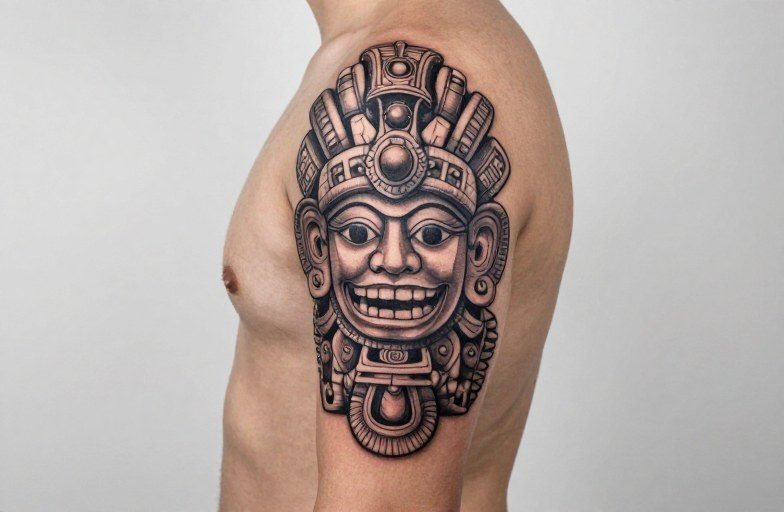
A Maya tattoo typically channels the visual language of the Classic Maya civilization, glyphs, the Long Count calendar, jaguar motifs, and celestial symbols. For most people who get one, it represents a connection to ancient wisdom, cyclical time, or personal transformation, though the specific meaning depends heavily on which symbol you choose and how it’s rendered.
Symbolism & Core Meaning
The Maya developed one of the most sophisticated symbolic systems in the ancient Americas. Their tattoos today borrow from that visual vocabulary, but the weight of each symbol varies dramatically.
Calendar Glyphs and Personal Significance
The Tzolk’in, a 260-day ritual calendar, paired numbers 1-13 with twenty day-names like Imix (water lily), Ik’ (wind), and Ajaw (lord). People often tattoo their birthday glyph, believing it carries personal resonance. The Haab’ solar calendar adds eighteen months of twenty days plus five unlucky days. These glyphs work best as compact designs, wrist, ribcage, or behind the ear, because fine linework preserves the intricate geometry. Blown up too large, the details can blur as the ink settles.
Jaguar, Serpent, and Celestial Power
The jaguar (balam) dominated Maya iconography as a symbol of night, underworld authority, and warrior prowess. Rulers wore jaguar pelts; the animal’s spotted coat mapped onto starry skies. The feathered serpent, often linked to Kukulkan, bridges earth and heaven. These motifs carry assertive energy, chest pieces, thigh panels, or full back work. They’re less about quiet personal meaning and more about claiming visible power.
- The Hunab Ku symbol, a modern design often mistaken as ancient, represents universal consciousness; it’s actually a 20th-century creation but widely adopted
- Double-headed serpents signify duality and cosmic balance
- The five-pointed shell star glyph marks significant dates or celestial events
History & Cultural Roots
Maya civilization stretched across southern Mexico, Guatemala, Belize, and Honduras from roughly 2000 BCE to Spanish contact. Their tattooing practices are harder to trace than their stone carvings, but evidence exists.
What Archaeology Actually Shows
Figurines and painted ceramics depict figures with patterned skin, though scholars debate whether these represent tattooing, scarification, or body paint. The Spanish chronicler Diego de Landa, writing in the 1500s, noted Maya elites marked their bodies, but his accounts blend observation with missionary bias. What we know for certain: the visual language, glyphs, animal gods, geometric borders, survives abundantly on stelae, pottery, and codices. Modern Maya tattooing draws directly from these sources, not from an unbroken traditional practice.
Contemporary Maya Communities
Living Maya peoples in Guatemala and Chiapas maintain textile patterns, calendar knowledge, and spiritual practices. Some tattoo artists from these communities now incorporate traditional motifs into their work, though this varies by family and region. If you’re drawn to Maya imagery, sourcing from actual Maya artists or thoroughly researching specific symbols shows respect for living culture, not just ancient ruins.
Mythology & Folklore
Maya cosmology layered multiple worlds, the sky, the surface earth, and the watery underworld, Xibalba. This three-tiered universe generated rich narrative imagery.
The Popol Vuh and Hero Twins
The K’iche’ Maya text Popol Vuh, recorded in the 1500s, tells how the Hero Twins outwitted Xibalba’s death lords. Their journey through the underworld’s houses of knives, cold, and jaguars offers potent tattoo narratives: the twins’ transformation into sun and moon, their resurrection of their father. These scenes demand narrative space, sleeves or back panels, to read clearly. Single-image tattoos of one twin or a specific trial (the bat house, the ball court) work better for smaller scales.
The World Tree
Yaxche, the ceiba tree, rooted in Xibalba and branched into the thirteen heavens. Its cross-shaped form appears constantly in Maya art. As a tattoo, it anchors compositions beautifully, vertical on the spine or forearm, spreading across shoulders. The tree’s trunk often carries calendar glyphs, its branches sheltering birds representing different sky layers.
Religious & Spiritual Angles
Maya spirituality was never monolithic; it varied by city-state, era, and social class. Modern interpretations range from scholarly reconstruction to New Age adaptation.
Ancestor Veneration and Blood Ritual
Classic Maya elites drew blood from tongues, ears, and genitals to nourish ancestors and sustain cosmic order. This imagery, bloodletting ropes, stingray spines, appears in temple art but rarely translates well to tattoo. The symbolism of sacrifice and continuity, however, resonates in abstracted forms: the rope-twist motif, the jade-blood droplet symbol. These work as subtle, personal pieces rather than literal reproductions of ritual scenes.
Modern Spiritual Adoption
Some practitioners of modern Maya spirituality, often called Maya cosmovision, incorporate tattooing as part of ceremonial life. This is specific to certain communities and teachers, not a universal practice. If you’re considering a Maya tattoo for spiritual reasons, distinguish between personal symbolism and claiming initiation into traditions you haven’t studied. The visual language is public; the living practice is not always open.
How It Ages on Skin
Maya tattoo designs present specific aging challenges due to their detail-oriented nature.
Glyph Readability Over Time
Small glyphs with interior lines, think the day-sign Ajaw with its multiple concentric elements, tend to fill in after 5-10 years. The ink spreads slightly under skin; what read as distinct bars and dots merge into grey blobs. Solutions: size glyphs at least 2-3 inches tall, prioritize bold exterior outlines over interior texture, and place them on low-movement areas (upper arm, calf) rather than hands or feet where ink fades fastest. Black ink holds; color in Maya-style tattoos (turquoise, jade green, ochre) often fades to muddy tones unless refreshed.
Line Weight and Shading Strategy
Traditional Maya art relies on crisp lines and flat color fields, not the graduated shading of European realism. This actually ages well, solid blacks and clean edges resist blurring better than soft grey washes. The risk is over-detailing: a stela reproduction with dozens of tiny glyphs becomes illegible. Smart adaptation simplifies, choosing one dominant motif with minimal supporting elements.
Design Tips & Pairings
Placement and combination choices shape how Maya tattoos read visually and culturally.
Complementary Styles
Maya geometry pairs surprisingly well with certain non-Maya approaches. Blackwork bands framing a central glyph echo the border patterns on Classic pottery. Dotwork backgrounds suggest star fields or the stippled texture of carved limestone. What clashes: photorealistic jaguar portraits alongside stylized glyphs create visual dissonance; choose one register, stylized or realistic, and commit.
- Wrist/forearm: single prominent glyph, readable at handshake distance
- Ribcage: vertical compositions like the World Tree, tolerating detail in protected skin
- Thigh: larger narrative scenes, good canvas for the Hero Twins cycle
- Upper back: symmetrical compositions, mirror-image glyphs or paired deities
Avoiding Common Missteps
Don’t mix Aztec and Maya imagery casually, they’re distinct civilizations with different visual languages. The Aztec sun stone and Maya Long Count operate differently; combining them signals confusion, not synthesis. Similarly, verify glyph accuracy: some online “Maya tattoo fonts” invent symbols. The Maya Hieroglyphic Database Project and academic resources provide reliable references. A misspelled glyph is permanently embarrassing in ways a misspelled English word isn’t, because fewer people can correct it.
The Bottom Line
A Maya tattoo carries weight because the source material is genuinely complex, mathematical, astronomical, mythological. The best pieces respect that complexity rather than flattening it into generic “tribal” aesthetics. Choose specific symbols over vague atmosphere, prioritize legibility in your design, and understand if you’re referencing ancient history, living culture, or personal interpretation. The ink lasts longer than the impulse to get it; make sure the symbol earns its permanence.
Frequently Asked Questions
How do I know if a Maya glyph tattoo is historically accurate?
Cross-reference designs against academic databases like the Maya Hieroglyphic Database Project or published scholarly works. Many popular ‘Maya’ fonts online contain invented symbols. A reputable artist specializing in this style should source from established epigraphic references.
Can I get a Maya tattoo if I’m not Maya or Latino?
Maya visual culture is historically documented and widely studied, but living spiritual practices belong to specific communities. Most Maya people welcome respectful engagement with their ancient heritage; the concern arises when tattoos claim spiritual authority from traditions you haven’t studied or been invited into.
What’s the difference between Aztec and Maya tattoo imagery?
These were distinct civilizations with different languages, calendars, and art styles. Maya glyphs are more curvilinear and include the Long Count calendar system; Aztec imagery tends toward more angular, militaristic symbols like the sun stone. Mixing them without understanding the difference is a common error.
Do Maya tattoos need to be black ink only?
Classic Maya art used vivid colors, Maya blue, jade green, ochre, but these pigments were for pottery and murals, not skin. Modern tattoos can use color, but black line work ages most reliably. If you want color, limit it to larger, simpler areas rather than fine details.
Related Tattoo Meanings
- Crocodile Tattoo Meaning: Power, Survival, and Ancient Guardians
- Khmer Tattoo Meaning: Sacred Symbols Modern Ink
- Please Lip Tattoo Meaning: Symbolism, Styles Placement
- Explore more









