
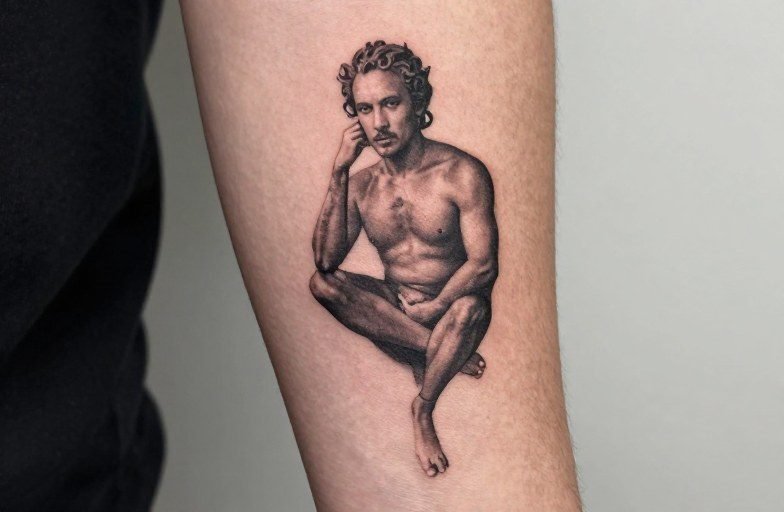
The Mark of Cain tattoo carries a loaded, paradoxical meaning: it represents both punishment and protection, exile and divine safeguard. For most who wear it, the symbol signals an identification with the outsider, the misunderstood, or the morally complex figure who bears a visible sign of separation from the mainstream. It can read as a warning, a shield, or a quiet declaration of having survived something that set you apart.
Symbolism & Core Meaning
The Paradox of Protection Through Punishment
The biblical mark functions as a contradiction worth sitting with. Cain, condemned to wander after murdering his brother, receives a mark from God not to increase his suffering but to prevent others from killing him. That tension, punishment that simultaneously shields, drives much of the tattoo’s appeal. People drawn to this symbol often resonate with the idea of being set apart by circumstance, choice, or trauma, yet still standing under some form of guardianship. The mark becomes less about the crime and more about the aftermath: surviving visible condemnation and continuing anyway.
Outsider Identity and Social Distance
There’s a practical social dimension here. The mark made Cain recognizable, immediately legible as someone to avoid or respect from a distance. In tattoo form, that translates to a symbol of self-imposed or enforced separation. Some wear it after leaving rigid communities, religious, familial, institutional, where they felt marked already. Others choose it during periods of deliberate isolation, creative retreat, or personal rebuilding. The symbol doesn’t require belief in the biblical narrative to function; it works as shorthand for “I am not of this group, and that is by design.”
History & Cultural Roots
Biblical Origins and Interpretive Gaps
The Genesis account leaves the mark’s nature undefined, no description of shape, placement, or material form. This ambiguity has fueled centuries of speculation. Some Jewish traditions describe it as a letter from the Hebrew alphabet; certain Christian interpretations imagined a physical deformity; folklore across European and American cultures often linked it to horned figures or skin discoloration. The tattoo draws from this interpretive void, allowing wearers to project their own specific meaning onto an ancient blank slate. The lack of canonical detail is the feature, not the bug.
Modern Cultural Transmission
The symbol gained tattoo-specific traction through literature, film, and music rather than religious circles. Neil Gaiman’s use of the mark in The Sandman introduced it to graphic novel audiences as a symbol of protection and consequence. Supernatural television narratives and various metal and dark folk music references cemented its association with anti-hero identification. These pop-culture channels matter because they shaped how most people first encounter the symbol, outside church, inside stories about complicated protagonists.
Religious & Spiritual Angles
Reclamation and Subversion
For those with religious backgrounds, the Mark of Cain tattoo often operates as reclamation. The biblical figure functions as archetypal villain in Sunday school contexts; wearing his mark can represent refusing that easy moral categorization. Some Christian-identified wearers emphasize the grace embedded in the story, God’s refusal to let Cain be destroyed, the mercy within judgment. Others use it to signal distance from faith communities that they feel marked them unfairly. The tattoo becomes a way to occupy the complicated middle: neither fully rejecting nor fully embracing the source material.
Non-Abrahamic Adaptations
The symbol also travels outside its origin. Some neopagan practitioners connect it to older wandering-deity figures, though these links are often more associative than historically grounded. Occult-influenced designs sometimes merge the mark with sigil traditions, treating it as a personal protective emblem charged through intention rather than divine fiat. These adaptations demonstrate how the symbol’s core themes, protection, exile, visible difference, translate across belief systems.
Design Tips & Pairings
Placement and Visibility Considerations
The mark’s meaning shifts with placement. Forehead or temple locations mirror the biblical implication of unavoidable visibility, but these are aggressive choices that affect employment and daily interaction. More common: the back of the neck, upper chest near the collarbone, or the forearm, visible when you choose, concealable when necessary. The hand functions as middle ground: seen in handshake, hidden in pocket. Consider how the mark’s meaning of “recognizable outsider” plays against your actual need for social navigation.
Complementary and Contrasting Elements
Common pairings include:
- Serpent imagery, playing the Eden-Cain narrative connection
- Broken agricultural tools, referencing Cain’s occupation and his curse upon the ground
- Eye motifs, emphasizing the “being watched” aspect of marked identity
- Text in Hebrew or Latin, grounding the symbol in specific textual traditions
- Geometric framing, modernizing the mark into clean line work
Line-only designs age cleaner than heavy shading on this particular symbol. The mark’s power comes from its graphic simplicity; elaborate ornamentation often dilutes rather than strengthens. Black ink holds up better than color, and the starkness suits the theme.
Common Variations & Styles
Letterform Interpretations
Some designs use specific Hebrew letters, most commonly the letter vav or interpretations of Tetragrammaton fragments, based on midrashic traditions about what God inscribed on Cain. These require careful research; incorrect Hebrew is a frequent and obvious mistake. The letterform approach appeals to those wanting textual grounding rather than abstract symbol. It reads more specifically Jewish or scholarly, narrowing but deepening the reference.
Abstract and Minimalist Approaches
Other variations reduce the mark to a simple geometric form: a circle, a vertical line, a small sigil-like arrangement of dots. These function as private signals, recognizable only to those already familiar with the reference. The minimalist route suits people who want the personal meaning without the conversational burden of explaining biblical narrative to strangers. Watercolor-style backgrounds behind simple mark shapes have trended, though the color bleeding can blur the symbol’s starkness over time.
Personal & Modern Meanings
Survival and Post-Trauma Identification
For some wearers, the mark represents surviving violence, whether received or committed, and the subsequent social repositioning that follows. The tattoo acknowledges a before and after, a line crossed that doesn’t uncross. It can mark recovery from addiction, incarceration, or abusive systems where the wearer felt both condemned and paradoxically protected by their separation. The symbol’s biblical context provides a narrative framework for experiences that otherwise resist clean storytelling.
Creative and Professional Identity
Artists, musicians, and others in non-traditional careers sometimes adopt the mark as professional identification, the visible sign of someone who operates outside conventional structures. This usage carries some risk of pretension; the symbol works best when there’s genuine social friction to back it up. Worn by someone whose life actually involves marginalization, exclusion, or chosen distance from mainstream paths, it resonates. Worn purely as aesthetic, it can flatten into empty edginess.
Final Thoughts
The Mark of Cain tattoo endures because it refuses easy reading. It is simultaneously victim and perpetrator symbol, divine blessing and divine curse, ancient text and contemporary projection. That instability is its strength. Good tattoo choices hold tension rather than resolve it. This one asks the wearer to live with paradox, visible yet guarded, condemned yet protected, wandering yet watched over. The skin carries what the story only suggests: that being set apart is not the same as being abandoned, and that marks of difference can function as shields. Choose it with that complexity in mind, place it where its visibility matches your life, and let the ambiguity do its work.
Frequently Asked Questions
Does the Mark of Cain tattoo have to be religious?
No. Many wearers connect to the symbol’s themes of protection and outsider identity without holding specific religious beliefs. The biblical narrative provides a framework, but the tattoo’s meaning depends on personal interpretation.
What’s the best size for a Mark of Cain tattoo?
Small to medium sizes work best for this symbol. The mark derives power from graphic simplicity; large elaborate pieces often lose the stark, immediate impact that makes the design effective.
Will people assume I’m a Satanist if I get this tattoo?
Some may make that assumption due to pop-culture associations and the symbol’s connection to outsider figures. The biblical mark actually represents divine protection, not demonic allegiance, but you’ll likely need to explain this distinction occasionally.
How well does this tattoo age over time?
Line-based designs with minimal shading age most cleanly. The symbol’s effectiveness relies on sharp contrast and clear form, so avoiding heavy detail and choosing black ink on high-contrast skin areas helps maintain legibility for years.
Related Tattoo Meanings
- Maya Tattoo Meaning: Symbolism, Design, and Cultural Roots
- Meaningful Mechanic Tattoo Meaning: Gears, Guts, and Grit
- Medusa Assault Tattoo Meaning: Symbolism Design Guide
- Explore more









