
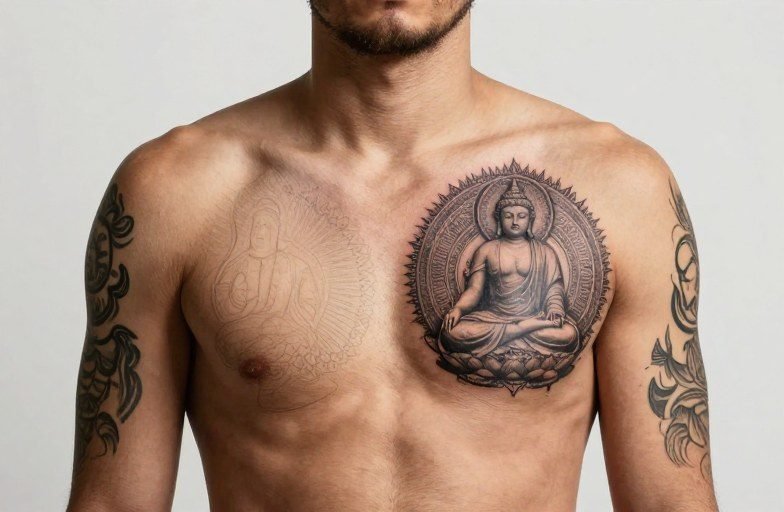
A male deep meaning spiritual tattoo isn’t about displaying faith like a badge. It’s an external mark of an internal reckoning, questions about purpose, mortality, the weight of existence, or the pull toward something larger than the self. These pieces carry symbols that resist quick interpretation: sacred geometry, eyes, serpents, celestial bodies, or abstracted religious iconography stripped of institutional context. The meaning lives in the specific combination, the placement, and what the wearer needed to remember at a particular moment.
Symbolism & Core Meaning
Spiritual tattoos for men tend to cluster around a handful of existential concerns. Death and impermanence show up in skulls, hourglasses, and wilting flora, not as morbid fixation, but as memento mori, the reminder to act while time remains. Transformation appears through butterflies (less common for men, but present), phoenixes, serpents shedding skin, or the alchemical ouroboros eating its own tail. Duality and balance emerge in yin-yang adaptations, the hermetic “as above, so below,” or the juxtaposition of light and dark elements in a single composition.
What separates a spiritual tattoo from a decorative one is the density of reference. A geometric mandala might contain Fibonacci ratios, Buddhist cosmology, and personal numerical significance simultaneously. The all-seeing eye can reference divine providence, Egyptian wedjat protection, or the pineal gland’s esoteric “third eye” function. The symbol doesn’t choose one meaning, it holds several in tension.
Placement as Meaning
Where the tattoo sits changes its function. Chest pieces over the heart traditionally carry what matters most, names of the dead, protective symbols, or representations of core belief. The back becomes a canvas for larger cosmological scenes, things the wearer carries but cannot see without assistance. Forearms and hands display commitment publicly; ribs and thighs keep the work private, revealed only in intimacy. The throat, increasingly common, marks a point of no return, visible, unavoidable, a declaration that this identity is fixed.
Line Work vs. Shading
Single needle or fine line work suits spiritual content well, delicate, precise, almost illustrative. The restraint of clean lines prevents the symbol from becoming melodramatic. Heavy blackwork or whip-shaded backgrounds create weight and permanence but can obscure detail over time. For pieces meant to last decades, moderate line weight with strategic black fill ages more gracefully than either extreme. Watercolor techniques, while popular, rarely hold their intended effect past five to seven years; the spiritual tattoo, by nature, tends toward longevity.
Religious & Spiritual Angles
Christian iconography in male spiritual tattoos often moves away from literal crosses toward the ichthys (fish), the Chi-Rho, or the anchor, symbols that carried secret meaning during persecution. The crown of thorns wraps around arms or encircles calves, referencing suffering without the explicit crucifixion scene. Eastern traditions appear in unalome designs (the path to enlightenment in Theravada Buddhism), lotus flowers rising from mud, or simplified mudra hand positions. These borrowings require care; wearing a sacred symbol without understanding its cultural weight reads as appropriation rather than genuine connection.
Esoteric and occult traditions offer alternatives outside organized religion. The tree of life from Kabbalah, planetary seals from Renaissance grimoires, or astrological charts calculated for the wearer’s birth moment all carry personal specificity. Norse runes, Algiz for protection, Othala for ancestral inheritance, Ansuz for divine communication, function as both symbol and functional magical object in reconstructionist practice. The sigil, a symbol created to represent a specific intention, offers perhaps the most personal option: designed by the wearer, charged with purpose, literally unique.
Secular Spirituality
Not every spiritual tattoo references a tradition. Some men choose natural phenomena, mountains, oceans, forests, as representations of the sublime, the experience of being overwhelmed by scale and beauty that functions as secular worship. The Voyager golden record, DNA helixes, or mathematical constants like pi or the golden ratio express reverence for cosmic order without supernatural claim. These pieces tend toward realism or scientific illustration, trusting the subject’s inherent weight over stylized interpretation.
Color vs. Black and Grey
Black and grey dominates male spiritual tattooing for practical and aesthetic reasons. The palette reads as serious, timeless, less susceptible to trend. Religious iconography in particular has centuries of precedent in charcoal, ink wash, and woodcut, monochrome carries historical authority. Black ink also ages predictably: it settles, softens, but remains legible. Color requires more maintenance, more sun protection, more touch-ups to prevent the muddied palette that develops when pigments fade unevenly.
That said, strategic color carries specific symbolic load. Gold leaf or metallic ink (though often poorly executed) references the divine, the halo, the precious. Red for blood, sacrifice, or the root chakra. Blue for the Virgin Mary’s mantle, for water, for throat chakra expression. Green for Islam, for nature, for heart chakra growth. When color appears in spiritual work, it usually does so sparingly, a single accent against black, or a small section of full color within a larger grey piece, creating focal point and hierarchy.
Who Chooses This Tattoo
The demographic is broader than stereotype suggests. Young men in military service often seek spiritual tattoos before deployment, protective symbols, memorials for friends already lost, attempts to make meaning from anticipated trauma. Men in recovery from addiction frequently mark sobriety anniversaries with spiritual imagery, the tattoo as permanent witness to a transformation. Others arrive at spiritual tattooing after loss: a father’s death, a divorce, a health crisis that reordered priorities. The common thread is transition, the symbol marking a before and after.
Some artists report increased requests from men in traditionally secular professions, tech, finance, law, who’ve reached material success without corresponding meaning. The tattoo becomes a corrective, a way to claim values that their work doesn’t express. These clients often arrive with extensive research, specific historical references, and a clear sense of what they want to carry forward. The consultation becomes collaborative archaeology, digging to find the precise symbol that holds their particular weight.
Design Tips & Pairings
Combining symbols requires compositional intelligence, not just accumulation. The eye within the triangle, set above a mountain range, with a serpent coiled below, this creates vertical hierarchy: observation, aspiration, grounded transformation. Without spatial relationship, symbols become a list rather than a statement. Good spiritual tattooing thinks in layers: foreground, middle ground, background, each carrying distinct information that resolves into single meaning.
Lettering in spiritual pieces demands particular care. Script, unless exceptionally well-executed, ages poorly; the fine loops of cursive blur, the negative space in serif fonts closes up. Block lettering, Greek or Hebrew characters, or numerical sequences hold their form better. When text appears, it should be essential, quotations too long become illegible, too generic become meaningless. A single word in a language the wearer has studied, a date in astronomical notation, a coordinate: these carry the density that spiritual tattooing requires.
Scaling for Body Flow
Spiritual symbols often originate in two-dimensional sacred contexts, manuscript illuminations, temple carvings, alchemical woodcuts. Adapting them to the body’s curves requires adjustment. A mandala that reads perfectly flat distorts across a shoulder’s roundness. The solution is often to break the symbol, let it wrap, or to choose placement that approximates its original context. The chest’s flat planes suit mandalas; the forearm’s cylinder suits serpents and spirals; the back’s broad surface suits landscape cosmologies. The body becomes part of the design problem, not merely canvas.
Mythology & Folklore
Norse mythology offers male spiritual tattooing some of its most requested imagery. Yggdrasil, the world tree, connects the nine realms and mirrors the axis mundi found across cultures. Ravens Huginn and Muninn, thought and memory, accompany Odin, suitable for men who value intellect and reflection. The Valknut, three interlocked triangles, often linked to the slain and Odin’s power, appears frequently though its precise original meaning remains debated among scholars. Thor’s hammer, Mjolnir, served as protective amulet in historical practice, a function some wearers seek to continue.
Greek and Roman sources provide the phoenix, the Gorgon’s protective gaze, the labyrinth as journey symbol. Egyptian material, Anubis weighing hearts, the eye of Horus, scarabs pushing the sun, carries millennia of continuous use. Celtic knotwork, while often reduced to decorative pattern, originally encoded complex relationships between elements, the endless line representing eternal connection. Japanese folklore contributes the oni mask, the dragon, the koi’s upstream struggle, all absorbed into irezumi tradition with specific rules of placement and combination that Western adoption frequently ignores.
These mythological borrowings work best when the wearer has genuine connection to the tradition, not merely aesthetic attraction. The symbols carry weight because they carried weight for others; to wear them without that continuity is possible, but thinner. The alternative is to work with a tattoo artist to develop personal symbolism that draws on mythic structure without direct quotation, creating, in effect, new folklore.
Final Word
A male deep spiritual tattoo succeeds when it resists immediate consumption. The stranger who asks “what does that mean?” should receive an answer that opens further conversation, not closes it. The symbol should reveal more over time, to the wearer most of all, who discovers new resonances as experience accumulates. The best spiritual tattoos are questions made visible, not answers made permanent. Choose the symbol that unsettles as much as it comforts, that reminds you of what you don’t know, that marks the moment you decided to carry something forward rather than leave it behind.
Frequently Asked Questions
How do I know if a spiritual symbol is appropriate for me to wear?
Research its origins and ongoing cultural significance. If it belongs to a living tradition you’re not part of, consult practitioners from that tradition. Some symbols are broadly shared; others carry specific obligations or meanings that require initiation or heritage. When uncertain, work with an artist to develop personal imagery inspired by, rather than directly copying, sacred material.
Do spiritual tattoos need to be large to carry meaning?
Scale doesn’t determine significance. A small symbol in a considered placement can hold more weight than a full back piece chosen casually. The density of personal connection matters more than square inches. That said, some imagery, cosmological scenes, detailed mandalas, requires space to function compositionally.
How do I explain my spiritual tattoo to family who might disapprove?
You don’t owe anyone explanation. If you choose to offer one, focus on what the symbol represents to you personally rather than defending its broader validity. Many spiritual symbols carry universal themes, transformation, protection, remembrance, that translate across belief systems without requiring full doctrinal disclosure.
Will my spiritual tattoo’s meaning change as I age?
Almost certainly, and that’s part of the design’s function. The symbol that marked a specific crisis becomes, over decades, a record of survival. What you needed to remember at twenty-five differs from what resonates at fifty-five. The tattoo’s fixed image against your changing interpretation creates a kind of dialogue with your past self.
Related Tattoo Meanings
- Vida Loca Tattoo Meaning: Loyalty, Loss, and Street Culture
- Mina Kimes Tattoo Meaning: Symbolism Behind the Design
- Sisyphus Tattoo Meaning: Endless Struggle Quiet Defiance
- Explore more









