
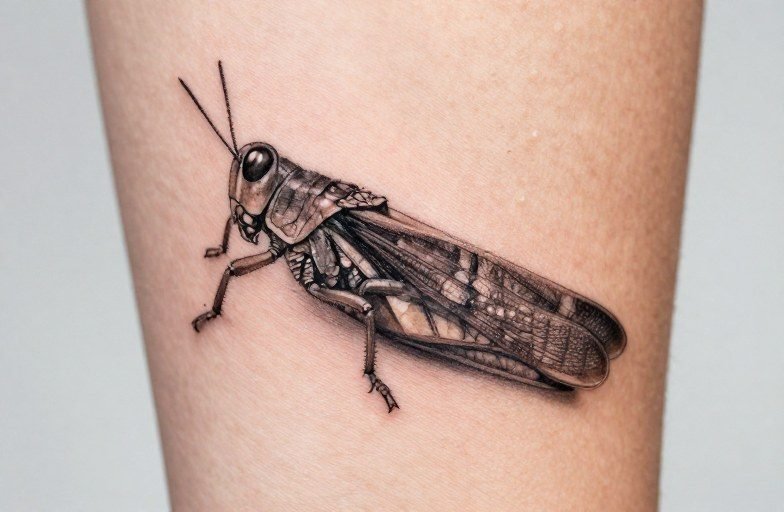
A locust tattoo most often signals destruction paired with uncanny resilience, swarms that strip landscapes bare, yet the insect itself survives, regenerates, and moves forward. The image works for people who’ve weathered collapse, started over after loss, or respect nature’s brutal cycles. Some wear it as warning, others as proof they made it through the swarm.
Symbolism & Core Meaning
The locust operates on contradiction. It represents famine and devastation in one breath, transformation and endurance in the next. Unlike the solitary grasshopper, the locust emerges from environmental pressure, crowding triggers physical changes, swarming behavior, mass migration. That biological switch from harmless to overwhelming mirrors human experience: how pressure reshapes people, how survival sometimes demands becoming something fiercer.
Destruction and Renewal
Swarms devour everything green, yet locusts also fertilize ground they pass, and their bodies become food for birds, reptiles, mammals. The cycle isn’t pure ruin. For tattoos, this duality attracts people who’ve dismantled their old lives, addiction recovery, leaving cults or abusive systems, surviving economic collapse, and recognize that destruction preceded their new growth. The imagery acknowledges harm done, not just harm survived.
Overwhelming Force, Individual Survival
A single locust is vulnerable. Millions become unstoppable. The tattoo can celebrate collective power, community, movement, shared struggle, or individual persistence within that mass. Placement and design shift this reading: one locust alone reads differently than a sleeve of descending swarm.
Religious & Spiritual Angles
Biblical texts feature locusts prominently, usually as divine instrument. Exodus describes the eighth plague; Revelation deploys them from smoke, with faces “like men” and power to torment. These apocalyptic associations draw people raised in or reacting against Christian tradition, sometimes as reclaimed symbol, sometimes as lingering dread made visible.
Islamic and Jewish Contexts
The Qur’an mentions locusts among God’s signs, and some Islamic scholars note their lawful status as food. Jewish dietary law also permits locusts, with specific species identified in tradition. Tattoos drawing on these angles tend toward geometric or calligraphic integration rather than naturalistic horror. The insect becomes permitted, even sacred, subverting the Western default of locust-as-plague.
Secular Spirituality
Outside organized religion, locusts attract practitioners of chaos magic, Discordianism, or ecological spirituality who embrace the insect as embodiment of natural excess and correction. The swarm doesn’t moralize; it responds to conditions. That mechanistic, almost amoral quality appeals to those who’ve abandoned frameworks of cosmic justice for something more Darwinian.
Best Placements
Locust anatomy, elongated body, powerful hind legs, veined wings, suits certain body contours better than others. The thorax and abdomen align naturally with forearm muscles or calf length. Wingspan works across shoulder blades, chest panels, or thigh pieces where the artist can stretch the transparent membrane sections.
- Forearm: Vertical orientation shows leg structure and mandibles clearly; easy to display or cover. Expect some fading on the wrist side from sun and friction.
- Ribcage/side: The body’s natural curve complements the locust’s arched posture. Painful placement, but the insect appears to cling or leap across the torso.
- Thigh: Ample space for swarm compositions, multiple insects at different angles, or locust paired with devoured vegetation. Heals relatively well, less sun exposure than arms.
- Hand/finger: Single small locust, often black-work. High visibility, fast fading, frequent touch-ups required. The joint movement can animate the legs slightly.
Neck and face placements happen but read more aggressively, prison associations in some regions, punk or underground signaling elsewhere. Consider your professional context and how the swarm reads at conversational distance.
Design Tips & Pairings
Locusts offer distinctive visual elements: compound eyes (often rendered as dense dotwork or solid black), tympanal organs on the abdomen, spined hind legs built for jumping. Skipping these details yields generic insect; emphasizing them creates recognizable, specific locust.
Line Weight and Texture
Wing membranes demand subtlety. Too heavy, and they read as beetle shells; too light, and they disappear in healing. Experienced artists use single-needle or tight three-needle linework for vein structures, sometimes leaving skin-breaks for highlights. The body carapace takes heavier black or solid color, creating contrast that defines the form.
Common Pairings
- Wheat or corn stalks: Direct biblical/agricultural reference, the food being destroyed. Sets narrative context immediately.
- Skull: Death and famine association, Mexican calavera style or realistic. Can edge into cliché without personal customization.
- Clocks, hourglasses: Time running out, seasonal inevitability. Works with art deco or traditional styling.
- Text: Short phrases in Latin, Hebrew, or Arabic, “Locusts have no king, yet they advance in ranks” (Proverbs 30:27) appears frequently. Keep lettering large enough to age legibly.
Swarm compositions require negative space management. Too dense, and the insects merge into texture; too sparse, and they look scattered. Good artists stagger sizes, overlap wings, vary angles to create depth without chaos.
Color vs Black and Grey
Real locusts range from drab brown to bright yellow, green, or pink depending on phase and species. Desert locusts in gregarious phase show striking black and orange patterning. These natural palettes translate well to tattoo, but the choice carries symbolic weight.
Black and Grey
Emphasizes the locust as shadow, plague, omen. Photorealistic rendering shows texture, decay, the insect’s almost armored quality. Traditional black-work simplifies to bold outlines, readable from distance, less dependent on skin tone for color clarity. Heals most predictably; black holds.
Color Approaches
Green and yellow locusts read more alive, more biological, less symbolic, more specimen. Red accents on wings suggest warning coloration, danger. Full rainbow treatments (often in neo-traditional or Japanese-influenced styles) aestheticize the insect, sometimes diluting the darker associations wearers seek. Consider whether you want the locust beautiful or disturbing; color choice is the primary lever.
White ink highlights on black locusts create chitin sheen but often yellow or disappear entirely within a few years. Use sparingly, if at all.
Who Chooses This Tattoo
The locust doesn’t attract casual botanical collectors or first-timers seeking something “pretty.” The imagery carries enough negative charge that wearing it signals intentionality. Common profiles include:
- Survivors of collective trauma: Cult leavers, disaster survivors, people who watched communities collapse and rebuilt elsewhere. The swarm as lived metaphor.
- Agricultural workers: Farmers, agronomists, people who’ve actually watched locust swarms descend. The tattoo marks professional identity and genuine threat.
- Military veterans from desert deployments: Locust swarms are ambient reality in Iraq, Afghanistan, parts of Africa. The insect becomes place-memory, sometimes humor (the ungovernable local wildlife), sometimes unease.
- Ecologists and biologists: Phase polyphenism, the transformation from solitary to gregarious form, is scientifically remarkable. These tattoos often emphasize accurate species representation over stylized menace.
The locust also appears in heavy metal and punk iconography, so some wearers come through music culture rather than personal narrative. Crossover happens: the biology enthusiast who also toured with a crust band, the veteran who studies entomology post-discharge.
Final Word
A locust tattoo commits to imagery that most cultures find at least unsettling, often actively hostile. That friction is the point. The insect doesn’t comfort; it insists on cycles of destruction and persistence that ignore human preference for stability. Good locust work respects that tension, accurate enough to show you did the research, bold enough to own the discomfort. Choose an artist who handles insect anatomy with confidence, who won’t soften the mandibles or cute the eyes. The power lives in the specificity: this creature, this threat, this survival.
Frequently Asked Questions
Does a locust tattoo always have negative meaning?
Not necessarily. While plague and destruction are common associations, many wearers emphasize transformation, ecological cycles, or survival through collapse. The meaning depends heavily on design choices and personal context.
How well does detailed locust wing work age over time?
Fine linework in wing membranes spreads and softens with age, typically becoming less distinct within 5-10 years. Bold vein structures with adequate spacing hold longer; consider slightly heavier lines than initially desired for longevity.
What’s the difference between a grasshopper and locust tattoo symbolically?
Grasshoppers generally read as solitary, lucky, or connected to summer and leisure. Locusts specifically invoke swarm behavior, mass destruction, and transformation under pressure. The two insects are biologically related but carry distinct cultural weight.
Are there specific locust species that work better for tattoo reference?
The desert locust (Schistocerca gregaria) offers the most dramatic visual phase changes and strongest cultural recognition. The migratory locust (Locusta migratoria) provides classic Asian references. Accurate species choice shows intentionality in the design.
Related Tattoo Meanings
- Lonely Wolf Tattoo Meaning: Solitude, Strength, and Self-Reliance
- Loon Tattoo Meaning: Wilderness, Grief Northern Soul
- Lucifer Tattoo Meaning: Symbolism, Design, and What It Actually Says
- Explore more









