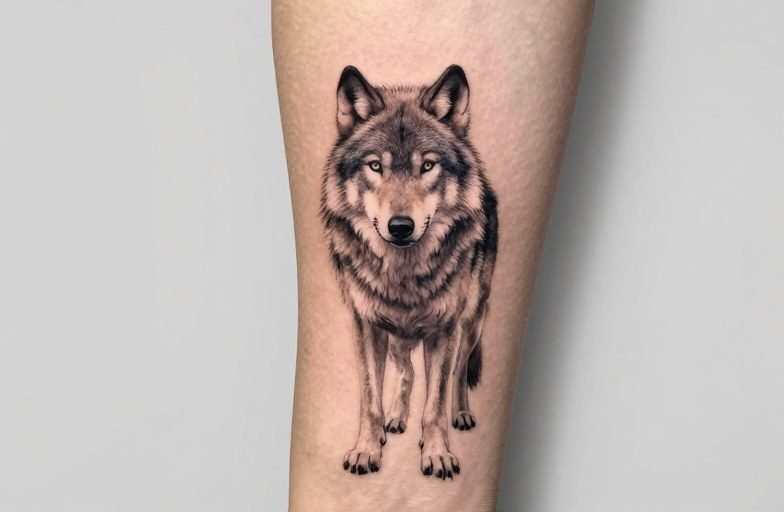
A lonely wolf tattoo carries a specific, layered meaning: self-sufficiency without hostility, solitude chosen rather than forced, and strength that doesn’t require a pack. Unlike the wolf as loyal pack animal, the lone wolf steps away from the group, by circumstance, temperament, or necessity. The image resonates with people who identify as outsiders, survivors of isolation, or those who’ve learned to trust their own judgment above the crowd’s noise.
Religious & Spiritual Angles
Norse and Pagan Connections
In Norse symbolism, wolves often linked to Odin’s companions Geri and Freki, “greedy” and “ravenous”, who shadowed the god through battlefields and wilderness. A solitary wolf, though, pulls from different threads: the outcast, the survivor of Ragnarök’s chaos, the beast that endures winter alone. Some modern pagan practitioners adopt the lone wolf as a spirit animal representing the shadow work of isolation, the necessary retreat for inner reckoning. The image works for those paths without requiring full religious commitment.
Christian and Monastic Parallels
Desert fathers and medieval hermits deliberately sought solitude; the lone wolf becomes a secular parallel to that deliberate withdrawal. Not martyrdom, not asceticism for display, just the choice to step back from society’s noise. Some wearers with Christian backgrounds find this resonance without making the tattoo explicitly religious. The wolf’s wilderness maps onto the desert, the mountaintop, the cell.
Best Placements
The lonely wolf demands space to breathe. This isn’t a finger or behind-the-ear micro-piece; the image needs enough real estate to show isolation in the landscape.
- Upper arm/outer bicep: Classic canvas. The cylindrical shape lets the wolf face forward or quarter-turn, with negative space above suggesting open sky or forest depth. Easy to show or cover.
- Thigh: Larger scale possible here. The wolf can sit, stand, or howl with terrain below, rocks, snow, cliff edge. Pain level moderate; healing straightforward on this meaty area.
- Back, upper or full: For the committed. A lone wolf on a ridge, small against vast background, reads immediately as isolation rather than just “wolf tattoo.”
- Forearm: Visible daily. Works better for alert, watchful poses, head raised, ears forward, since the horizontal format suits that energy. Expect fading from sun exposure; plan touch-ups.
- Ribcage: Painful, private. The loneliness reads as internal, not performative. Good for howling poses where the rib expansion mimics the breath of the cry.
Avoid cramming the image into spots where the wolf must shrink to insignificance. The meaning lives partly in the scale relationship, creature against emptiness.
Color vs Black and Grey
Black and Grey Realism
This dominates lonely wolf work for good reason. The palette reads as night, winter, overcast, conditions where actual lone wolves operate. Grey wash builds fur texture without distraction; deep blacks anchor the eyes and silhouette. Over time, black and grey ages cleaner than color. The blues and purples some artists add for “cold” effect often shift muddy after five years. Stick to charcoal tones with crisp white highlights for snow or moon.
Strategic Color Use
When color appears, restraint carries the meaning. A single amber eye. Blood on snow. A distant aurora. Full-color “fantasy wolf” treatments undercut the loneliness, too bold, too busy, too social. Watercolor backgrounds can work if the wolf itself stays solid, grounded, separate from the flowing color around it. Think of the color as weather, not decoration.
Design Tips & Pairings
The difference between “generic wolf” and “lonely wolf” lies in composition and supporting elements.
- Negative space: The wolf should occupy minority of the skin. Open sky, bare rock, empty snowfield, this surrounding void speaks the loneliness. Crowd the frame with trees or moon detail and you lose the point.
- Posture: Howling suggests active communication with absence, calling to nothing. Sitting, head lowered, reads as resignation or acceptance. Walking away, toward frame edge, implies ongoing solitary journey. Standing alert, facing viewer, claims the solitude as power.
- Weather and terrain: Snow and ice most common; wind-flattened grass or desert scrub less expected but equally valid. Avoid full forests, too inhabited. Single dead tree, okay. Moon, optional but overused; consider no moon, just starfield or overcast blankness.
- Paired elements: Single paw print trail fading into distance. Broken chain (escaped, not freed by others). Distant, unreachable horizon line. These amplify without explaining.
Script pairings rarely work. Words pin the meaning down too specifically; the image should carry the weight. If you must, a single word in small placement, “alone,” “still,” “far”, but most artists advise against it.
History & Cultural Roots
Origins of the Symbol
The “lone wolf” as cultural concept solidified in early twentieth century, often linked to espionage terminology where it described operatives without network support. Earlier, in American frontier mythology, the solitary trapper or ranger sometimes carried wolf associations. Native American traditions vary enormously by nation, some see wolf as teacher and community member, others recognize the exile or the wanderer. The tattoo’s specific meaning of chosen or endured solitude draws from multiple streams without belonging fully to any.
Modern Adoption
Military veterans, particularly those with difficult returns to civilian life, have adopted the lone wolf as ambiguous symbol, pride in self-reliance, acknowledgment of disconnection, sometimes both simultaneously. The image appears in motorcycle culture with similar duality. These adoptions aren’t appropriation so much as parallel evolution: the symbol finds people who need it, regardless of origin path.
Common Variations & Styles
Style choice dramatically shifts the emotional register.
- American traditional: Bold outline, limited palette, the wolf stylized almost to cartoon. The loneliness reads as stubbornness, almost cheerful defiance. Heals hard, lasts decades.
- Realism: Photographic detail, individual fur texture, accurate eye reflection. The emotional weight comes from the wolf seeming to actually exist, actually suffer or endure. Requires skilled artist; bad realism looks like a blurry dog.
- Neo-traditional: Stylized but detailed, richer color possibilities, decorative elements possible without losing focus. Good middle ground for those wanting some ornament.
- Geometric/dotwork: The wolf constructed from lines, triangles, stippled shadow. The abstraction distances the emotion, cooler, more intellectual loneliness. Mandala elements behind or around can suggest the universe’s indifference rather than social rejection.
- Japanese influence: Wolves rare in traditional irezumi, but the compositional approach, asymmetrical, flowing, background-dominant, adapts well. Consider this for the lone wolf on ridge against misty mountain.
Scar cover-ups and stretch mark incorporation sometimes use the lonely wolf specifically, the visible damage becomes part of the terrain, the wolf’s endurance mapping onto the body’s own survival.
What to Remember
The lonely wolf risks cliché because it’s popular, not because the meaning is shallow. The difference between meaningful and generic lies in specificity of design. A wolf copied from Pinterest, dropped on skin without compositional thought, says “I like wolves.” A wolf placed in deliberate emptiness, at scale that emphasizes isolation, with posture suggesting your particular relationship to solitude, that says something harder to name and more valuable to carry.
Consider timing. This image chosen during acute grief or fresh betrayal may read differently to you in five years. The tattoo doesn’t become wrong, but your relationship to the loneliness might shift from wound to scar to story. Design for that longevity: avoid references too specific to current circumstances.
Finally, the lonely wolf doesn’t require you to be lonely. Some wear it who’ve found their way back to connection, keeping the image as record of who they became in isolation. The meaning isn’t prescription; it’s documentation. Choose an artist who understands that distinction, and give them enough skin to let the emptiness speak.
Frequently Asked Questions
Does a lonely wolf tattoo always mean someone is depressed or antisocial?
No. The symbol carries multiple valid readings: self-reliance, chosen independence, survival through isolation, or simply affinity for wilderness aesthetics. Context and design determine which reading dominates.
How much should I expect to pay for a quality lonely wolf tattoo?
A competent black and grey piece starts around $400-800 for palm-sized, scaling to $1,500+ for larger realism work. Color adds time and cost. The emptiness around the wolf requires as much skill as the animal itself, budget for that negative space.
Will a lone wolf howling at the moon look dated?
The moon-howling composition is extremely common; it won’t look dated so much as familiar. For something less immediately recognizable, consider the wolf in non-howling posture, or omit the moon entirely in favor of empty sky or stark terrain.
Can a lonely wolf tattoo work as a matching piece with someone else?
The concept inherently resists pairing, two wolves together aren’t lonely. If you want connection to someone while keeping the symbol, consider separate pieces showing the same wolf at different moments, or wolves facing each other across distance rather than sharing space.
Related Tattoo Meanings
- Snake Eating Itself Tattoo Meaning: Cycles, Rebirth Self-Consumption
- Miss Honey Tattoo Meaning: Nostalgia, Kindness Quiet Strength
- Loon Tattoo Meaning: Wilderness, Grief Northern Soul
- Explore more