
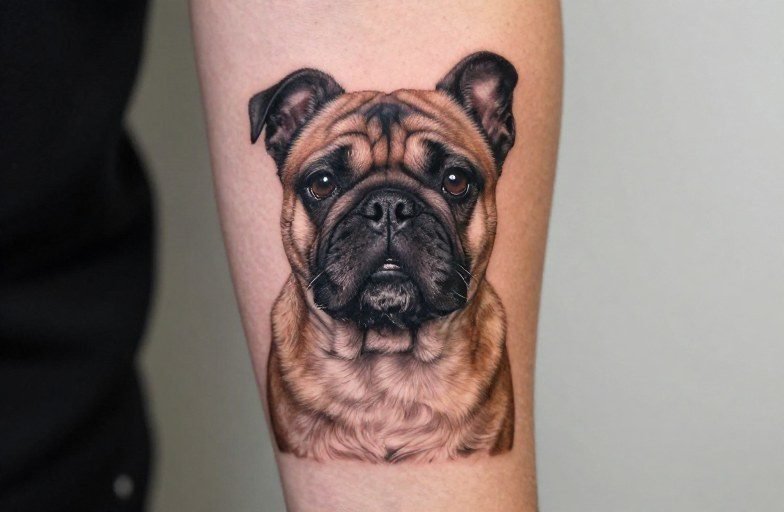
A fudog tattoo depicts the Chinese guardian lion, called shi in Mandarin or komainu in Japanese tradition. Despite the name, it has no connection to actual dogs. These stone figures traditionally flanked temples, palaces, and tombs as protective sentinels. In tattoo form, they carry layered symbolism: fierce guardianship, warding off harm, and attracting prosperity.
Symbolism & Core Meaning
The core symbolism centers on duality and vigilance. Fudogs almost always appear in pairs, one male, one female, representing the balance of yin and yang. The male rests his paw on a sphere or pearl, symbolizing dominion over the world and the cosmic order. The female typically has a cub beneath her paw, representing nurturing and the cycle of life.
As a tattoo, this duality translates to personal balance: strength tempered with compassion, action paired with patience. The open mouth and bared teeth aren’t merely aggressive, they signal alertness, the creature’s perpetual readiness to confront threats. Some trace the open/closed mouth pairing to the Sanskrit sounds “A” and “Un,” representing the beginning and end of all things.
Protection vs. Aggression
The protective aspect dominates most fudog tattoo choices, but execution matters. A fudog with relaxed features and a calm stance reads as settled guardianship, suitable for someone who feels they’ve established their boundaries. The snarling, dynamic pose suits those drawn to active confrontation of obstacles. Neither is more “authentic”; the posture changes the emotional register of the piece entirely.
Mythology & Folklore
The guardian lion tradition entered China through the Silk Road, often linked to Persian and Indian protective beast imagery. Buddhist temples adopted them as temple guardians, and the practice spread through Korea to Japan. By the Han dynasty, stone lions flanked important buildings, though the actual animal remained exotic, most Chinese artisans had never seen a living lion.
This unfamiliarity shaped the fudog’s distinctive appearance. The curly mane, stocky body, and shortened snout reflect artistic interpretation rather than biological accuracy. Japanese komainu developed even more stylized features, sometimes with horn-like protrusions and flame-like tails. Regional variations exist: Okinawan shisa figures blend fudog and local dog imagery, with one mouth open to catch good fortune, the other closed to keep it.
The Pearl and the Cub
The sphere beneath the male’s paw carries multiple interpretations. Some traditions identify it as a houju or sacred pearl granting wishes and representing spiritual wisdom. Others read it as a symbol of the moon or the totality of Buddhist law. The cub beneath the female’s paw sometimes appears as a ball, creating visual symmetry between the pair while maintaining distinct symbolic roles.
Religious & Spiritual Angles
Buddhist contexts emphasize the fudog’s role as dharma protector. Temple guardians don’t merely defend the physical structure, they safeguard the teachings within. For practitioners, this layer adds spiritual weight: the tattoo becomes commitment to protecting one’s practice and values.
Shinto shrines in Japan use komainu similarly, though with less doctrinal specificity. The figures serve as general spiritual boundary markers, separating sacred space from ordinary existence. Secular wearers often connect to this boundary-keeping function without religious affiliation, marking personal thresholds, transitions, or protected internal territory.
Feng Shui Applications
Feng shui tradition places guardian figures at entry points to block negative energy. Tattoo adaptations sometimes reference this by placing fudogs near body “gates”, wrists, throat, or ankles, though this interpretation remains more common in discussion than actual placement choice. The symbolism of directional guarding translates more reliably: facing outward on the body suggests external vigilance; inward-facing, self-protection.
Best Placements
The fudog’s substantial form and detailed mane reward larger scale. Thighs and outer calves provide excellent canvas for full seated or standing poses. The rounded muscle of the shoulder cap accommodates the mane’s radial flow naturally. Chest pieces allow paired fudogs to mirror across the sternum, literalizing the male/female duality.
Forearms work for smaller, more graphic treatments, single fudog heads or simplified silhouettes. The inner bicep, surprisingly, suits compact compositions where the creature curls protectively. Hands and fingers generally fail; the detail required for recognizable fudog features blurs at small scale, and the mane’s fine lines don’t age well in high-wear zones.
- Back: Full paired composition with architectural elements, clouds, or flame backgrounds
- Ribcage: Dynamic leaping pose following the body’s diagonal
- Knee: Fudog head as central mandala, mane radiating with the joint’s movement
- Upper arm: Classic sleeve cap or standalone piece with wind bars
Design Tips & Pairings
Line weight separates successful fudog tattoos from muddy ones. The mane’s curls require confident, varying stroke weights, too uniform and the texture flattens; too delicate and it blurs within years. Shading in the face should emphasize the broad planes: heavy cheekbones, pronounced brow ridge, deep-set eyes. Asian tattoo tradition often uses teardrop-shaped flame patterns in the mane and tail; Japanese-influenced work incorporates maple leaves or wind bars.
Color choices carry symbolic weight. Traditional stone-gray or bronze tones reference the original sculptures. Red and gold accents suggest prosperity and auspicious energy. Black and grey allows focus on form and texture, particularly effective for photorealistic stone-texture renderings.
Common Pairings
Clouds and wind bars frame fudogs in traditional compositions. Lotus flowers soften the guardian’s ferocity with spiritual purity. Architectural elements, torii gates, temple pillars, or stone pedestals, ground the figure in its traditional context. Peonies, associated with wealth and honor in Japanese tattooing, complement the prosperity aspect. Dragons create tension between guardianship and chaotic power; this pairing works best with clear visual hierarchy so the symbols don’t compete.
Personal & Modern Meanings
Contemporary wearers rarely invoke temple protection literally. More commonly, the fudog represents guarding something specific: recovery, creative practice, family boundaries, or personal growth. The paired figure format suits couples or siblings getting complementary tattoos, each carrying one guardian, the pair complete only together.
Some choose fudogs after periods of vulnerability, the image marking a shift toward self-defense and boundary-setting. Others connect to heritage, particularly Chinese, Japanese, or Korean diaspora identity, though cultural fluency varies widely among wearers. The tattoo functions as cultural symbol without requiring genealogical claim, interest and respect suffice, though avoiding specific religious iconography one doesn’t understand remains advisable.
Key Takeaways
- Fudog tattoos depict guardian lions, not dogs, with roots in Chinese temple protection traditions
- Paired male/female figures represent cosmic balance; single figures emphasize individual guardianship
- Large scale and bold line work suit the form best; avoid small placements where detail degrades
- Manipulation of mouth position, paw objects, and posture changes symbolic emphasis significantly
- Stone texture, traditional color, or black-and-grey each carry distinct aesthetic and cultural resonances
- Modern meaning typically centers on personal boundary-keeping rather than literal spiritual protection
Frequently Asked Questions
What’s the difference between a fudog and a foo dog tattoo?
They’re the same subject, both names romanize the Chinese term shi (guardian lion). “Fudog” and “foo dog” reflect different transliteration conventions, not distinct imagery. Japanese tradition uses komainu for similar temple guardian figures.
Can I get a single fudog tattoo or do they need to be paired?
Single fudog tattoos work perfectly well. The paired tradition reflects architectural placement, not a tattoo requirement. A single figure emphasizes personal, individual protection rather than cosmic balance or relationship symbolism.
How well does fudog tattoo detail age over time?
Fine mane curls and facial details blur gradually, especially in high-movement areas. Bold outer contours and solid black in the eyes and nose anchor recognizability. Expect touch-ups to mane texture and teeth definition after 5-8 years depending on sun exposure and placement.
Is a fudog tattoo culturally appropriative if I’m not Asian?
The guardian lion appears across multiple Asian cultures with long histories of exchange and adaptation. Respectful engagement, avoiding specific religious symbols you don’t understand, choosing appropriate artistic tradition for the style, and learning basic symbolism, matters more than ethnicity. The image has circulated globally for centuries.
Related Tattoo Meanings
- Gardenia Tattoo Meaning: Purity, Secrets Quiet Strength
- Gecko Tattoo Meaning: Adaptation, Survival Quiet Luck
- Goose Tattoo Meaning: Loyalty, Migration Guardianship
- Explore more









